
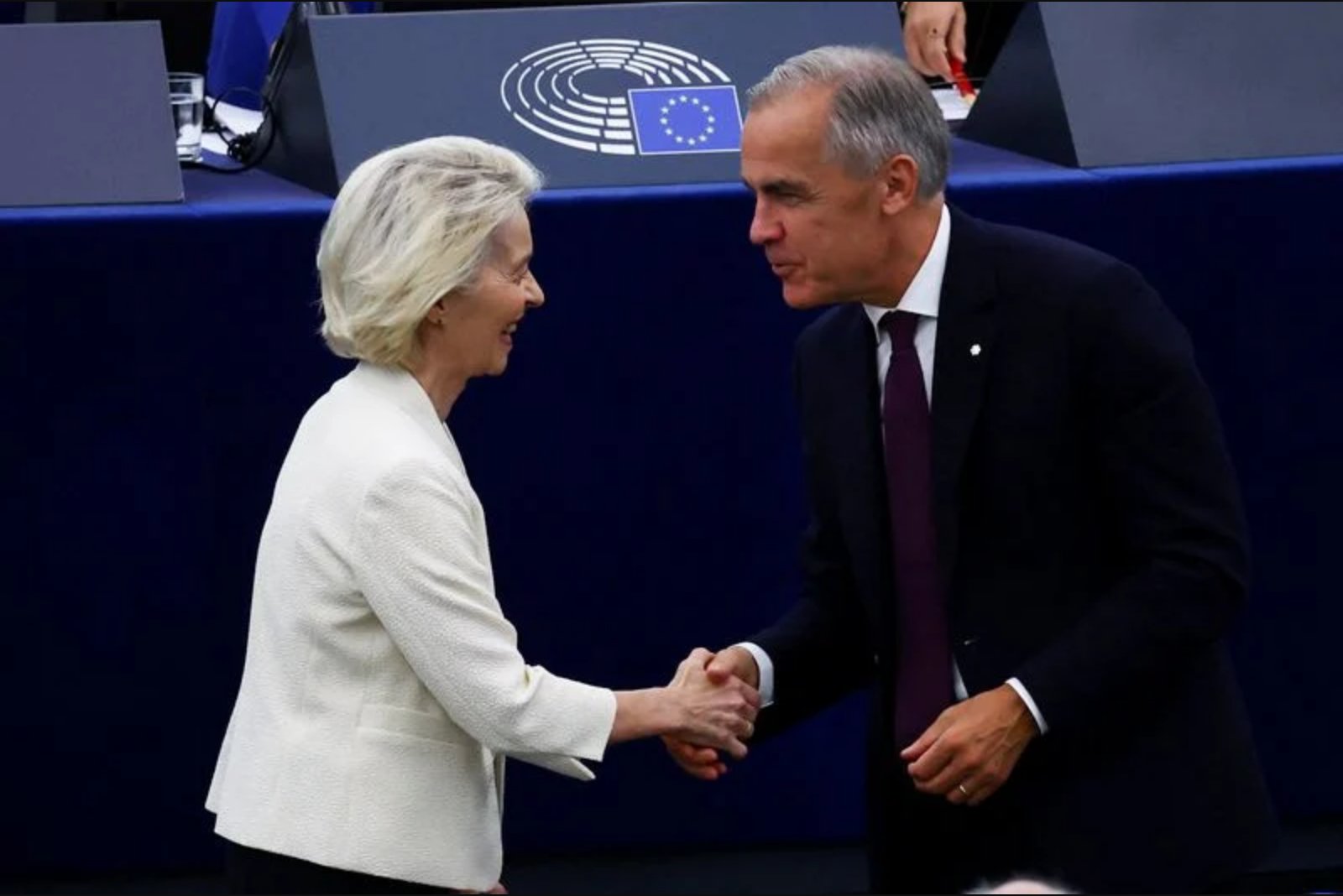
BRUSSELS, Sept 16 - European Commission President Ursula von der Leyen on Wednesday signalled she wants to open the door to a new form of partnership that would allow Canada to become the European Union's first "associate member." The declaration came shortly after Canada’s Prime Minister Mark Carney, attending von der Leyen’s annual speech in Strasbourg, said Canada was seeking a "unique alliance" with the EU but not full membership.
The idea remains undefined in legal terms. There is no "associate member" status in the EU’s founding treaties, and while associate-style arrangements have been suggested in the past, none has been enshrined. Germany, for example, recently proposed an associate arrangement for Ukraine as a potential intermediate step toward accession, a suggestion that did not secure broad support among EU capitals.
What the proposed relationship would cover
In her address, von der Leyen described plans to develop a "common prosperity and economic space" between Canada and the EU. The scope she outlined would involve cooperative work on manufacturing, the establishment of a tech alliance, the integration of defence industrial bases, and closer coordination on activities in the Arctic. She also cited collaboration on artificial intelligence, energy and critical minerals as part of the envisaged agenda.
Why implementing an 'associate' status is complicated
Creating a formal associate-member category would be legally novel and potentially complex. Von der Leyen made her remarks in her capacity as head of the European Commission, the bloc’s executive body, but any decision to create such a status would rest with EU member states. The European treaties do not currently contain a mechanism for this exact arrangement, and von der Leyen has not proposed writing an associate-membership clause into the treaties.
Altering the treaties to establish a new status would require unanimity among the 27 EU capitals and subsequent domestic ratification across all member states. That is a high bar; past trade deals between Canada and the EU illustrate the political difficulty. The Comprehensive Economic and Trade Agreement, known as CETA, was negotiated more than a decade ago and entered into provisional force nine years ago, yet several EU countries still have not completed ratification.
If Canada sought alignment with the EU Single Market under any close integration scenario, Ottawa would have to align its national regulations and standards with EU law. Countries participating in the European Economic Area - such as Iceland, Norway, Switzerland and Liechtenstein - effectively accept EU rules without holding EU decision-making power. The result, if Canada were to enter the Single Market without full membership, would be to become a rule-taker with no direct vote on policy.
Historically, Canada's regulatory framework has been oriented toward its largest trading partner, the United States, a dynamic that would complicate the harmonisation required for deeper Single Market access.
Implications for EU accession candidates
Officials say that exploring a deeper Canada-EU alliance would not change the formal accession trajectory for European candidate countries. Nonetheless, perceptions matter: if Canada is seen as receiving special treatment, it could become an irritant for aspiring members engaged in long-term alignment and politically sensitive reforms.
Full EU membership remains limited to European states and carries the full suite of benefits: access to the bloc’s €18 trillion ($20.77 trillion) Single Market, voting rights and representation within EU institutions, eligibility for EU funding and legal recourse through the European Court of Justice. Critics of associate-style arrangements have noted that such formulas can result in participation without voting influence; Ukraine described Germany’s earlier associate proposal as "unfair" because Kyiv would have been able to participate without formal voting rights.
The EU has indicated it could be ready to admit new members as soon as 2030. Among current candidate countries, Montenegro, Albania, Ukraine and Moldova are viewed as the most advanced in their accession processes.
Context for Ottawa
Canadian interest in a special relationship with the EU has been framed in part by repeated sovereignty-related tensions with U.S. President Donald Trump, according to Canadian officials, creating political impetus to diversify alliances. Both Brussels and Ottawa have cited shared goals of countering economic domination by large powers and defending the rules-based international order as motivation for deeper cooperation.
At present, the contours of any associate-member arrangement remain undefined and would require detailed negotiation between Canada, the European Commission and EU member states. Legal, political and regulatory hurdles would need to be overcome before such a partnership could be implemented.
Currency note: $1 = 0.8667 euros.