
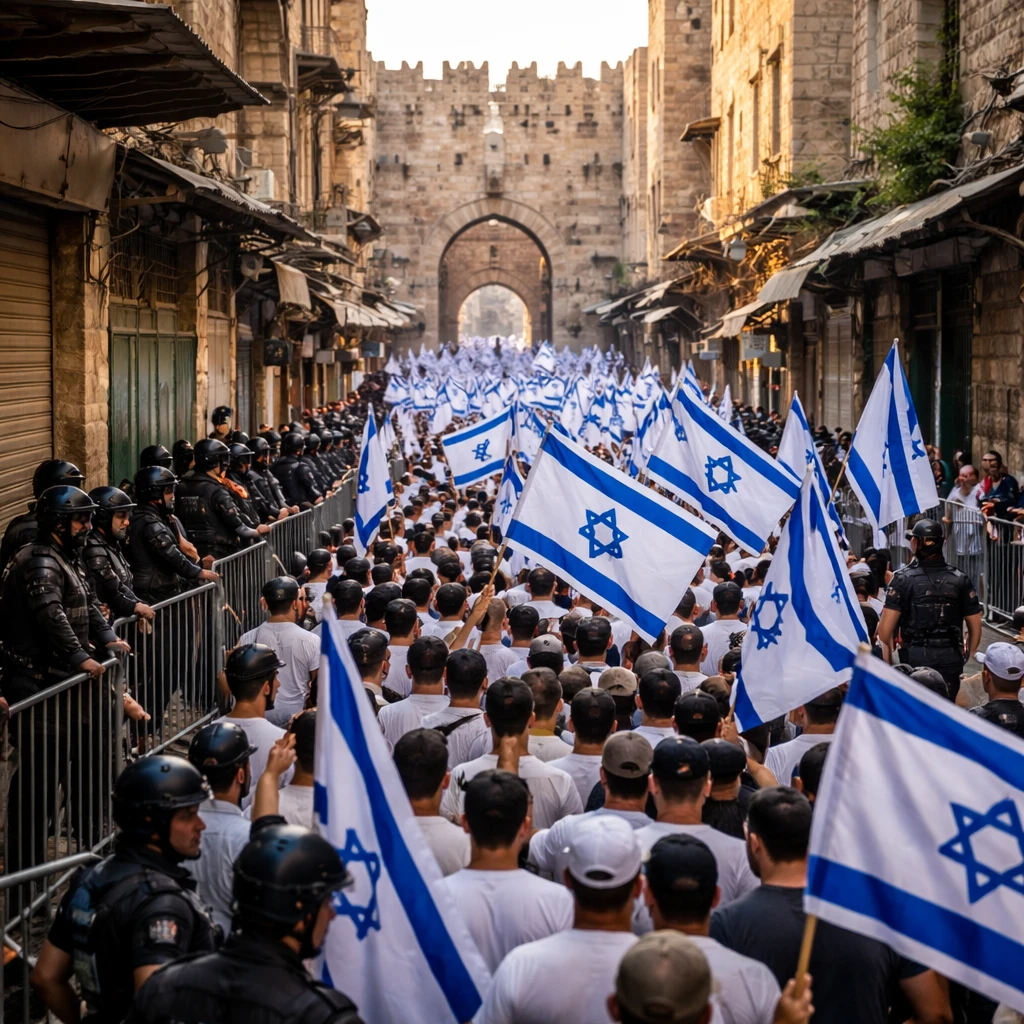
JERUSALEM, May 14 - Thousands of Israeli nationalists marched on Thursday through the Muslim quarter of Jerusalem's walled Old City in the central event of Jerusalem Day, moving under a significant security presence. The annual procession commemorates Israel's capture of East Jerusalem in the 1967 Middle East war, an outcome followed by Israel's annexation of the area that the United Nations and most countries do not recognise.
The parade is the main public celebration of the day for many Israelis and has evolved into a conspicuous demonstration of nationalist sentiment. For Palestinians, the march is viewed as a deliberate provocation that they say undermines their ties to the city and exacerbates existing tensions.
Authorities in Jerusalem mobilised thousands of police officers to oversee the event, deploying personnel in riot gear to key points in and around the Old City. Large barricades were erected in the Damascus Gate area - the primary entrance to the Old City's Muslim quarter - and restrictions were put in place that prevented Palestinians who do not live inside the Old City from entering that area.
Merchants in Old City markets reported that they had to close their shops ahead of the procession. That precaution added to the visible impact of security measures and the atmosphere in the quarter on the day of the march.
"Jerusalem is our holy city. It is our holy city forever," said Shira Gefen, a 53-year-old Israeli who travelled to Jerusalem from her home near Haifa for the event.
The route of the procession began in West Jerusalem and finished at the Western Wall, a surviving portion of an ancient retaining structure venerated by Jews as the Temple Mount - a site linked to their religion's two ancient temples. Muslims refer to the same complex as Al Haram Al Sharif, or the Noble Sanctuary, which is considered the third holiest site in Islam. The juxtaposition of the sites and the march's path through predominantly Palestinian areas of the Old City contribute to the procession's heightened sensitivity.
Ultra-nationalist Jewish groups have in previous years marched through Palestinian neighborhoods of the Old City in large numbers, and such movements have in some instances been accompanied by hostile chants from parts of the crowd. Demonstrators, including many youths, have on past occasions chanted slogans such as "Death to Arabs", an element that officials and observers say intensifies fears and fuels confrontation.
Palestinians view the Jerusalem Day event as part of a more extensive pattern of efforts to strengthen Jewish presence across the city, a trend they regard as harmful to their claims. Many Palestinians continue to assert East Jerusalem as the capital of a future Palestinian state, a position that underpins much of the contention surrounding public actions and policy moves in the city.
While the procession is a long-standing fixture on the city's political calendar, its recurrence often revives disputes about access, sovereignty and the status of holy sites, and it regularly tests the limits of crowd control and municipal arrangements in Jerusalem.