
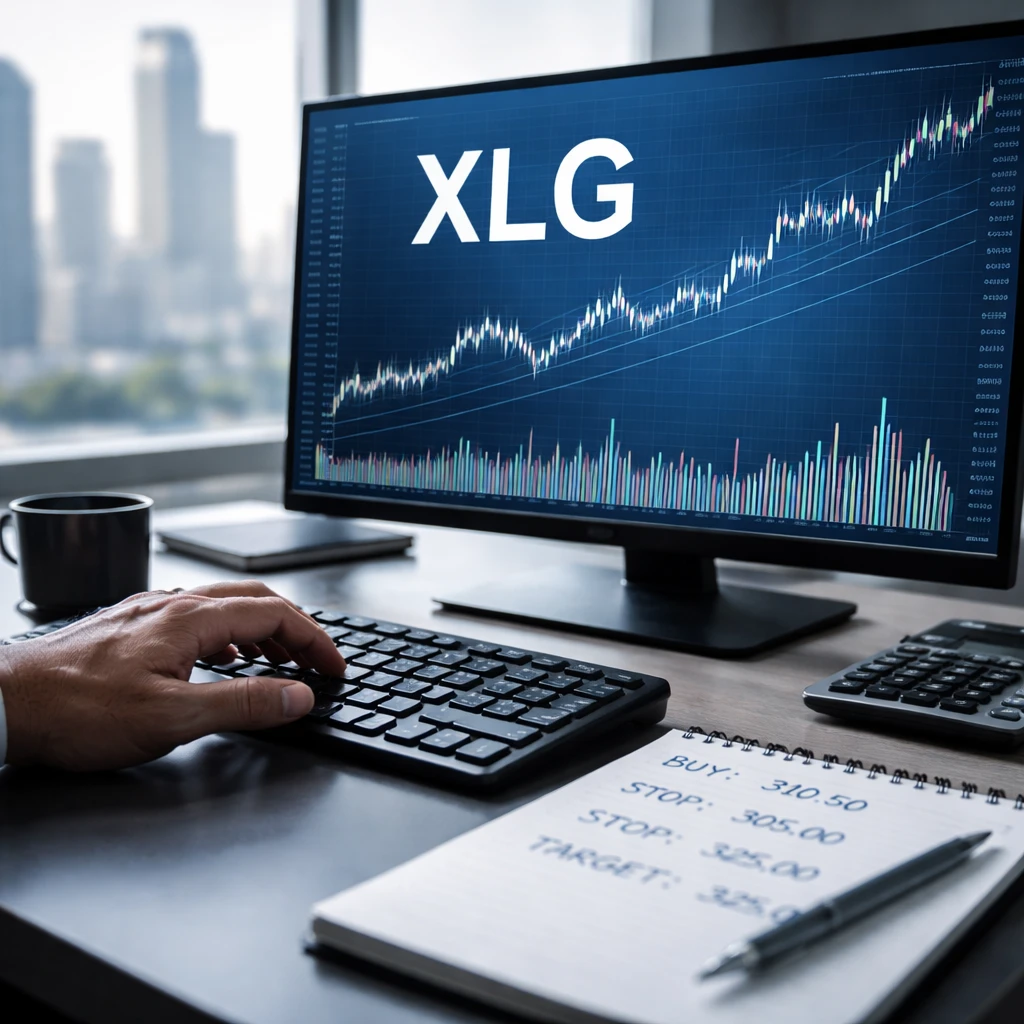
Hook & thesis
XLG is a concentrated way to own today’s market leaders. Momentum in the largest tech names - the very firms that dominate XLG’s composition - remains robust, and that gives this ETF a reasonable valuation for tactical buyers who manage risk tightly. For investors willing to accept concentration risk and guard the downside, XLG looks like an attractive swing candidate.
This isn’t a blind endorsement: the trade is conditional and sized for a targeted mid-term window. The plan below is explicit on entry, stop, and target, and assumes a mid-term timeframe of 45 trading days because that’s a realistic window for idiosyncratic top-line beats or sector rotation to play out.
What XLG is and why the market should care
XLG concentrates exposure in the largest, most influential U.S. names. That concentration is a double-edged sword: it amplifies upside when a handful of companies report strong earnings or benefit from structural trends, but it also magnifies downside when those names face cyclical slowdowns or valuation compression.
The market should care about XLG because mega-cap earnings momentum and capital spending decisions from those names often determine index performance for months at a time. For example, the recent coverage of one major AI infrastructure leader noted a Q4 fiscal 2026 revenue print of $68.1 billion and guidance for the next quarter of $78 billion - numbers that underline how a few companies can move the needle for concentrated portfolios (reported 04/02/2026). When these firms accelerate revenue and keep margins high, ETFs like XLG tend to re-rate favorably; when they stumble, the opposite happens.
Support for the bullish case - facts and logic
- Large-cap leaders continue to show extraordinary top-line momentum in some pockets of the market. The example above points to material sequential revenue guidance that can sustain multiple expansion in concentrated vehicles.
- Liquidity and market positioning favor megacap-centric funds during risk-on rotations. Many institutional flows still prefer indexed, liquid exposures that tilt to winners; that structural demand can support a higher entry multiple for XLG through the next earnings cycle.
- Valuation is not irrational when set against strong earnings and guidance from the largest constituents. That combination supports a tactical long so long as downside is managed with firm stops.
Valuation framing
We’re framing XLG’s valuation qualitatively rather than with an exact market-cap multiple because concentration metrics and constituent-level earnings momentum are the dominant drivers here. Historically, concentrated large-cap funds trade at a premium when earnings guidance from the top holdings is accelerating; they compress when that guidance misses. Given the recent evidence of outsized revenue guidance from at least one major constituent, the ETF’s current pricing can be read as reasonable for a tactical buy with well-defined risk limits.
Catalysts (what can move XLG higher)
- Continued upside in earnings and guidance from top constituents. Another quarter of outsized revenue and guidance from a few mega caps would likely lift XLG.
- Positive fund flows into large-cap concentrated strategies as risk appetite returns.
- Early signs of durable AI infrastructure spending translating into order books and capex guidance from hardware and software suppliers.
- Any clear pivot from the Fed toward easing expectations would boost equity multiples and help XLG outpace broader indexes.
Trade plan (actionable)
Because a live intraday quote was not available at the time of this write-up, I’m placing precise trade levels based on the most recent close context and the ETF’s typical trading range. This is a mid-term swing trade designed to capture a directional move over the next earnings and news flow window.
| Action | Price | Horizon |
|---|---|---|
| Entry | $80.00 | Mid term (45 trading days) |
| Stop | $72.00 | |
| Target | $95.00 |
Rationale: the entry at $80 gives a controlled cost basis inside the ETF’s typical post-rotation range, the $72 stop protects capital against a deeper rotation away from mega-caps, and the $95 target allows the trade to capture a meaningful re-rating or continued earnings surprise among the top contributors. The position should be re-assessed on any major macro surprises, significant constituent downgrades, or a decisive break below the stop.
Sizing and risk management
This is a medium-risk swing. Keep position size consistent with a stop that limits the portfolio-dollar loss to a pre-defined fraction of risk capital (for example, 1-2% of total portfolio value). If multiple positions are already exposed to the same mega-cap names, reduce size to avoid concentration risk.
Risks and counterarguments
- Concentration risk - XLG’s concentrated exposure means weakness in one or two constituents can depress the ETF sharply. If a large holding reports a significant miss, the ETF could gap lower and invalidate the trade.
- Valuation compression - With much of the upside priced into leading stocks, any disappointment or signs of slowing revenue could trigger a fast multiple contraction.
- Macro sensitivity - Higher-for-longer rates or an unexpected Fed hawkish turn would pressure growth and high-multiple names disproportionately, likely pushing XLG below the stop.
- Sector rotation - If capital rotates into value, cyclicals, or small caps, concentrated large-cap funds can lag meaningfully even in a flat market.
- Event risk - Geopolitical headlines, regulatory actions, or company-specific investigations could quickly change the risk-reward profile.
Counterargument
A strong counterargument is that XLG’s current pricing already reflects the concentrated leaders’ momentum and any disappointment would be punished heavily. If institutional flows turn away from concentrated strategies or if one of the ETF’s top components issues conservative guidance, the upside could be limited while downside becomes steep. That scenario argues for staying on the sidelines or reducing size until clearer evidence of sustainable multiple expansion appears.
What would change my mind
I’d step back from this trade if any of the following happen: a decisive break below the $72 stop on heavy volume, clear signs of slowing order trends or guidance among the ETF’s largest constituents, or an abrupt regime change in rates expectations (i.e., an unexpectedly hawkish Fed statement that moves real yields materially higher). Conversely, I’d add to the position if top constituents continue to show outsized revenue guidance and the ETF moves above $95 on confirmatory volume and breadth.
Conclusion
XLG offers a reasonable tactical long today for disciplined traders who accept concentration risk and adhere to strict stops. The tailwind from large-cap earnings momentum and structural flow patterns supports a measured long, but the margin for error is slim. Use the mid-term (45 trading days) window to let earnings and news flow play out, keep size modest relative to portfolio risk, and respect the stop. If fundamentals among the ETF’s dominant names continue to surprise to the upside, this trade should work; if those names falter, cut losses and re-evaluate from the sidelines.
Trade plan recap: Buy XLG at $80.00, stop at $72.00, target $95.00 - mid term (45 trading days) - risk level: medium.