
Hook & thesis
Village Farms International (VFF) is a classic small-cap agricultural and cannabis hybrid that the market is still sorting out. At the current price of $2.90 the company is generating meaningful free cash flow and trades at modest multiples relative to its peers in the broader cannabis/produce/controlled-environment agriculture complex. Given improving financing, expanding EU-GMP exports and operational progress on potency transparency and branding, Village Farms merits a re-rate higher.
Our actionable stance is a mid-term long: enter on weakness or at-market around $2.90, stop at $2.40 and target $4.50 over the next 45 trading days. The combination of a conservative balance sheet, $31.5M of recent free cash flow, and EV/EBITDA of ~7.3x supports upside to the mid-single digits without assuming extraordinary multiple expansion.
What Village Farms does and why the market should care
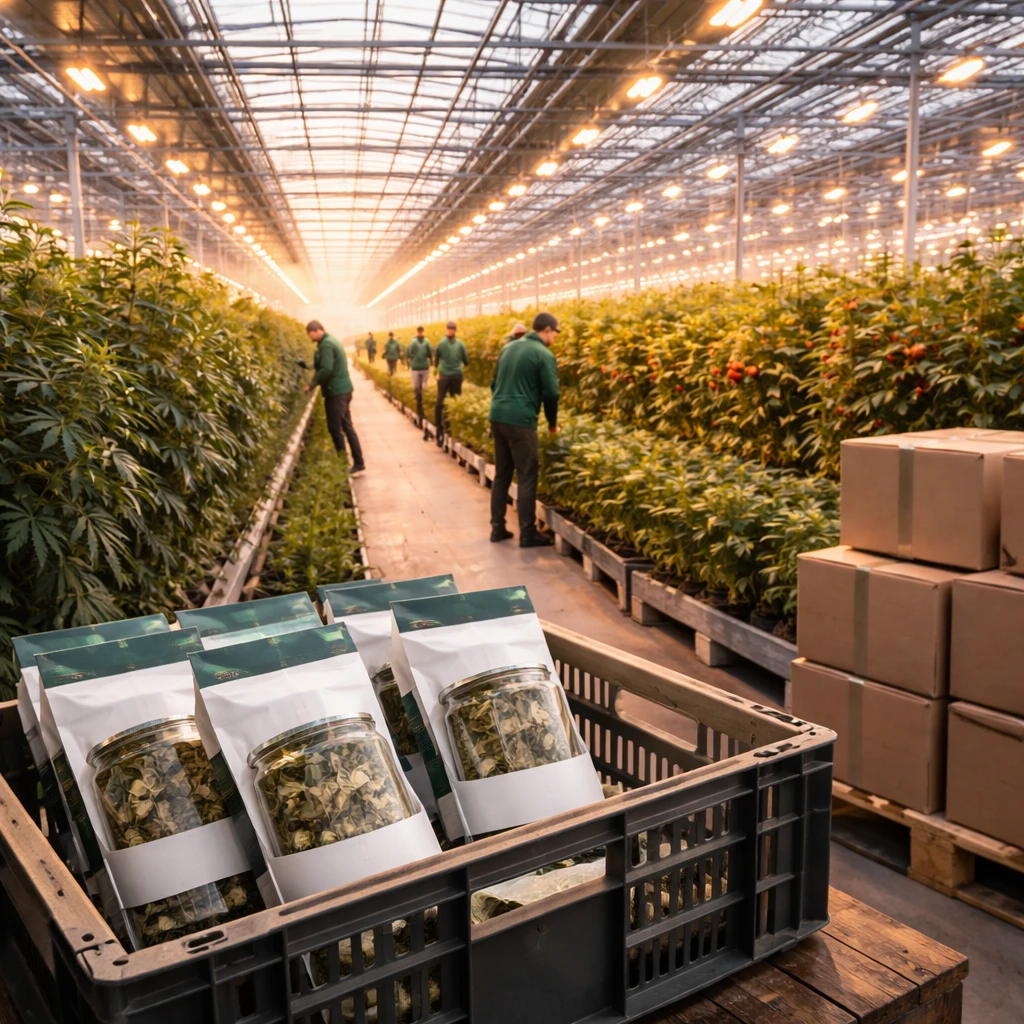
Village Farms operates greenhouse agriculture across several related segments: Canadian Cannabis (Pure Sunfarms, Rose LifeScience), U.S. Cannabis (Balanced Health), Produce (tomatoes), Energy (landfill-gas power plants) and Leli (cannabis supply to coffee shops). That diversified asset base gives Village Farms multiple optionalities: cash flow from produce and energy, growth from international medical cannabis exports and consumer-brand upside in recreational product lines.
The market should care for three reasons. First, the company is already generating free cash flow - $31.5M in the latest reported period - which is rare for many cannabis operators still burning cash. Second, recent operational wins are making Village Farms a credible exporter into highly regulated markets: management reported a 758% year-over-year increase in export sales through EU-GMP certified operations, unlocking higher-margin medical channels in markets such as Germany and the U.K. Third, financing has become cheaper and longer-dated: a loan amendment on 03/30/2026 reduced the rate by 50 basis points and extended maturity to 02/2031 on a $15.4M variable-rate loan - a sign creditors view the company more favorably.
Key fundamentals and valuation snapshot
| Metric | Value |
|---|---|
| Price | $2.90 |
| Market cap | $333.9M |
| Enterprise value | $283.7M |
| Free cash flow | $31.5M |
| P/E | ~10.2x |
| P/B | ~1.10x |
| EV/EBITDA | ~7.3x |
Those numbers tell a straightforward story: the market cap sits in the low hundreds of millions while the company generates meaningful cash flow and trades at mid-single digit EV/EBITDA multiples. For investors who believe the company will convert export momentum into durable higher-margin sales, current multiples look conservative. Even absent a dramatic re-rating, a move to $4.50 implies only modest multiple expansion coupled with continued cash generation.
Operational evidence backing the thesis
- Export momentum: Village Farms won a prominent export award on 01/26/2026 after reporting a 758% YoY increase in export sales via EU-GMP operations, indicating real traction in tightly regulated medical markets.
- Product transparency and branding: On 04/09/2026 Pure Sunfarms piloted THC potency range labeling for dried flower in BC, a consumer-facing initiative that reduces regulatory friction and increases trust in markets sensitive to consistency.
- Improving financing: The company secured a loan amendment on 03/30/2026 that cut the interest rate by 50 basis points and extended maturity to 02/2031 on a $15.4M variable-rate loan - a practical sign that lenders view the business more favorably.
Catalysts (2-5)
- Continued export growth into EU and other regulated markets: additional tender wins or contract rollouts in Germany, the U.K. or Israel would be direct revenue and margin catalysts.
- Quarterly earnings that show sequential improvement in free cash flow or margin expansion driven by medical exports and produce operations.
- Further financing wins or debt reductions that materially lower interest expense and extend maturities.
- Regulatory tailwinds in the U.S. cannabis market that free up tax deductibility or spur demand, which would benefit the U.S. Cannabis segment indirectly.
Trade plan - actionable
Direction: Long
Entry: buy at $2.90
Stop loss: $2.40
Target: $4.50
Horizon: mid term (45 trading days) - this horizon gives time for a catalyst-driven re-rate (quarterly results, export contract news, or improved industry sentiment) while limiting exposure to longer-cycle risks (macro shifts, slower organic growth).
Why these levels? Entry at $2.90 reflects the current market price and allows layering on small pullbacks given average volumes near 1.2M-1.5M. The $2.40 stop is below recent support levels and provides a clear failure point where export/financing momentum would not be translating into durable valuation improvement. The $4.50 target is reachable with a modest multiple expansion and continued FCF conversion - it is below the 52-week high of $4.99 but represents nearly 55% upside from the entry.
Risks and counterarguments
Any trade must account for what could go wrong. Here are the principal risks and a counterargument to our thesis.
- Regulatory setbacks: Cannabis remains political and regulatory risk is non-trivial. Failure to secure licenses in key U.S. states or adverse changes in export rules could compress revenue expectations quickly.
- Legal exposure: There is active litigation interest; for example, a plaintiff firm investigation into past license setbacks has previously pressured the stock. Legal developments could create headline risk and additional costs.
- Execution risk on exports: Winning tenders and converting export growth into repeatable profits requires supply chain discipline and consistent GMP-level production. Any lapse could slow margin expansion.
- Commodity/produce cyclicality: The produce segment and greenhouse agriculture are exposed to commodity-price moves, weather and input-cost volatility that can dent near-term cash flow.
- Capital allocation missteps: If management pursues aggressive acquisitive moves or dilutive financing instead of preserving cash flow and margins, valuation can suffer.
Counterargument: Skeptics will say Village Farms is a conglomerate of dissimilar businesses (produce, cannabis, energy) that should trade at a conglomerate discount, and that the cannabis segments still face margin pressure and regulatory uncertainty. That is a fair point. If export wins do not translate into durable contracts or if the company needs to raise capital at low prices, the re-rate thesis breaks down.
Why this trade is asymmetric
Asymmetric risk/reward is what makes this trade attractive. On the downside, a drop below $2.40 would likely indicate the operational story is deteriorating. On the upside, continued FCF and export traction should push EV/EBITDA from ~7x toward a mid-teens multiple if growth proves sustainable, which is consistent with our $4.50 target without assuming heroic margin expansion.
What would change our mind
We would downgrade this trade if any of the following happen:
- Material deterioration in free cash flow or a surprise dilutive equity raise that undermines current per-share economics.
- Loss of EU-GMP certification or a major export contract cancellation.
- Significant legal judgments or regulatory fines that require large cash outlays or force management to divert capital from growth initiatives.
Conclusion
Village Farms is a cash-generating, diversified greenhouse operator with emerging high-value export channels and improving capital terms. At $2.90 the stock offers a compelling mid-term risk/reward: manageable downside with a clear stop at $2.40 and meaningful upside to $4.50 if export momentum and FCF conversion continue. This is a pragmatic, catalyst-driven long: enter size deliberately, use the stop to limit downside and add on confirmed upside momentum.
Trade plan recap: Long VFF at $2.90, stop $2.40, target $4.50, horizon mid term (45 trading days).