
Hook & thesis
Clorox is a classic portfolio cleaner: resilient brands, steady free cash flow and a rich dividend, temporarily punished by an inventory reset and margin squeeze. The market has moved from worry to opportunity. With shares trading around $96.60 and a dividend yield north of 5%, the immediate downside looks limited compared with the upside if retailers rebuild inventories and margins recover.
My thesis is simple: reduced operational complexity and clearer near-term comps will let Clorox demonstrate recovering gross margins and stable consumption. That flow-through should support an earnings rebound and multiple expansion from current levels, creating a profitable swing trade over the next ~45 trading days with defined risk control.
What the company does and why the market should care
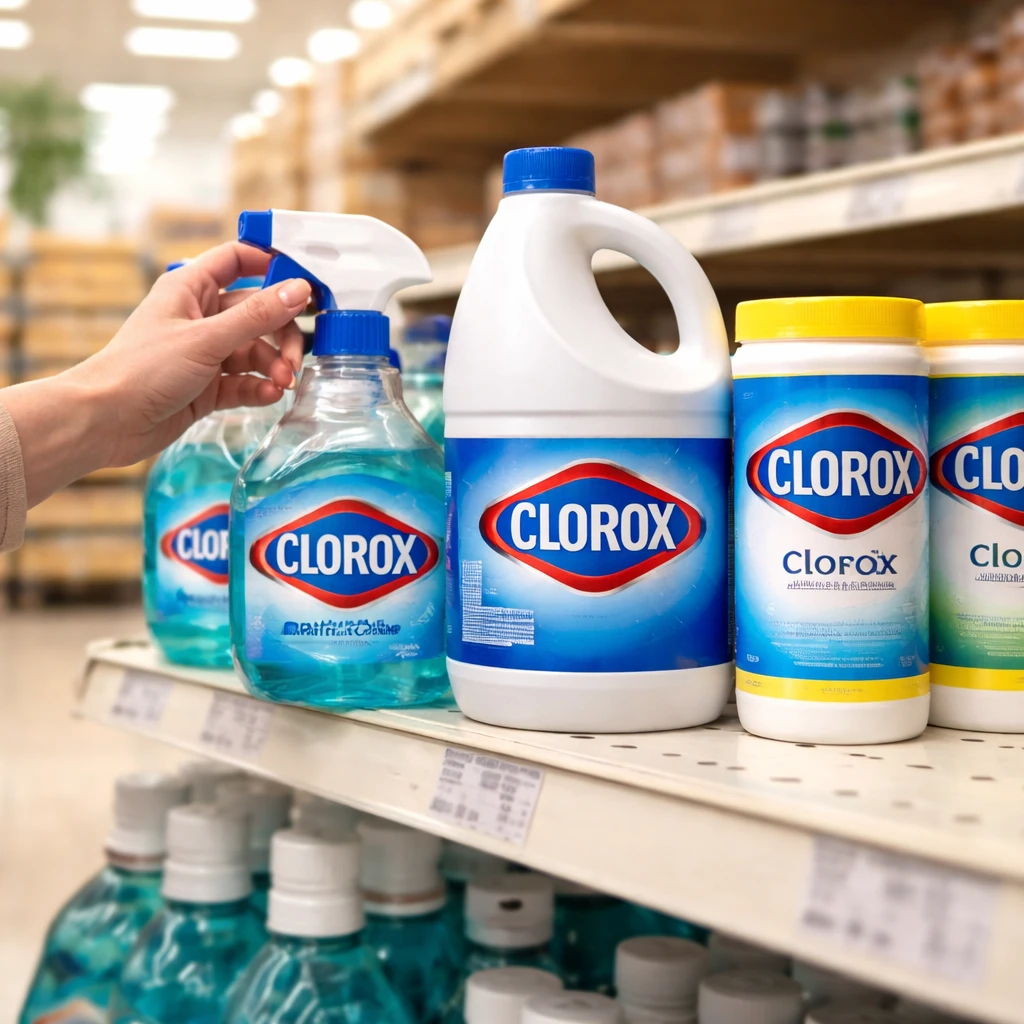
Clorox manufactures and markets household and professional consumer products across four segments - Health & Wellness, Household, Lifestyle and International. Those categories include cleaning, bags and wraps, grilling and pet products, food and water-filtration products. The business is predictable, defensive and cash-generative in down cycles - exactly the type of company investors favor when macro growth is uncertain.
Why the market should care now: two dynamics are converging in Clorox’s favor. First, the company generates meaningful free cash flow - $778 million in the most-recent reporting frame - giving management options to support the dividend and allocate capital to high-return needs. Second, recent weakness appears concentrated: lower consumption, margin pressure from higher input costs and a temporary retailer inventory correction that management said will subtract roughly 7.5 percentage points from fiscal 2026 sales growth and about $0.90 of EPS (02/04/2026). Those look likely to be transitory rather than structural.
Key numbers that matter
- Current price: $96.60 (previous close $96.66)
- Market cap: $11.68 billion; enterprise value: $14.25 billion
- Trailing earnings per share: $6.24; P/E ~15.5-15.8
- Free cash flow: $778 million
- EV/EBITDA: ~11.86; EV/Sales: ~2.11
- Dividend: $1.24 quarterly; yield roughly 5.1% - 5.3% depending on the series cited; 49 consecutive years of increases (company track record)
- Technicals: 10-day SMA ~$99.81, 50-day SMA ~$106.20, RSI ~35 (near oversold), MACD shows bearish momentum but a small negative histogram (-0.316)
Valuation framing
Clorox trades at a P/E in the mid-teens (~15.5). With an EV around $14.25B and free cash flow approaching $0.78B, implied EV/FCF is roughly 18x. Those multiples look reasonable for a defensive, cash-generative consumer staples company that pays a 5%+ yield. The headline math suggests the stock is priced for a mediocre recovery rather than for a durable reset: the market is discounting several quarters of soft results but not the possibility of margin normalization and modest top-line stabilization.
Qualitatively, consumer staples often trade at a premium for stability and cash returns. Clorox’s current multiple aligns more with a cautious stance than with a premium growth multiple; if the company can convert margin improvement into visible EPS beats, that gap can close and justify a multiple re-rating back toward mid- to high-teens EV/EBITDA or a higher P/E consistent with defensive peers.
Catalysts (what will move the stock)
- Retailer inventory normalization - as the temporary correction works through, reported sales should accelerate versus the depressed comps and margins recover.
- Margin stabilization - even a modest restoration of gross margin will flow strongly to EPS given the company’s fixed-cost base.
- Dividend support & yield attraction - upcoming payable date and steady payout keep income buyers interested (dividend payable 05/08/2026; record date 04/22/2026).
- Positive cash flow execution - $778M FCF gives flexibility and can underpin investor confidence if management demonstrates disciplined capital allocation.
- Compression in short interest tail risk - persistent short interest (roughly 8.2M shares at 04/15/2026) could exacerbate rallies if sentiment turns.
Trade plan (actionable)
Trade direction: Long
Entry price: $96.60 (current market area)
Stop loss: $88.00 - below a near-term support band and below the 52-week low of $95.73 (the stop is set more conservatively to allow for a short-lived dip while still controlling risk).
Target price: $115.00 for the primary swing objective.
Horizon: mid term (45 trading days). I view this as a classic mid-term swing: inventory normalization and early margin improvement should be visible in the next two to eight fiscal quarters, and the 45-trading-day window gives enough time for market sentiment and earnings-quality signals to reset the multiple. If the trade begins to accelerate, consider holding a tranche for long term (180 trading days) upside toward $130 - $140, contingent on consistent operational improvement.
Position sizing: keep exposure reasonable given yield-hunting flows - a portfolio allocation that limits downside to a comfortable percentage is prudent, given consumer staples can still experience protracted category weakness in some cycles.
Why this setup makes sense
Short-term headwinds already appear priced: management has acknowledged the retailer inventory correction and quantified its earnings impact. The payout is secure and the free cash flow is large enough to support shareholder returns. Technically, the stock is near recent lows with RSI in the mid-30s - a bounce is plausible if one or two catalysts print positively.
Risks and counterarguments
- Inventory correction lasts longer than expected. If retailers reduce orders for an extended period, top-line recovery could be delayed and EPS will stay under pressure. That would invalidate the thesis until clearer demand evidence arrives.
- Margin pressure persists. Continued commodity or freight inflation without successful price realization would compress margins further and reduce free cash flow, keeping multiples depressed.
- Competition and private-label gains. Increasing private-label penetration or aggressive promotional activity from competitors could squeeze volumes and force continued promotional spending.
- Macroeconomic shock. A broader consumer downturn could shrink consumption structurally, reducing the appeal of even defensive names and forcing multiple contraction.
- Execution risk. Management needs to convert operational simplification and cost actions into visible margin gains; failure here would keep the stock rangebound or lower.
Counterargument: One could argue the stock is a value trap - that consumption shifts away from certain categories (e.g., household or lifestyle products) are more permanent than management and consensus expect. If that is true, the dividend could be maintained but EPS and valuation would compress structurally. That outcome would make my trade wrong until the company demonstrates successful portfolio repositioning or accelerates new growth channels.
What would change my mind
I will reassess if any of the following occur: an updated guide lowering full-year EPS materially below management’s current range, sustained gross-margin deterioration across two consecutive quarters, or a marked drop in free cash flow below the current $778M run-rate. Conversely, if retail inventories show clear rebuilds, gross margins tick up, and management reaffirms capital returns, I would become more aggressive and lift targets.
Conclusion
Clorox is a high-quality consumer staple trading at a valuation that discounts temporary softness. The combination of a >5% yield, solid free cash flow, and a clearly-articulated inventory issue gives a defined entry and risk profile. For traders seeking a mid-term swing, entry at $96.60 with a stop at $88.00 and a target of $115.00 balances upside from multiple expansion and fundamental recovery with controlled downside. The trade is not without risk, but the math and catalysts stack in favor of a rebound if the company can show margin stabilization and retailers resume normal stocking patterns.