
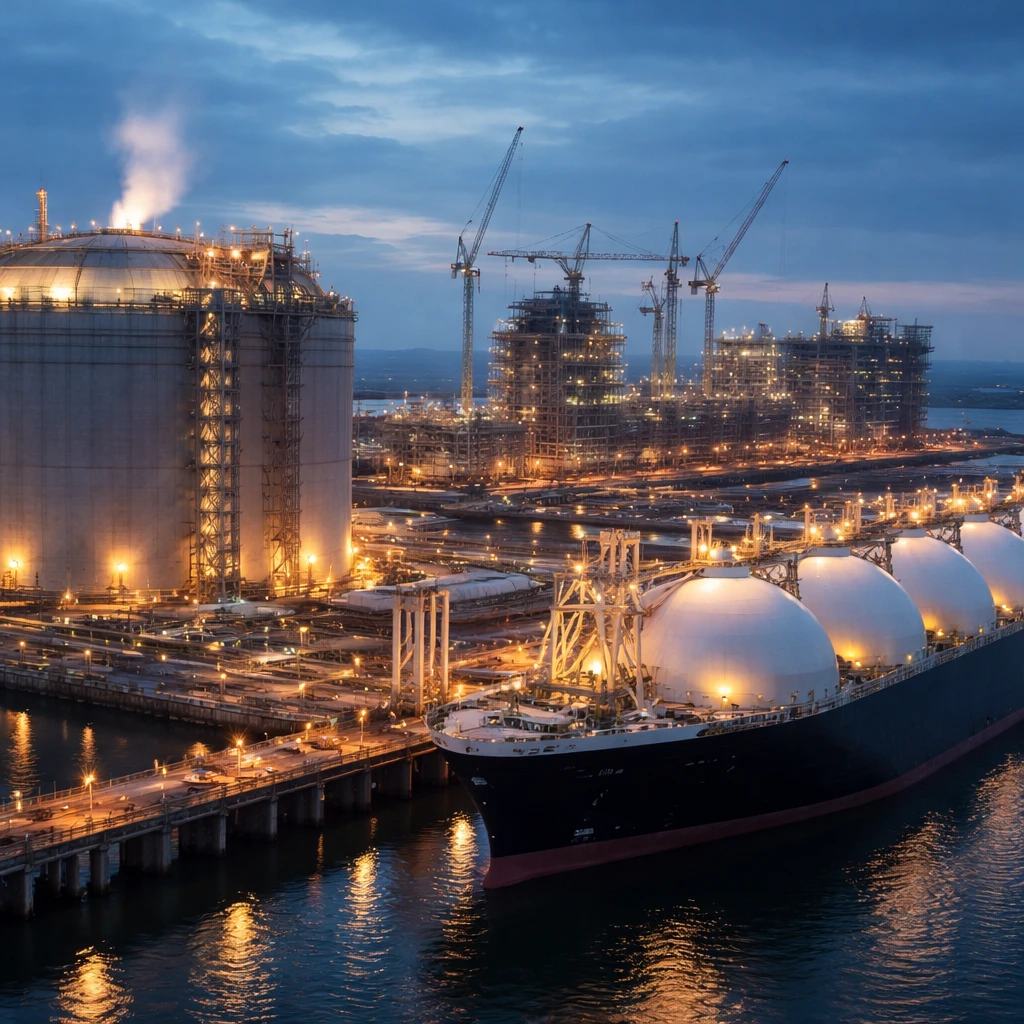
Hook + Thesis
Venture Global is a development-first LNG company whose value to investors comes from building low-cost export capacity and locking in long-term offtake agreements. That growth story is intact: incremental volumes coming online and multi-year contracted cash flows can compound value over several years. But the stock tends to react violently to short-term changes in global gas prices, headline flow and policy shifts. My thesis: own Venture Global for long-term growth but avoid chasing intraday or multi-week price spikes. Use a staged entry with a clearly-defined stop to protect against downside volatility.
The trade below is designed for investors who want to participate in the multi-year capacity ramp while limiting exposure to near-term commodity gyrations. I lay out a specific entry, stop and target, the rationale behind the levels, catalysts that can drive re-rating, and the risks that could derail the thesis.
Business overview - why the market should care
Venture Global builds and operates liquefied natural gas export facilities and sells LNG under long-term contracts and shorter-term commercial arrangements. The economic value of the company derives from:
- Large-scale, capital-intensive projects that create long-lived export capacity.
- Fixed or indexed offtake contracts that provide predictable revenue streams once projects are commissioned.
- Exposure to secular demand growth for LNG in markets shifting from coal to gas, and regions seeking diversified gas supply.
For equity holders the implication is simple: successful delivery and ramp of commissioned trains convert construction-stage value into recurring cash flow, often prompting re-rating. But headline-driven swings in spot gas and shipping costs create short-term noise that can leave the share price disconnected from project economics.
Support for the argument - available facts and positioning
The available public dataset did not include a recent market snapshot or quarterly line items to quote. That said, the investment logic is structural and centered on capacity delivery and contractual coverage. In practical terms, investors should evaluate Venture Global along three lenses:
- Project execution and commissioning dates - delivered trains materially shift valuation by moving cash flows from development risk to operating cash flows.
- Contract coverage and pricing - a higher percentage of long-term contracted volumes reduces commodity exposure and improves cash flow visibility.
- Balance sheet flexibility - access to project-level financing and corporate liquidity affects the company’s ability to fund growth without excessive dilution.
Because up-to-date line-item financials are not present in the dataset, this note focuses on trade mechanics tied to execution milestones and macro catalysts rather than on specific recent revenue or margin figures.
Valuation framing
Valuing a development-stage LNG platform is a hybrid of asset-based and cash-flow approaches. When projects are under construction, much of the equity value hinges on the gap between project net present value (driven by contracted offtakes and expected margins) and the company’s enterprise value. Once trains are operational, valuation tends to move toward a multiple of normalized EBITDA or distributable cash flow.
Qualitatively, Venture Global’s valuation should reflect (1) the pace of capacity additions that convert development value into operating cash flow, (2) the ratio of contracted vs merchant exposure, and (3) prevailing LNG price dynamics. If the market awards a multiple expansion, it will be because project execution is ahead of schedule, offtake pricing is stronger than anticipated, or shipping/logistics constraints create a higher near-term spot price environment. Conversely, project delays, cost overruns or weakening demand push valuation lower.
Trade plan (actionable)
Note: Latest market snapshot and company financials were not available at the time of this write-up; trade levels below are designed as a disciplined plan reflecting the thesis and the typical volatility profile for development-stage LNG equities. Adjust sizes to your portfolio and risk tolerance.
| Action | Price | Horizon |
|---|---|---|
| Primary Entry - initial position | $18.50 | Long term (180 trading days) |
| Add-on Entry - scale-in on pullback | $13.50 | Long term (180 trading days) |
| Stop Loss - hard protection | $12.75 | Applies to aggregate position |
| Primary Target - take profit | $34.00 | Long term (180 trading days) |
| Conservative Target - partial exit | $25.00 | Mid term (45 trading days) |
Rationale:
- The $18.50 primary entry is intended to capture long-term upside while avoiding chasing short-term spikes. It reflects a level where the risk/reward becomes attractive given the company’s pipeline conversion prospects.
- An add-on at $13.50 allows disciplined scaling if the stock retraces on cyclical weakness; the stop at $12.75 limits downside in the event of execution problems or broader commodity-driven selloffs.
- The $34.00 target assumes meaningful re-rating from delivery and ramp of capacity alongside improving contracted cash flows. The $25.00 conservative target is a nearer-term take-profit if market sentiment tightens and the stock gaps up ahead of project milestones.
- Time horizon - the base plan is long term (180 trading days) to capture project deliveries and contract roll-ins that usually materialize over months. The conservative target allows mid-term (45 trading days) profit-taking if sentiment shifts quickly.
Catalysts
- Project commissioning updates and first cargo deliveries from new trains - tangible evidence that development risk has been de-risked.
- New long-term offtake agreements or expansions of existing contracts - increases revenue visibility and reduces merchant exposure.
- Favorable LNG price cycles or tighter shipping markets that push spot premiums higher and improve merchant economics.
- Credit or project financing improvements that lower funding costs and reduce dilution risk.
Risks and counterarguments
Below are the principal risks that could invalidate the trade thesis, followed by a counterargument to the bull case.
- Execution risk - Project delays, cost overruns or technical issues during commissioning can compress equity value sharply. Because so much value is front-loaded in construction, setbacks have outsized share-price impact.
- Commodity price volatility - A sustained drop in global LNG demand or prices (driven by milder weather, slower industrial demand or oversupply) can reduce both spot revenue and the economics of incremental merchant sales, hurting margins.
- Financing and dilution risk - If project-level financing conditions deteriorate, the company may need to raise equity or issue expensive debt, diluting existing shareholders and increasing leverage.
- Regulatory and political risk - Export projects can be affected by changes in permitting, tariffs, or political opposition in either host or destination countries, interrupting flows or increasing costs.
- Market repricing - The broader market can de-rate development-heavy energy names if investors prefer cash-generative equities; a rotation away from growth-in-energy can compress multiples even if projects succeed.
Counterargument
Critics will point out that LNG developers are cyclically exposed: when global gas markets weaken, even contracted projects face pressure through renegotiations or lower spot-linked revenue. They may argue that the company’s shares are better avoided until a larger proportion of capacity is fully commissioned and cash-generative. That is a fair point: if you have a low tolerance for headline-driven volatility or for potential near-term dilution, waiting for more visible cash flow is sensible.
Conclusion - stance and what would change my mind
Stance: Long-term constructive, near-term cautious. Own Venture Global as a staged position to capture multi-year capacity and contracted cash flow expansion, but do not chase sharp rallies without trimming into strength. The plan above gives a clear entry, add-on, stop and targets so investors can participate while controlling downside.
What would change my mind:
- I would materially reduce conviction if the company reported a large, unanticipated project delay or cost overrun that pushes commissioning by multiple quarters and forces cash calls or heavy equity issuance.
- I would also reassess if LNG demand fundamentals deteriorate significantly—e.g., a sustained global gas surplus or major policy shifts that curtail gas-to-gas switching—reducing long-term price expectations and contract economics.
Conversely, my conviction would increase if the company publishes transparent, on-time commissioning milestones, reports expanding contracted coverage at attractive pricing, or secures cheaper, longer-term financing that reduces dilution risk.
Key takeaways
- Venture Global offers a long-duration growth story tied to incremental LNG export capacity and contracted cash flows.
- Because of headline and commodity sensitivity, the right approach is staged entry and strict stops — don’t chase price spikes.
- Use the trade plan above as a framework: initial entry at $18.50, add at $13.50, stop at $12.75, and primary target at $34.00 over a 180 trading-day horizon.
Trade responsibly: size positions relative to your portfolio, and treat the stop as an active risk-management tool, not a suggestion to set and forget.