
Hook & thesis
Utz Brands (UTZ) is trading near the low end of its 52-week range at about $7.78, offering an unusually cheap headline valuation for a branded snacks business: price-to-sales sits near 0.48 and enterprise value per share implies a single-digit multiple on the company’s modest free cash flow. That combination - recognizable brands, steady snack demand, and a depressed share price - argues for a tactical buying opportunity.
That said, the near-term path to upside is not free. Geopolitical frictions tied to Iran have contributed to episodic inflation in commodity and logistics markets; for Utz, that can translate into elevated input costs and squeezed margins. The trade I’m proposing accepts that risk but uses valuation and technical cues to frame a risk-controlled, mid-term swing.
The business and why investors should care
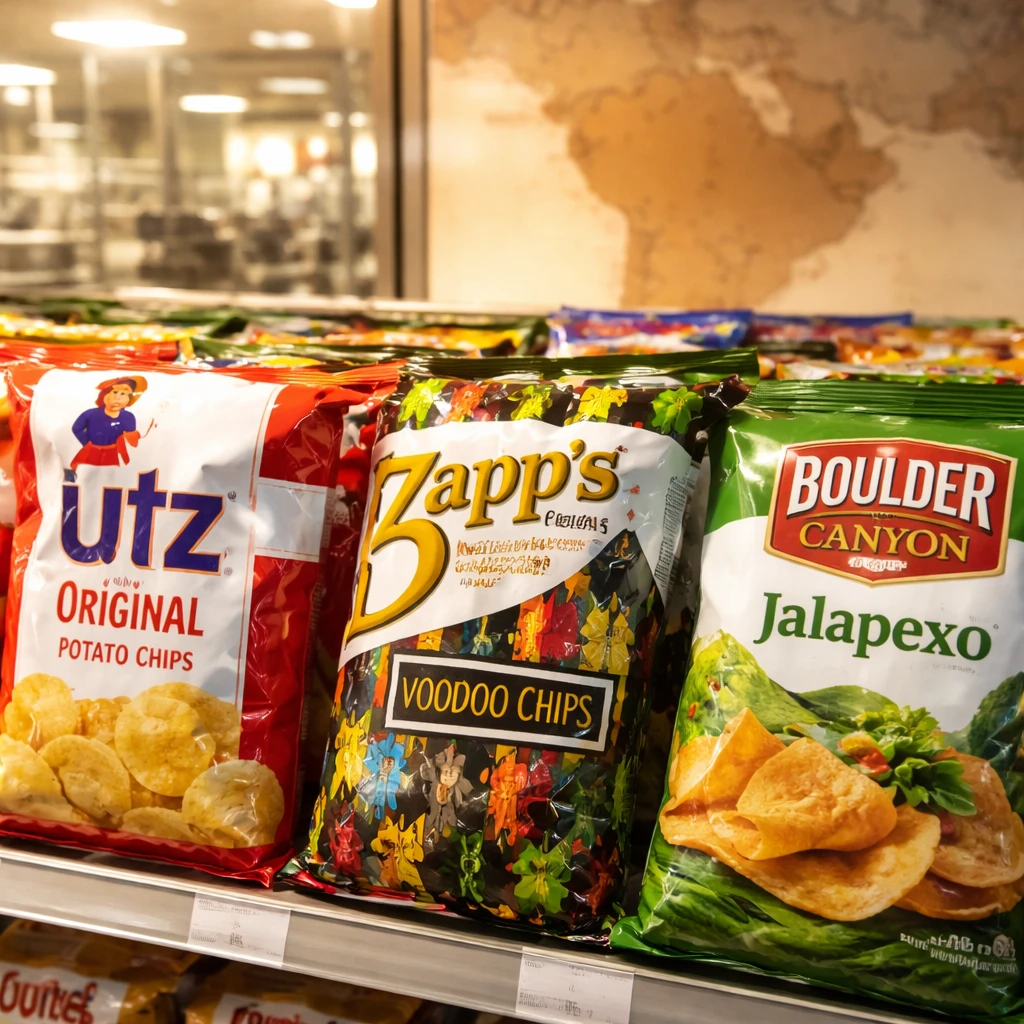
Utz Brands manufactures, markets and distributes salty snacks across a portfolio that includes Utz, ON THE BORDER Chips & Dips, Golden Flake, Zapp's and Boulder Canyon. Packaged snacks are inherently defensive in consumer cycles: demand tends to be stable and branded products can support pricing. For Utz specifically, the stable revenue streams from branded snacks — combined with an active dividend program (recent quarterly distribution of $0.063 per share; ex-dividend date 04/13/2026 and payable 04/23/2026) — make the company attractive for income-oriented and value investors.
Why the market should care now: Utz is cheap relative to its historical trading band and to what you’d expect for a branded-snacks business with national distribution. At roughly $7.78 per share, the snapshot market capitalization is about $1.12 billion and the enterprise value is roughly $1.43 billion. The company’s EV/EBITDA is around 15.5x and price-to-sales about 0.48x. Free cash flow is limited but positive at about $9.4 million on the most recent reporting; that small but existing cash generation supports the dividend and a baseline valuation floor.
Evidence and recent trends
Operationally, Utz reported Q2 2025 revenue of $366.7 million (reported 08/04/2025) — a 2.9% year-over-year increase — which confirms that branded demand is intact. The company has been contending with margin pressure driven by higher input and logistics costs as well as continued investments in operations and marketing; those costs have weighed on near-term profitability.
Balance-sheet signals are mixed. Debt metrics show leverage pressure: reported debt-to-equity is around 1.22. Liquidity ratios are adequate with a current ratio near 1.19 and a quick ratio near 0.82, but cash on hand is limited. In short, Utz is not a debt-free cash machine; the balance sheet can tolerate stress but not without pain if cost inflation re-accelerates.
Technically, recent momentum is neutral-to-constructive: 10- and 20-day moving averages sit under price ($7.67 and $7.63 respectively), the 50-day average is higher at $8.51 (so the stock is below the intermediate trend), RSI is neutral at about 47, and short interest equates to roughly 3.7 days to cover on the latest reporting date (03/31/2026). Short volume has been meaningful in recent sessions, which increases the potential for squeezes on positive news.
Valuation framing
Look at the arithmetic: at roughly $7.78 the company trades at ~0.48x price-to-sales and an EV of about $1.43 billion. Free cash flow of $9.4 million produces a poor FCF yield today, but branded snack assets carry durable value and should command at least a 0.7-1.0x P/S multiple in a normalized environment. If multiple mean-reversion occurs toward 0.8x - 1.0x P/S and revenue stabilizes or grows modestly, the stock could move materially higher even without a dramatic margin recovery. Analysts’ longer-term price targets have been more optimistic (an average 12-month target was reported at $22.33 by some outlets), but I view those as aspirational absent clear margin improvement and deleveraging.
In other words, the valuation today compensates for operational risk. The math behind the trade is not a return to peak margins; it is a modest re-rating of the multiple and the removal of near-term execution fears.
Trade plan (actionable)
- Direction: Long Utz Brands (UTZ).
- Entry price: Buy at $7.78. (rounded to current trading levels to capture mean-reversion.)
- Stop loss: $6.50. Tight enough to limit downside if inflation-driven margins worsen materially; allows some noise but protects capital.
- Target: $11.00. This target assumes mid-term multiple re-rating toward 0.8-1.0x P/S or a modest combination of improved margins and multiple expansion.
- Horizon: mid term (45 trading days). The thesis is a tactical re-rating; 45 trading days gives enough runway for sentiment to shift after cost data, commodity price movements, or an operational update, but it’s short enough to limit exposure to a prolonged margin drag.
Catalysts that could drive the trade
- Any clear signs of commodity-cost stabilization or a retreat in freight/logistics costs that restore margin confidence.
- Quarterly results or an analyst note showing better-than-feared margin improvement or clearer cost pass-through to consumers.
- Positive retail or promotional data indicating that branded snack volumes are stable or growing despite macro pressure.
- Short-covering events: short interest at roughly 3-4 days to cover means a constructive print or press release could force mechanical buybacks.
Risks and counterarguments
- Inflation-driven margin degradation: Rising commodity prices (potatoes, vegetable oil, packaging) or higher freight costs originating from geopolitical disruptions tied to Iran could push margins lower and force prolonged price investments that damage volume and profits.
- High leverage: Debt-to-equity near 1.22 increases financial vulnerability. If cash flow weakens materially, Utz may have limited flexibility to invest or pay dividends without adding incremental leverage or diluting shareholders.
- Operational volatility: The company has been investing in operations and marketing; capex or integration costs (from past acquisitions) could persist and suppress free cash flow below the current $9.4 million level.
- Sentiment and liquidity risk: Average daily trading volumes are elevated, and shorting activity has been sizable in recent weeks; that can amplify downside moves during negative headlines and create whipsaw for holders.
- Macro consumption shift: A deeper-than-expected consumer pullback on discretionary grocery purchases could reduce demand for higher-priced branded snacks and compress pricing power.
Counterargument: One legitimate counterargument is that Utz’s valuation is cheap for a reason: low profitability and high leverage. If the company fails to control input-cost inflation, the share could reset lower and remain depressed for quarters. In that view, waiting for clearer margin improvement in a quarter or two before buying is the sensible, lower-risk approach.
What would change my mind
I would abandon this trade plan if any of the following occur: (1) a quarterly report shows widening gross-margin erosion with guidance materially below estimates; (2) management signals additional leverage or a dividend cut to preserve liquidity; or (3) commodity cost trends accelerate meaningfully with no path to pass-through or productivity gains. Conversely, I would add to the position if Utz reports sequential margin improvement and lowers leverage guidance, or if commodity cost indices roll over in a clear and persistent manner.
Conclusion
Utz is a classic value-for-a-reason situation. The company’s recognizable brands, positive albeit small free cash flow, and a dividend create a valuation floor that makes a mid-term long attractive at $7.78, provided you limit downside with a strict stop at $6.50. The trade is a calculated bet on multiple re-rating and a stabilization of input costs within roughly 45 trading days. If inflationary pressure linked to geopolitical developments (notably dynamics associated with Iran and their knock-on effects on commodities and logistics) intensifies, the company’s margin profile could be worse than priced, and the trade would fail. Still, for disciplined traders who size positions carefully and respect the stop, the valuation today compensates for the near-term operational risk.
| Metric | Value |
|---|---|
| Current price | $7.78 |
| 52-week range | $7.12 - $14.67 |
| Market cap | $1.12B |
| Enterprise value | $1.43B |
| Price-to-sales | 0.48x |
| EV/EBITDA | ~15.5x |
| Free cash flow | $9.4M |
| Debt-to-equity | ~1.22x |
| Q2 2025 revenue | $366.7M (reported 08/04/2025) |
Key immediate items to watch
- Commodity and freight-cost data over the next 30-45 days.
- Any company commentary or quarterly release that moves guidance or margin expectations.
- Short-interest updates and volume patterns that could amplify moves.
If you take this trade, size it as a meaningful but not core position and be ready to act quickly if the stop triggers. The upside to $11.00 is credible if costs stabilize and sentiment improves; the downside is controlled by the $6.50 stop if inflation re-intensifies.