
Hook & thesis
Toast isn’t just another point-of-sale provider. It’s a vertically integrated platform for restaurants that combines payments, hardware, online ordering, analytics and a growing software stack that customers find sticky. The stock has been punished recently on broader SaaS and AI-driven sector fears, yet the company reported record free cash flow of $608 million and continues to add locations at scale. That combination - real cash generation plus a large, underpenetrated market - makes a tactical long trade attractive right now.
My trade thesis: buy Toast at a near-term entry of $29.50 and hold for a mid-term period while the market digests FCF strength and the probability of sustained top-line execution improves. This is a sentiment-driven opportunity with fundamental cover: market cap around $17.4B, enterprise value about $15.5B, and guidance-level ARR (~$2.3B for 2026) that implies a reasonable EV-to-ARR multiple. If sector volatility eases and investors refocus on cash flow and restaurant penetration metrics, Toast should re-rate materially higher from here.
What Toast actually does and why the market should care
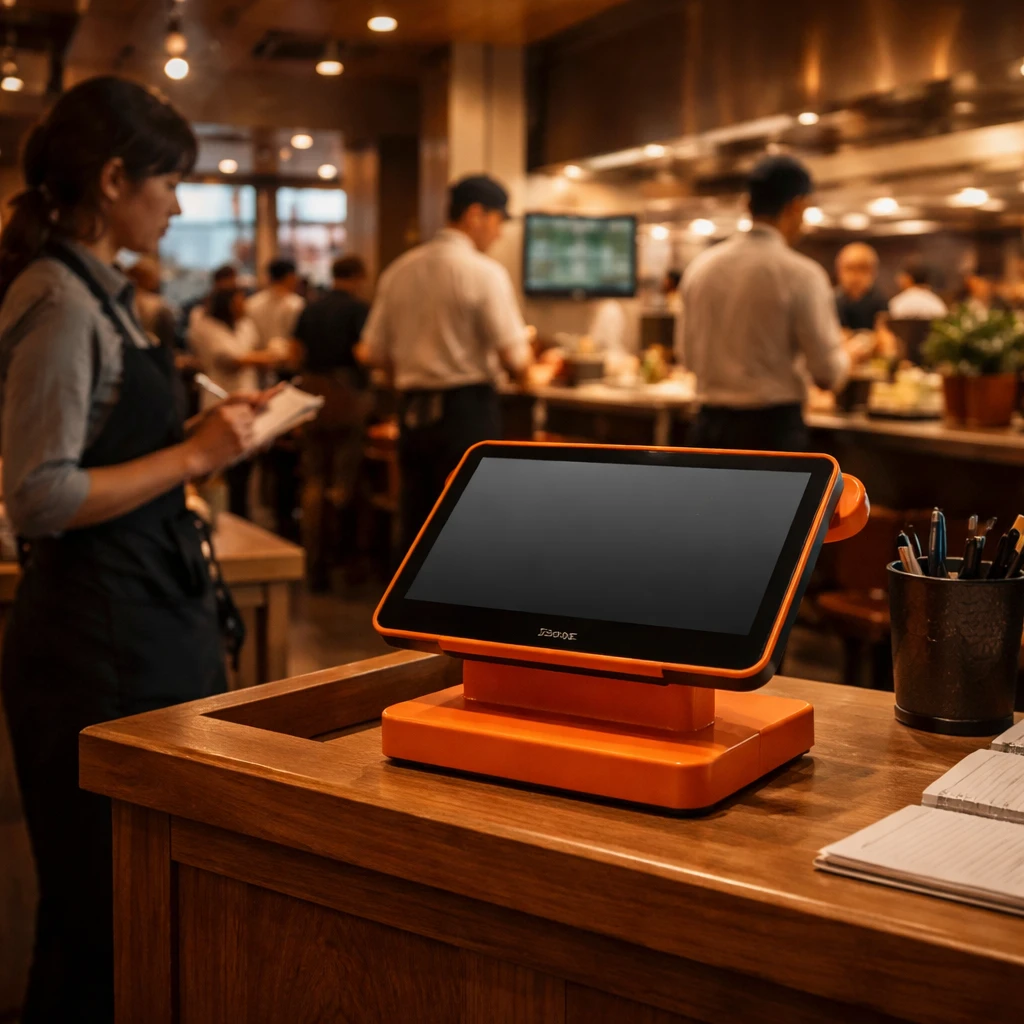
Toast builds the operating infrastructure for restaurants. That ranges from physical terminals and guest-facing displays to the payments rails, online ordering, kitchen display systems and analytics that run a restaurant’s daily operations. The firm is highly vertical: it sells hardware, recurring software subscriptions and takes payment revenue. Because restaurants are operationally sensitive, switching costs are meaningful once a location runs on Toast’s stack. That gives the company predictable recurring revenue plus payments-derived cash flow.
The market cares for two reasons. One, the restaurant industry is large and still fragmented: Toast serves roughly 164,000 locations and the U.S. market still has over 700,000 restaurants on legacy systems. Two, Toast is now generating real free cash flow - not just growth at any price. In a market rotating away from purely growth narratives, FCF matters.
Key fundamentals and the numbers that back this idea
| Metric | Value |
|---|---|
| Current price | $29.46 |
| Market cap | $17.35B |
| Enterprise value | $15.53B |
| Free cash flow (trailing/last reported) | $608M |
| 2026 ARR guidance (company commentary) | $2.3B |
| 52-week range | $24.35 - $49.66 |
| Trailing P/E | ~49x |
Put simply: EV / ARR is in the mid-single digits based on 2026 guidance, and free cash flow is now a real, measurable line item at $608M. That’s a very different starting point versus earlier-stage SaaS names that are still cash burning. The valuation metrics (roughly 2.7x price-to-sales and EV-to-sales ~2.5x) imply the market has punished the multiple, not the business model itself.
Technicals and sentiment backdrop
Technically, the stock shows bullish short-term momentum: the 9-day EMA sits under the current price and MACD is in bullish posture with a positive histogram. RSI is mid-60s (~61.7), which is not yet overbought and leaves room for a bounce. Short interest has been meaningful (short interest reports show ~28.3M shares most recently) and short-volume data over recent sessions indicates heavy short participation on intraday moves. That can amplify a re-rating if sentiment shifts or earnings/cash flow surprises occur.
Valuation framing
Toast trades at a market cap of approximately $17.4B and an enterprise value near $15.5B. If you use the company’s ARR guidance of roughly $2.3B for 2026, EV-to-ARR is around 6-7x depending on the precise ARR figure you use. That is far below what some high-growth SaaS names fetched at peak multiples and reasonable when paired with $608M in FCF. The market is effectively demanding proof that Toast can extend beyond small- and mid-sized restaurant penetration and keep pricing power intact as AI lowers some software development barriers for incumbents.
Compare that to broader SaaS derating: the recent sell-off applied a discount to mission-critical software too, and Toast was swept up. The argument for a re-rate is not a return to nosebleed multiples, but a move from current mid-single-digit EV/ARR to the low double-digits as execution de-risks and cash flow sustains.
Catalysts (what could drive the trade)
- Continued FCF delivery and updated guidance that tightens revenue-to-cash conversion expectations - investors respond to the $608M FCF print and any improvement thereafter.
- Evidence of scale wins with national chains or higher-average-ticket customers that demonstrate Toast is not confined to small independents.
- Sector stabilization: a cooling off in AI-driven sell-offs in SaaS that leads investors back toward fundamentals rather than fear-driven multiple compression.
- Institutional support: incremental buying from value-oriented funds (the ValueAct position expansion is precedent) or reduced short interest.
Trade plan (actionable)
I recommend a defined-entry swing trade:
- Trade direction: Long
- Entry: Limit order at $29.50
- Target: $40.00
- Stop loss: $25.00
- Time horizon: mid term (45 trading days) - expect this trade to play out over several weeks as sentiment and multiple expansion need time to recover.
Rationale on sizing and horizon: this is a sentiment-sensitive, conditional long. The mid-term window (45 trading days) allows time for one or two catalysts (earnings/FCF confirmation, improved guidance, or sector calm) to materialize and for short interest to unwind. Use position sizing consistent with your risk rules: the stop at $25 limits downside to about 15% from entry, while the $40 target offers ~36% upside, a roughly 2.4:1 reward/risk ratio.
Risks and counterarguments
- AI-driven competitive pressure: New AI tooling could lower the cost for large restaurant chains to build homegrown solutions or adopt cheaper, narrowly focused tools. If national chains accelerate self-built stacks, pricing power and addressable market mix could deteriorate.
- Execution risk expanding to larger chains: Toast has been dominant in small and mid-sized locations, but winning national accounts is a different sales motion. Failure to penetrate higher-average-ticket segments would cap upside and keep the multiple constrained.
- SaaS multiple compression persists: If the market continues to punish software multiples broadly, Toast’s re-rating will be limited regardless of FCF strength and the stock could revisit the low-$20s or worse.
- Payments regulatory / merchant economics: Toast participates in payments revenue. Any adverse shifts in interchange economics, regulation or fee structures could compress margins and FCF generation.
- Counterargument: The primary bear case is that AI and cheap tooling permanently reduce the moat around Toast’s software stack. That’s plausible at scale — if national chains standardize on internally developed systems, Toast’s growth runway and pricing power would be impaired. However, I view this as a longer-term structural threat rather than an immediate event: switching an operational restaurant stack is costly and risky, and many operators prefer an integrated vendor with payments, hardware and support rather than assembling disparate parts.
What would change my mind
I would trim or exit this position if any of the following happens: (1) management lowers ARR guidance materially or signals that FCF was a one-off; (2) clear evidence emerges of large national chains consciously moving away from Toast in volume that meaningfully impacts total addressable market; (3) payments economics deteriorate materially due to regulation or contract changes; or (4) the broader SaaS sell-off accelerates and Toast’s short interest spikes back above prior peaks, suggesting the market expects deeper downside.
Conclusion
Toast is a public company with both a recurring software revenue base and a payments business that now produces meaningful free cash flow. The market has punished the stock amid macro and AI fears, creating a tactical entry point for investors who want exposure to a dominant restaurant OS with real cash flow. The trade proposed here is not a buy-and-forget—it's a structured swing with a clear entry, stop and target anchored to measurable fundamentals and a time-bound horizon.
Trade summary: buy $TOST at $29.50, stop $25.00, target $40.00, mid-term (45 trading days). Focus on FCF confirmation and any signs of sector sentiment normalization.