
Hook / Thesis
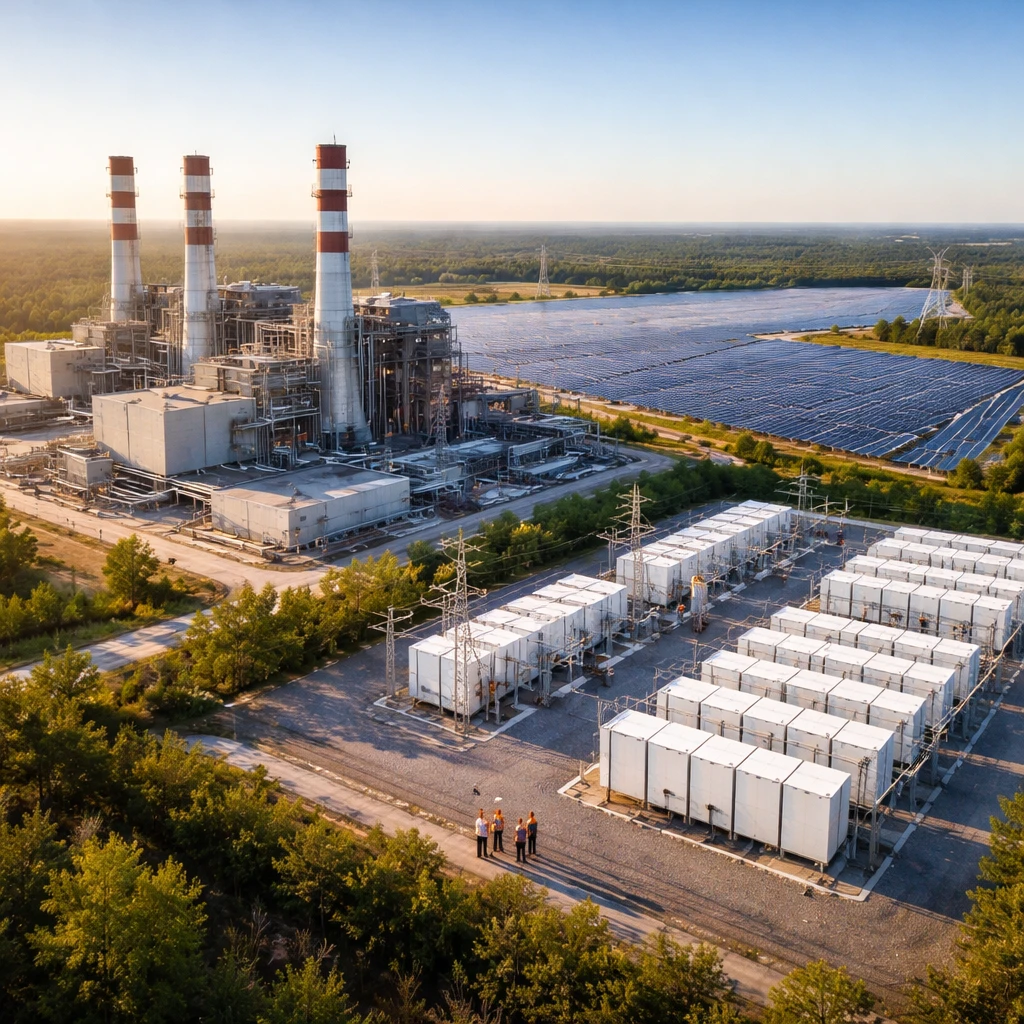
Southern Company is no longer just a regulated utility delivering steady dividends. The company is actively pivoting its asset base toward battery storage, nuclear upgrades, and renewable generation while leaning on a record $26.5 billion Department of Energy loan to accelerate grid modernization. That funding - aimed at supporting gas plants, nuclear work, storage and transmission upgrades to serve the rapid build-out of AI data centers and other demand centers - changes the growth runway in a meaningful way.
At a current price near $93.72 and a market cap of roughly $105.6 billion, Southern offers a mix of income (annualized dividend $3.04; yield ~3.1%) and total-return optionality if investors re-rate utilities tied to clean-energy buildouts and regulated rate-base expansion. My view: buy for a long-term trade (180 trading days) with a pragmatic entry near current levels, a recovery target above the 52-week high, and a stop that respects both the company’s leverage and negative free cash flow dynamics.
What the company does - and why the market should care
The Southern Company is a holding company with three principal segments: Traditional Electric Operating Companies (vertically integrated utilities serving Alabama, Georgia, Florida and Mississippi), Southern Power (developer, owner and manager of generation assets with a growing renewables footprint) and Southern Company Gas (natural gas distribution across multiple states). Management has leaned into a two-track strategy: maintain regulated earnings stability while growing Southern Power’s wholesale renewable and storage footprint.
Why investors should pay attention: Southern is positioned at the intersection of three durable trends. First, U.S. utility capital spending is running hot - investor-owned utilities plan to spend roughly $1.4 trillion through 2030 - which supports regulated rate-base growth and rate-case opportunities. Second, the acceleration of data centers and electrification creates sustained load growth. Third, federal support - highlighted by the 02/26/2026 DOE announcement that made a $26.5 billion loan available to Southern subsidiaries - materially lowers financing risk for large grid projects and could unlock more predictable returns on new assets.
Recent performance and financial picture (numbers)
| Metric | Value |
|---|---|
| Share price (current) | $93.72 |
| Market cap | $105.6B |
| Q4 2025 operating revenue | $6.98B |
| Q4 2025 adjusted EPS | $0.55 |
| 2026 EPS guidance | $4.50 - $4.60 |
| Annual dividend | $3.04 (quarterly $0.76) |
| Dividend yield | ~3.1% |
| EV | $178.19B |
| EV/EBITDA | ~13.4x |
| P/E (TTM) | ~24x |
| Free cash flow (most recent) | -$3.59B |
| Debt to equity | ~2.04 |
Two facts leap off the sheet. Revenue momentum is real: Q4 2025 operating revenue of $6.98 billion beat consensus ($6.49 billion), and kilowatt-hour sales grew 4.9% year-over-year. At the same time, adjusted EPS in that quarter was $0.55 (slightly below the $0.57 consensus), and free cash flow was negative (-$3.59 billion). The negative FCF reflects heavy capex and acquisition spending tied to Southern Power and grid upgrades - not surprising given the DOE loan and the company’s stated priorities.
Valuation framing
Southern trades at roughly 24x reported earnings and an EV/EBITDA of ~13.4x. For a large regulated utility with a meaningful growth layer in wholesale renewables, that multiple sits in line with historically defensive utility peers before a full clean-energy re-rate. Market cap near $105.6B versus enterprise value of $178.2B highlights the sizeable leverage in the capital structure; debt-to-equity around 2.04 is above what conservative equity-only investors prefer and explains a lower-for-now multiple relative to high-growth clean-energy names.
Put another way: the market is pricing Southern as a steady income utility with modest growth. The DOE loan, the company’s plan to deploy battery storage and nuclear upgrades, and accelerating kilowatt-hour demand provide a credible path toward higher regulated returns and wholesale profits. If the market starts to ascribe a partial growth premium to Southern Power’s renewable platform (similar to the premium seen in earlier re-ratings of integrated renewables platforms), upside to current valuation is plausible.
Catalysts
- Rate-case wins and regulatory approvals that expand rate base or accelerate cost recovery - each can lift near-term EPS and de-risk long-term returns.
- Deployment milestones tied to the $26.5B DOE loan - visible capital starts and contracted storage/renewables projects would validate the pivot.
- Strong load growth from data-center rollouts and electrification in the Southeast - sustained higher kilowatt-hour sales will support rate requests.
- Operational progress on nuclear and gas upgrades that reduce unit operating costs and improve fleet availability.
- Dividend consistency and the 25th consecutive annual dividend increase (announced 04/20/2026) which sustains investor confidence in the income story.
Trade plan (actionable)
Thesis: Buy Southern Company for long-term upside driven by a multi-year clean-energy and grid modernization program, backed by federal financing and steady load growth. Trade direction: long. Risk level: medium.
Entry: $93.50 (buy limit). Stop loss: $86.00. Target: $106.00. Time horizon: long term (180 trading days). Rationale: The entry is around current prices and close to near-term technical support. The stop at $86 protects against a deeper downdraft that would likely reflect either a failed regulatory path or materially worse-than-expected operating results; it sits above the 52-week low of $83.09 but allows for volatility. The $106 target (~13% above the entry) reflects a recovery above the recent 52-week high ($100.84) and factors in partial premiuming for successful project execution and some upward multiple compression toward growth-utility peers.
Position sizing guidance: treat this as a core-satellite trade for income investors who can stomach balance-sheet risk while seeking upside from execution. Reassess after meaningful catalysts (rate-case wins, DOE-funded project starts, or sequential EPS beats) or if free cash flow trends materially improve.
Risks and counterarguments
- Balance-sheet stress and negative FCF: Free cash flow was -$3.59 billion, and debt-to-equity is ~2.04. Heavy capital intensity could pressure liquidity if projects are delayed or regulatory recovery is slower than expected.
- Regulatory risk: Returns on new assets depend on state public utility commissions. Disallowed costs, slower recovery timelines, or political pushback could reduce the economic benefit of large projects.
- Execution risk on clean-energy projects: Construction delays, supply-chain issues for batteries or grid equipment, or overruns could push timelines and cost recovery out past rate-case cycles.
- Commodity / macro shocks: Inflation, rising interest rates, or energy price shocks could increase financing cost or undercut demand assumptions for certain merchant assets.
- Valuation re-rating could be slow: Even with successful execution, markets may be slow to re-rate a levered utility into a partial growth multiple; investors should be patient.
Counterargument: Some investors will argue this is still a classic utility - high leverage, slow growth, and regulatory drag - and that more aggressive clean-energy pure-plays offer better upside. That’s valid: pure renewables developers can show faster top-line expansion and lower balance-sheet drag. Southern’s advantage is scale, steady dividends (annualized $3.04, ex-dividend 05/18/2026, payable 06/08/2026) and an unusually large federal loan that de-risks big-grid upgrades. If you need high growth and are unwilling to hold through regulatory cycles, a purer growth name is a better fit.
What would change my mind
I will upgrade the view (or increase the target) if Southern: (1) secures material rate-case wins that explicitly expand allowed returns on new assets; (2) shows positive free cash flow trends within two consecutive quarters; or (3) announces large, contracted renewable-plus-storage deals that prove Southern Power can scale profitably without diluting the regulated business. Conversely, I would cut exposure if FCF worsens materially, if the DOE-funded projects hit cascading delays or cost overruns, or if regulators impose unfavorable disallowances.
Conclusion
Southern Company sits at a practical inflection: a conservative regulated utility with a growing clean-energy growth arm and access to unprecedented federal funding. That combination supports a balanced long-term trade: yield today with potential upside as projects translate into rate-base growth and wholesale earnings. The trade is not without risk - leverage and negative FCF are real - but for investors comfortable with a medium-risk utility allocation, buying near $93.50 with a stop at $86 and a target of $106 over a long-term horizon (180 trading days) offers a sensible risk/reward to capture the company’s clean-energy pivot.
Key points
- DOE $26.5B loan materially lowers financing risk for grid and clean-energy projects (02/26/2026).
- Q4 2025 revenue beat: $6.98B, kWh sales +4.9% YoY; 2026 EPS guidance $4.50-$4.60.
- Market cap ~$105.6B, EV ~$178.2B, EV/EBITDA ~13.4x, P/E ~24x; dividend yield ~3.1%.
- Trade plan: long at $93.50; stop $86.00; target $106.00; horizon long term (180 trading days).