
Hook and thesis
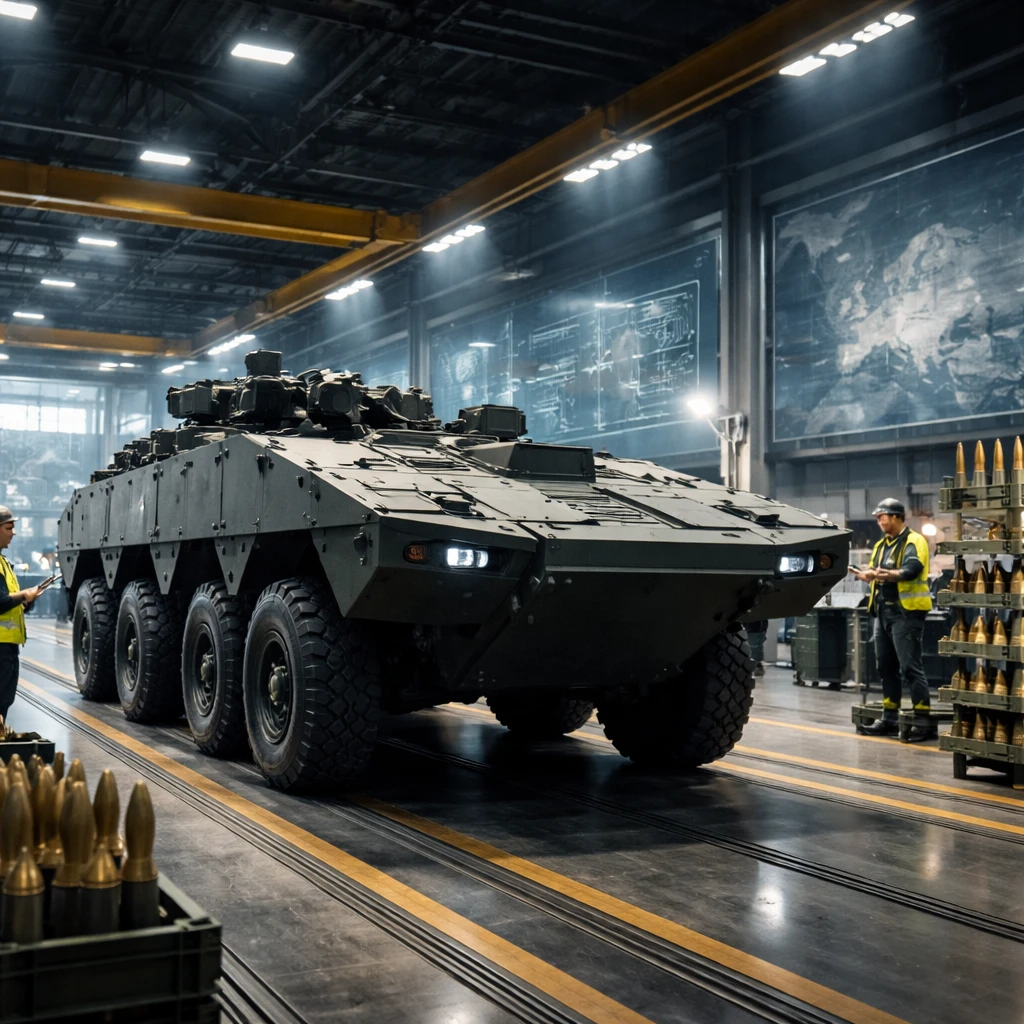
Rheinmetall is not a one-product supplier. It sells integrated capability - armored vehicles, turrets and guns, air defense components, munitions and digital force-multipliers - across multiple NATO militaries. That breadth matters because the current funding cycle coming through NATO governments and allied procurement plans is broad-based: it raises budgets for vehicles, ammunition and sensors simultaneously. A supplier that can deliver across those lines stands to win more of the incremental wallet share a single-service vendor cannot.
My actionable stance is constructive: buy a tactical long on Rheinmetall with a clearly defined entry at $110.00, a stop at $88.00 and an initial target at $155.00. The trade is sized for a long-term horizon (180 trading days) to capture large program awards and delivery cadence while giving the company time to execute. The thesis is fundamentally macro-driven - NATO and allied rearmament - and execution-dependent: backlog conversion, margin preservation under higher activity, and supply chain scaling.
Business explained - why the market should care
Rheinmetall operates across multiple combat domains. Its business mixes heavy hardware - tracked and wheeled combat vehicles, turrets and main guns - with munitions, propellants and increasingly complex electronic systems. That mix is valuable in a spending upswing because governments rarely increase a single line item in isolation: they fund whole programs that require vehicles, guns, and ammunition together. Selling across the stack means Rheinmetall can capture integrated program shares and aftermarket sustainment - a higher-margin recurring revenue source.
From a market standpoint, defense cycles are long and lumpy. Order announcements and contract awards are discrete events that materially re-rate suppliers when they confirm multi-year funding. What investors need to monitor are three things: order backlog visibility (the certainty of funded orders), production ramp capacity (to protect margins), and geopolitical durability (political will to spend). Rheinmetall scores well on the first and third in the current environment given reinforced NATO commitments; the second is the primary execution risk.
Valuation framing
Valuing a company in an unfolding defense super cycle is partly arithmetic, partly narrative. Multiples expand when future orders are visible and margins are protected during ramp-up. Historically, defense primes trade at a premium to industrial peers because of sticky follow-on services and recurring aftermarket. In Rheinmetall's case, the market should pay up for demonstrable, funded multi-year programs that cover vehicles, ammunition and sustainment.
Absent a single consensus market-cap snapshot here, the practical investor approach is to view current prices as a probability-weighted discount to a scenario where Rheinmetall secures and executes several mid-to-large program awards. If awards confirm, revenue and free cash flow should inflect higher and justify multiple expansion. If awards are delayed or deliveries stumble, the stock will reprice sharply lower. The trade plan below reflects that asymmetric pay-off: a disciplined entry to capture upside while capping downside with a stop that respects delivery and execution risk.
Catalysts - what will move the stock
- Order awards from NATO members and bilateral procurement agreements - especially for vehicles, artillery and munitions - that increase funded backlog materially.
- Quarterly updates showing backlog growth and improving margin trajectory as production scales.
- Announcements of strategic partnerships or local production deals in allied countries that shorten delivery timelines and de-risk export approvals.
- Positive macro news on defense budgets - NATO communiqués or national budget votes setting higher defense baselines for multiple years.
- Evidence of supply-chain de-risking and manufacturing capacity expansion without large cost overruns.
Trade plan (actionable)
Direction: Long
Entry price: $110.00
Target price: $155.00
Stop loss: $88.00
Risk level: Medium
Time horizon: long term (180 trading days) - this horizon gives time for program awards to be publicized, for initial production milestones to be reached and for the market to re-rate a demonstrable backlog. Expect price action to be volatile around award announcements; keep position size manageable relative to portfolio volatility.
Rationale for levels: The entry sits below recent run-ups that tend to price in early-cycle optimism but above a level that would indicate materially deteriorating sentiment or a clear execution miss. The stop is tight enough to control downside if backlog or delivery guidance disappoints, but wide enough to avoid whipsaw around short-term news. The target reflects a multiple expansion scenario if several medium-sized programs are converted to funded backlog and margins stabilize or improve with scale.
Key points to monitor while holding
- Order flow and backlog disclosures: size, country, funded vs. option value.
- Production-rate commentary and CAPEX guidance for capacity expansion.
- Margin trend: gross and operating margins as activity increases.
- Cash conversion and working capital: ramping production can drain cash if not managed.
Risks and counterarguments
Every trade has obvious and non-obvious risks. Below are the main ones I consider before adding exposure.
- Execution risk - Ramping production for complex systems is hard. Delays, supplier shortages or quality issues can blow margins and push deliveries into future fiscal years.
- Export and political risk - Export approvals, especially for critical systems, can be delayed or denied. Political shifts in buyer countries could defer or reduce orders.
- Funding timing - Governments pass defense budgets on cycles. Commitments can be announced but not immediately funded; the timing of cash flows matters for valuation.
- Inflation and input-cost pressure - High activity demands more raw materials and labor, pressuring margins if contract terms are fixed or indexed poorly.
- Competitive pressure - Large programs attract multiple primes and consortium bidders; wins are never guaranteed and program splits reduce upside.
- FX and macro - Revenues and costs denominated in multiple currencies can introduce volatility; macro slowdowns could reduce appetite for new platform buys in non-urgent markets.
Counterargument
One plausible counterargument is valuation already prices a near-term boom. If the market has pre-baked aggressive order wins and margin improvement, the room for upside is limited and disappointment risk increases. In that scenario, even confirmed awards may be split across competitors and fail to move the stock materially. That is why the entry is set at $110.00: it seeks to avoid buying the top of an optimism spike and forces discipline via a hard stop at $88.00 if the story does not proceed as expected.
What would change my mind
I would downgrade this trade if any of the following occur: (1) a string of awarded programs are materially smaller than consensus or heavily derisked to competitors; (2) management repeatedly lowers guidance on capacity expansion or margins due to supplier constraints; (3) key buyer governments publicly delay funding or reverse procurement commitments; or (4) cash conversion weakens substantially, forcing dilutive financing. Conversely, I would add to the position if the company announces multiple funded programs across different domains (vehicles + munitions + electronics) with clear funded multiyear revenue profiles and stable or improving margins.
Conclusion
Rheinmetall's multi-combat product set makes it a natural beneficiary of a multi-year NATO spending cycle. The trade here is constructive but pragmatic: the macro tailwind is strong, but revenue realization is lumpy and execution matters. The recommended tactical long at $110.00 with a stop at $88.00 and a target of $155.00 over a 180-trading-day horizon balances upside potential against delivery risk. Keep position size disciplined and treat program awards and margin progression as the primary catalysts that should drive re-rating.