
Hook & thesis
Powell Industries (POWL) is a business that looks very different today than it did a year ago: revenue drivers and investor sentiment have both re-rated after a more than 200% share-price run and a surge in new orders. The company now sits on a reported backlog of roughly $1.6 billion and has accelerated its automation capabilities through the Remsdaq acquisition — two positives the market is rewarding as the stock trades at a new 52-week high of $224.71.
That momentum creates an opportunity for a disciplined swing trade. The technicals are bullish (RSI ~70, MACD signaling momentum) and the company's fundamentals - 28% return on equity, strong free cash flow of $161.5 million, and a clean balance sheet - support a premium multiple. Valuation is already rich: market capitalization sits around $8.15 billion and the stock trades near a 42.5x P/E on trailing earnings of $5.14 per share. My thesis: there is room for a near-term move higher if order momentum and margin expansion continue, but the premium multiple leaves downside risk if growth disappoints. The trade is to go long on a measured pullback, with a clear stop and target.
What Powell does and why the market should care
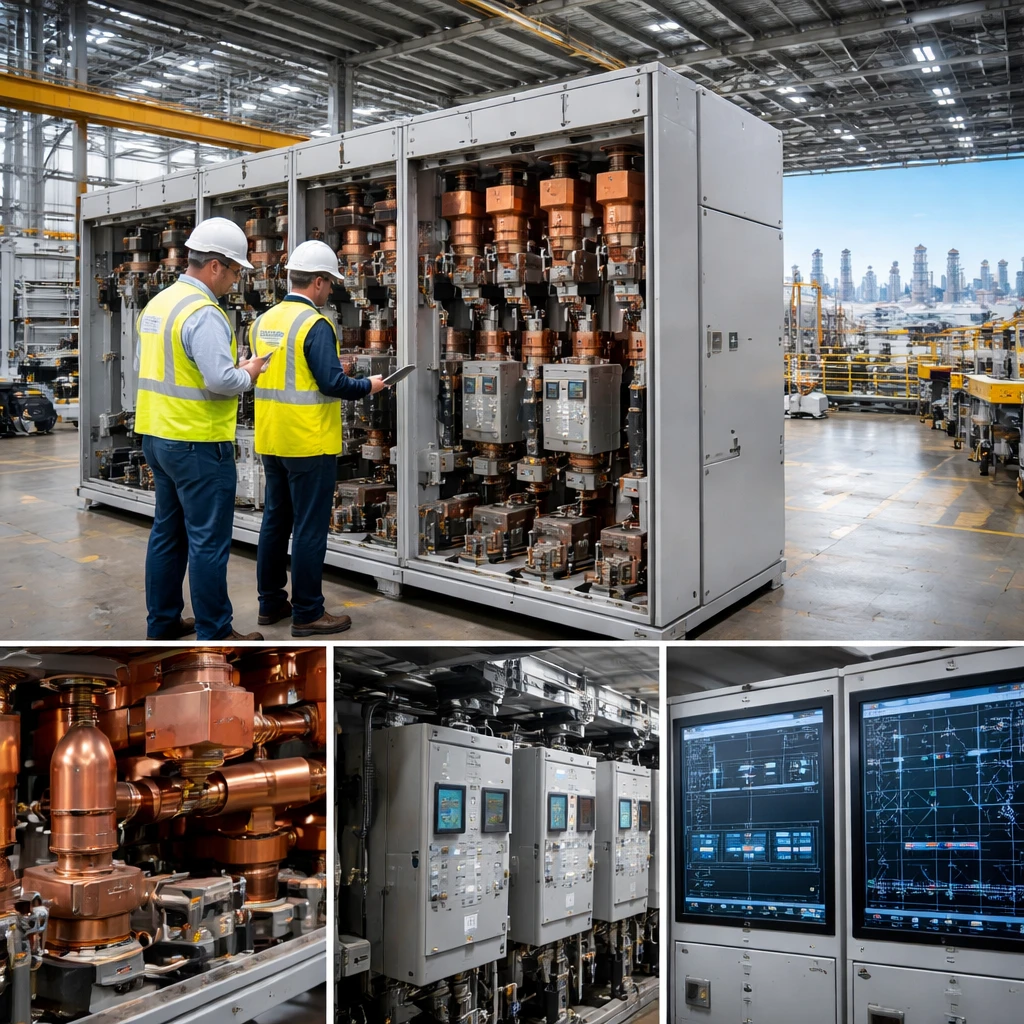
Powell Industries is a niche, engineering-led supplier of custom electrical systems: integrated power control rooms, substations, arc-resistant switchgear, medium-voltage circuit breakers, motor control centers and related automation and communications systems. These are mission-critical assets for utilities, industrials, and energy infrastructure customers. The company's solutions are sticky, project-driven and typically involve long lead times, which is why backlog matters.
Two fundamental drivers explain why investors are focused on Powell today:
- Backlog and order momentum. Powell reported a backlog near $1.6 billion and a 63% surge in new orders in recent commentary. For a business where projects can span quarters, that lifts near-term revenue visibility and supports margin leverage.
- Automation and M&A. The acquisition of Remsdaq Ltd. (announced 07/15/2025) augments Powell's RTU and automation capabilities and strengthens its addressable market in utilities and grid modernization. Combining custom switchgear with improved telemetry and control software increases the stickiness and potential lifetime value per customer.
Supporting numbers
Use these concrete figures to frame the opportunity:
| Metric | Value |
|---|---|
| Current price | $223.82 |
| 52-week range | $51.49 - $224.71 |
| Market cap | $8.15 billion |
| Shares outstanding | 36.43 million |
| EPS (trailing) | $5.14 |
| Trailing P/E | ~42.5x |
| Free cash flow (TTM) | $161.5 million |
| ROE / ROA | 28.0% / 17.1% |
| Dividend (quarterly) | $0.27 per share |
Valuation framing
Powell's current market cap of about $8.15 billion and trailing earnings of $5.14 per share imply a P/E near 42.5x. EV/EBITDA sits north of 32x and price-to-sales is roughly 7.1x. Those multiples are expensive versus traditional industrial benchmarks but not necessarily out of line for a high-quality, project-oriented supplier showing rapid order growth and improved automation exposure.
Crucially, the valuation makes Powell sensitive to execution risk. If the $1.6 billion backlog converts to revenue with stable or improving margins, the market can rationalize multiple expansion. If orders re-contract or margins compress, the premium will likely retrace quickly. In short: valuation is a bet on continued order growth, margin stability, and successful integration of automation assets like Remsdaq.
Catalysts to watch
- Quarterly order intake and backlog updates - continued high-single-digit to double-digit order growth would support the stock.
- Margin progression - evidence that higher automation content or operational improvements are lifting gross and operating margins.
- Execution on Remsdaq integration and cross-selling into utility accounts.
- Dividend increases or share buybacks that demonstrate capital return discipline (board raised quarterly dividend to $0.27, payable 03/18/2026, showing willingness to return cash).
- Macro infrastructure pushes or accelerated grid modernization spending that increase switchgear demand.
Trade plan - actionable and specific
Thesis: Buy Powell on modest weakness to capture continued order conversion and automation-led margin expansion while respecting a premium valuation.
Entry: Buy at $220.00. This entry is a slight pullback from the print high and lets you avoid buying the exact top.
Stop loss: $188.00. If price drops to $188, momentum has likely turned and the risk/reward becomes unfavorable; this is roughly a 15-16% downside from current levels and sits well above the 50-day moving average troughs seen earlier in the rally.
Target: $260.00. This target equates to roughly a 16% upside from the $224 area and implies a P/E of about 50x on current trailing earnings, which is achievable if order growth and margin evidence continue to accelerate over the next several quarters.
Horizon: mid term (45 trading days). The rationale: projects and order conversion are slower than pure software names, but Powell's recent news cadence (order wins, acquisitions, dividend actions) and the momentum indicators suggest enough near-term visibility for a 6-9 week swing. If you plan to hold beyond that, reassess with the next quarterly results and backlog update.
Position sizing & risk-management notes
- Given the rich valuation and the stock's volatility (RSI ~70, high short-volume days), keep position size conservative: limit risk per trade to 1-2% of portfolio capital.
- Trail the stop to protect gains if the stock moves favorably; use incremental partial profits near $240 and $250 before the final target of $260.
Risks and counterarguments
- Execution risk: Powell is a project business. Delays, warranty issues, or cost overruns on large builds would pressure margins and free cash flow.
- Valuation sensitivity: At ~42.5x P/E and EV/EBITDA >32x, the stock is priced for continued growth. Any slowdown in orders or margin compression could trigger sharp multiple contraction.
- Short-interest & liquidity dynamics: Short interest has been meaningful historically (over 1.1 million shares at the 03/13/2026 settlement) and short-volume spikes can exacerbate downside volatility on negative headlines.
- Macro & cyclical exposure: Industrial capital spending can be lumpy and tied to broader macro cycles. A slowdown in utility or industrial CAPEX would hit order flow.
- Integration risk: Remsdaq brings automation capability, but integration and cross-sell execution is not guaranteed; if the acquisition fails to generate expected synergies, growth could disappoint.
- Counterargument: The stock's rapid run and premium multiple may simply reflect a re-rating that is already 'baked in' - with accelerated order flow and a neat story around automation, downside could be limited and upside incremental. If you believe backlog and automation revenue are sustainably higher, a lower stop and longer horizon could be justified.
What would change my mind
I would re-evaluate the long stance if any of the following occur: a meaningful contraction in reported backlog or new orders, clear margin erosion on project execution, or evidence that Remsdaq integration is dilutive rather than additive. Conversely, if Powell reports sustained sequential margin improvement and confirms multi-quarter order strength, I would move to a longer-term position and raise the target range.
Conclusion
Powell Industries sits at an inflection where engineering moat, automation capability, and a sizable backlog have the potential to support further upside, but the market is charging a premium for those attributes. The trade here is a disciplined swing long: buy around $220, protect at $188, and take profits toward $260 over a mid-term 45 trading-day window. Size the trade carefully, watch order flow and margin signals, and be ready to cut losses quickly if execution or demand trends deteriorate.
Key near-term dates to watch: the dividend payable date 03/18/2026 (shows capital return posture) and quarterly updates tied to backlog and order intake.