
Hook and thesis
NVR is one of the more quietly resilient names in homebuilding. The stock now sits near $6,482 after a pullback from last year's highs; on a fundamental basis the company still generates meaningful free cash flow, carries low leverage and delivers industry-leading returns on equity. For patient, appropriately sized allocations I see this pullback as a buying opportunity: the balance sheet and cash flow profile make NVR better positioned than many peers to weather a high-rate, low-inventory housing environment.
This is an actionable trade idea: enter at $6,482.53, place a protective stop at $6,100.00 and target $7,800.00 over a long-term (180 trading days) horizon. The plan is based on conservative valuation math (single-digit free cash flow yield upside relative to peers' cyclicality), a clear operational edge (option-based land model) and a series of near-term catalysts that can reaccelerate orders and margins as rate volatility eases.
What NVR does and why the market should care
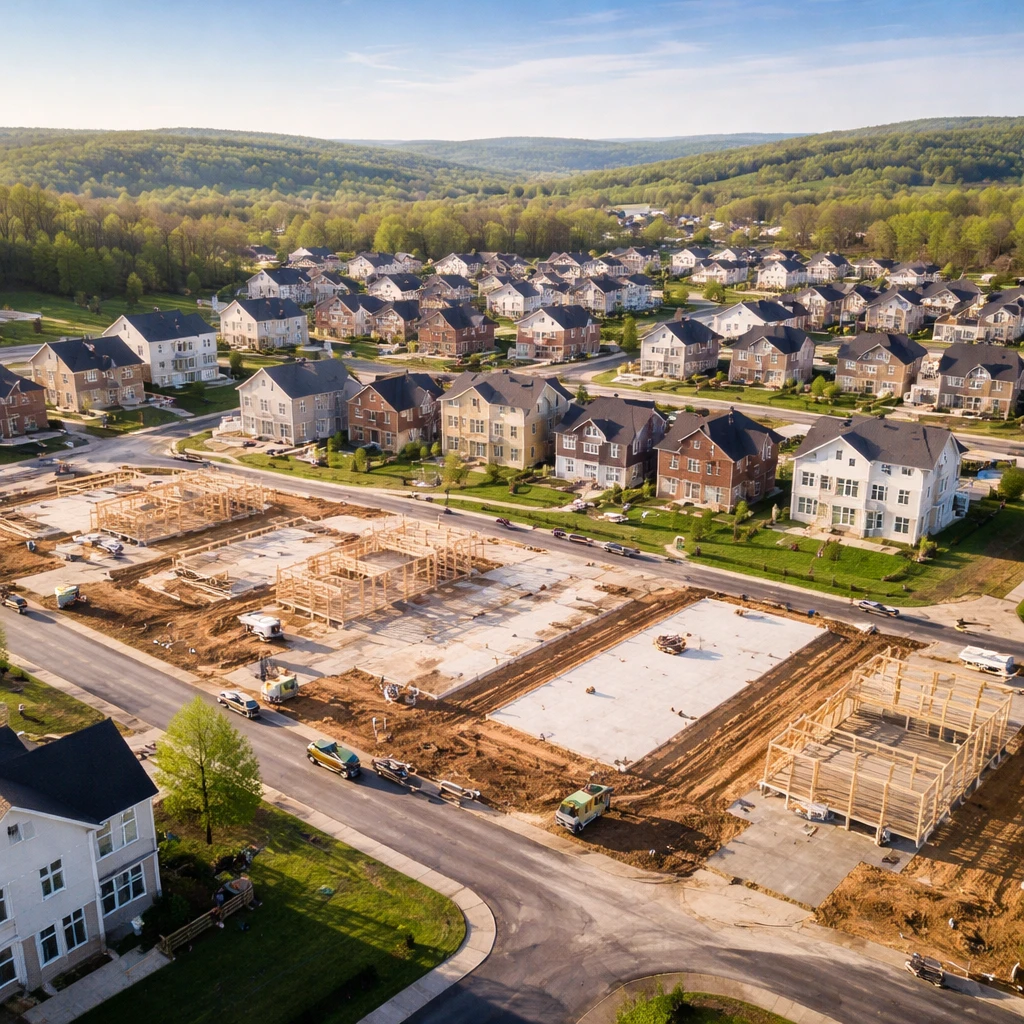
NVR, Inc. builds and sells single-family detached homes, townhomes and condominiums across the Mid Atlantic, North East, Mid East and South East regions. Its business differs from many large homebuilders because NVR generally uses an option-based land model rather than carrying large parcels on the balance sheet. That approach reduces capital intensity, lowers carrying costs during slow demand periods and preserves flexibility to deploy capital into active markets when returns are attractive.
The current housing market backdrop is supportive of builders who can deploy capital efficiently. Existing-home inventory has been constrained, and several industry analyses flagged a multi-year supply shortage. For NVR this means demand for new construction remains structurally supported even as mortgage rates fluctuate. The company’s relatively low debt-to-equity (about 0.24) and strong liquidity position make it less vulnerable to financing stress than more levered peers.
Key fundamentals and hard numbers
- Share price and market cap: NVR trades near $6,482.53 with a market capitalization around $17.97 billion.
- Earnings and valuation: EPS is roughly $490.45, implying a forward price-to-earnings multiple near 13.2x on the company’s current share price.
- Cash flow and capital returns: free cash flow last reported at about $1.0968 billion, implying an approximate FCF yield of 6.1% relative to market cap.
- Returns and leverage: return on equity about 34.67% and return on assets about 22.88%, while debt-to-equity sits near 0.24 - a conservative leverage profile for a cyclical builder.
- Liquidity and float: shares outstanding are roughly 2.78 million with a float near 2.64 million, creating a high single-share price and thinner liquidity than mega-cap names.
Valuation framing
On a simple multiple basis NVR looks reasonable. The stock trades at roughly 13x reported earnings and closer to ~16x price-to-free-cash-flow. Enterprise value is around $16.7 billion with an EV/EBITDA near 10.2x. For a company generating north of $1 billion in free cash flow, with an ROE above 30% and limited financial leverage, a mid-teens multiple is defensible.
Compare this logic qualitatively: homebuilders are cyclical, but NVR’s capital-light land strategy compresses downside risk versus builders carrying large land inventories. That lower capital intensity should translate into steadier margins and cash flow through a rate-driven housing slowdown, supporting the multiple observed today. The company’s historical reluctance to split shares keeps the per-share price high and limits retail participation – that’s a trading headwind but not a valuation shortfall.
Technical and liquidity context
Technically the stock shows cooling momentum: 10/20/50-day moving averages and an EMA profile point to recent weakness and the MACD is in bearish momentum territory. RSI is modestly weak at ~41, meaning there's room for downside but not an extreme oversold reading.
Low float and limited daily volume (average ~24k) mean price moves can be amplified in either direction. Short interest has ticked up recently, and short-volume statistics show elevated short activity in late April. That can magnify volatility and fuel sharp, short-term moves versus fundamentals.
Catalysts (what can push this trade higher)
- Rate relief or stabilization: even a modest decline in 30-year mortgage rates would improve affordability and likely accelerate orders and reduce cancellations.
- Operational improvements / margin recovery: better absorption rates, lower cancellation rates and tighter construction costs would re-expand gross margins and lift reported earnings.
- Housing shortage narrative and demand persistence: articles and sector narratives published in April 2026 emphasize a multi-year housing supply shortfall, which favors builders that can execute efficiently.
- Strong cash flow realization or buyback activity: continued free cash flow conversion could support buybacks or special capital returns, reinforcing per-share value given the small float.
Trade plan (actionable)
Entry: buy at $6,482.53. This is essentially the current price and provides a straightforward execution point given the low float and limited liquidity.
Protective stop: $6,100.00. The stop sits below the March low near $6,301 and gives the position room to absorb short-term rate-driven noise while cutting losses if the business shows sharper-than-expected weakness.
Target: $7,800.00 over a long-term (180 trading days) horizon. This target reflects modest multiple expansion toward mid-teens on a company generating roughly $1.1B in FCF and earning ~$490 per share. It also sits well below the 52-week high of $8,618, leaving room for further upside if sentiment recovers strongly.
Position sizing and time frame: treat this as a long-term (180 trading days) position. The housing cycle and mortgage-rate dynamics play out over months, not days. Limit exposure to a size that tolerates single-digit percentage swings given volatility from low float and active short interest.
If you prefer a layered approach: initiate half of the target size at $6,482.53 and add on weakness toward $6,300, keeping the same stop for the full position. This reduces execution risk around thin markets.
Risks and counterarguments
- Macro and rate risk: sustained higher mortgage rates or another rate shock could meaningfully reduce buyer affordability, increase cancellations and compress margins across the sector.
- Order and cancellation volatility: published quarterly commentary has shown periods of declining new orders and higher cancellation rates; if those trends accelerate the company’s earnings and cash flow would be impaired.
- Liquidity and stock structure: a very high per-share price and small float create outsized intraday moves and make progressive buying or selling more difficult without moving the market.
- Execution and regional concentration: a material deterioration in one of NVR’s regional markets (e.g., NY metro or Mid Atlantic) could disproportionately affect results given the geographic mix.
- Valuation complacency: while multiples appear reasonable today, homebuilders historically re-rate quickly on downward revisions; if guidance weakens the multiple could compress fast despite healthy historical returns.
Counterargument: technicals and sentiment are weak—MACD shows bearish momentum, RSI is not oversold and short interest has risen. For traders focused on shorter horizons this could justify waiting for a clearer technical base or a reduction in short activity before committing large size.
What would change my mind
I would reassess the bullish stance if the company reports sustained declines in new home orders and a persistent rise in cancellation rates beyond management's prior commentary, or if free cash flow falls materially below the reported ~$1.1B run-rate. A sharp increase in leverage, meaningful impairment charges on land options, or a macro shock that sends mortgage rates materially higher would also force a downgrade.
Conclusion
NVR blends high returns on equity, a conservative balance sheet and a capital-efficient land model. Those attributes matter when mortgage rates and buyer behavior are volatile. The stock is not without near-term technical and liquidity risks, but for disciplined, appropriately sized positions I view the current price as a buyable dip. The recommended trade - entry $6,482.53, stop $6,100.00, target $7,800.00 - is designed to lean into NVR’s fundamental resilience while limiting downside if macro or operational realities deteriorate more than expected over the next 180 trading days.
| Metric | Value |
|---|---|
| Current price | $6,482.53 |
| Market cap | $17.97B |
| EPS | $490.45 |
| P/E | ~13.2x |
| Free cash flow | $1.0968B |
| ROE | 34.67% |
| Debt / Equity | 0.24 |
Trade action: Buy at $6,482.53, stop $6,100.00, target $7,800.00. Time horizon: long-term (180 trading days).