
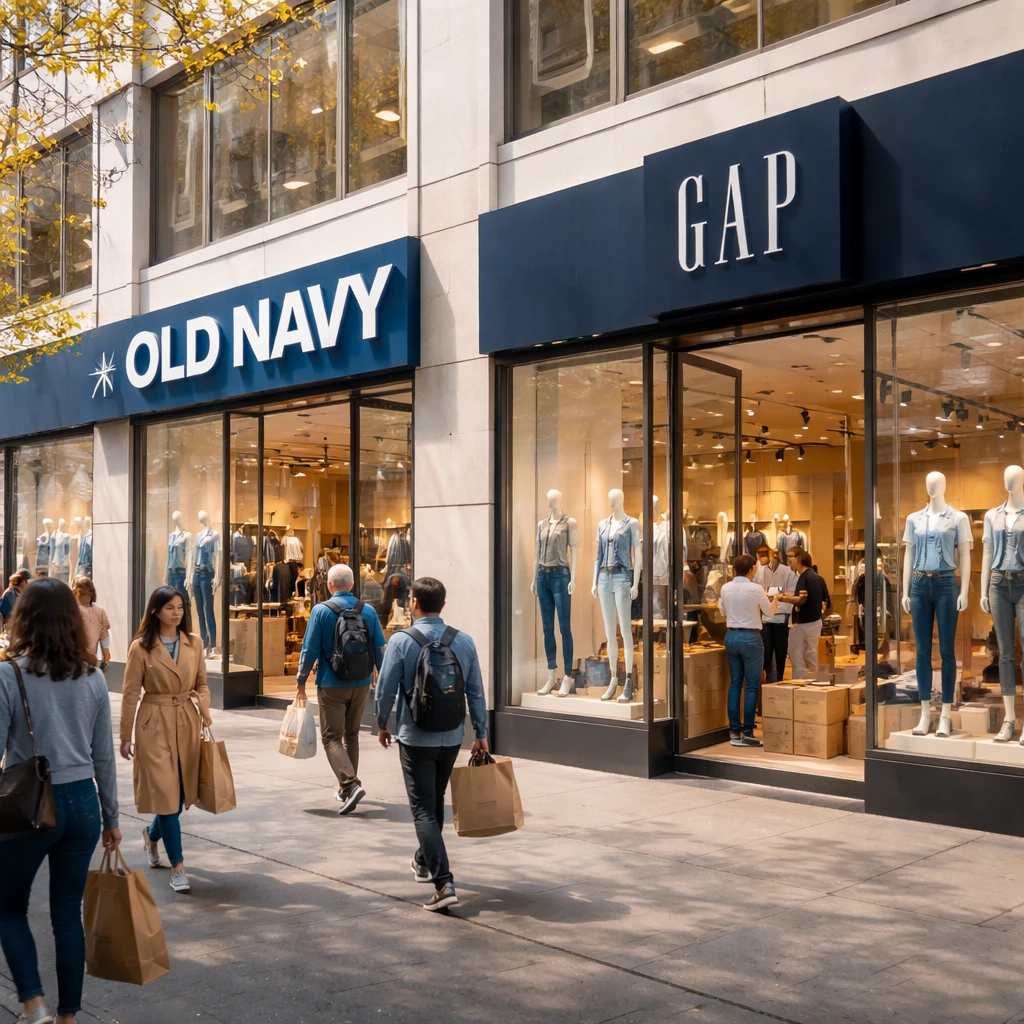
Hook + thesis
The Gap underwhelmed during the recent holiday season, and investors punished the name for missing sales expectations. That reaction was predictable and in many ways overdone - weak holidays are headline damage in the near term but do not erase the structural improvements the company put in place in 2025 and is executing through 2026.
My base thesis: Gap Inc. is a mid-term buy. Inventory discipline, margin recovery potential, and brand-level initiatives (notably at Old Navy) should drive a reacceleration in comparable sales and profit improvement through 2026. For active traders, there is a clear swing entry opportunity on the current weakness with defined risk and a realistic target that prices in multiple expansion and operational improvement.
What the company does and why it matters
Gap Inc. operates a multi-brand portfolio in mass and value apparel channels, with Old Navy, Gap, Banana Republic, and Athleta representing differentiated price points and target customers. The market cares because Gap is a large, capital-light retail operator that can generate meaningful free cash flow if it nails inventory turns, keeps promotions under control, and grows full-price sell-through. In a retail environment where execution matters more than top-line noise, disciplined inventory and margin recovery are the fastest levers to flow through to the bottom line.
Why now - the fundamental driver
The recent holiday miss created a short-term negative narrative, but that miss also reset expectations, giving the next wave of quarterly updates room to surprise to the upside if the company executes. Three operational drivers support the thesis:
- Inventory discipline and margin repair - Management prioritized inventory reduction and fewer promotions in prior quarters. If full-price sell-through improves, margins have upside without requiring dramatic revenue growth.
- Brand-level initiatives - Old Navy remains the growth engine in the portfolio; targeted assortments, better clearance cadence, and marketing investments should translate into stronger comps when traffic rebounds.
- Cost and capital returns optionality - Gap has room to reallocate SG&A, optimize store footprint, and redeploy capital to the highest-return channels. Any acceleration in cash flow opens the path to buybacks, which can be a powerful P/E re-rating catalyst.
Data & numbers
The public dataset in this briefing did not include recent quarterly line items to cite verbatim. That said, the market reaction to holiday misses typically compresses multiples quickly; this often creates asymmetric return profiles where downside is limited by already-lowered expectations while upside remains meaningful if execution stabilizes. Given that reality, a disciplined entry with tight risk controls is appropriate.
Valuation framing
Without current market-cap or consensus estimates in the brief, valuation must be assessed qualitatively. Gap historically traded at a modest multiple reflecting mid-single-digit revenue growth but higher operating margins when inventory and assortments were managed well. If Gap can show consecutive quarters of margin improvement and comp stabilization, a multiple expansion from depressed levels is reasonable - especially given the optionality in Old Navy and Athleta. In short, this is a classic operational turnaround story where earnings leverage can create outsized returns versus top-line improvements alone.
Catalysts (2-5)
- Quarterly results showing sequential improvement in inventory turns and gross margin.
- Better-than-expected comparable sales at Old Navy or Athleta, which would validate product and marketing changes.
- Management commentary on further cost optimization or accelerated share buybacks.
- Evidence of improved full-price sell-through (reduced promo depth) in monthly sales reports or analyst checks.
Trade plan - actionable
This is a mid-term swing trade designed to capture operational improvement and multiple re-rating. The suggested trade parameters are purposefully specific and sized for disciplined risk-taking.
| Leg | Price | Notes |
|---|---|---|
| Entry | $16.00 | Enter a full position on a pullback to this level or better; stagger entries if you prefer averaging. |
| Stop-loss | $11.00 | Hard stop to limit downside; tight relative to entry to keep risk/reward attractive. |
| Target | $24.00 | Realistic near-term target that assumes margin recovery and some multiple expansion. |
| Horizon | Mid term (45 trading days) - enough time for quarterly commentary, monthly sales cadence, and initial margin improvement to show up. | |
Why these levels? Entry at $16.00 gives room for holiday noise to shake out while keeping upside meaningful to $24.00, which prices in a modest re-rating and improved margins. The $11.00 stop limits downside and preserves capital if the recovery narrative fails to materialize.
Position sizing & risk management
Risk no more than 1.5% to 3% of portfolio capital on this single trade. If you enter at $16.00 with a $11.00 stop, the per-share risk is $5.00. Use that to calculate sizing consistent with your risk tolerance. Consider adding a small second tranche on a confirmed improvement in monthly sell-through metrics or on a constructive management call.
Risks and counterarguments
Any trade needs a sober look at what could go wrong. Here are the principal risks and a standalone counterargument to the bullish thesis.
- Persistent traffic weakness - If consumer apparel traffic remains soft and price sensitivity stays elevated, Old Navy and Gap full-price sell-through may not recover quickly enough to restore margins.
- Inventory missteps - Even with a stated focus on inventory discipline, execution is hard. Overshooting markdown reductions could leave the company exposed to older inventory sitting at full price.
- Macro shock - An adverse macro shock (higher unemployment, credit squeeze) would suppress discretionary spending, hitting mid-priced apparel retailers hard.
- Competitive pressure - Aggressive pricing or product moves by larger peers or fast-fashion players could undercut Gap’s recovery and force deeper promotions.
- Corporate execution risk - Management must sustain the strategic focus across brands; any pivot away or leadership disruption could slow implementation.
Counterargument
A valid bearish read is that the holiday miss signals deeper structural demand deterioration for Gap’s core customer. If that’s true, margin repair and inventory discipline will only buy time while comps continue to erode. In that scenario, valuation will compress further and the $11 stop is a prudent limit to cut exposure quickly rather than let losses accumulate.
What would change my mind
I would reassess the bullish stance if any of the following appears: 1) consecutive quarterly comps deteriorate across brands without margin improvement, 2) inventory levels remain elevated with continued aggressive promotions, or 3) management abandons the cost or brand plans previously communicated. Conversely, sustained sequential margin expansion, improving full-price sell-through, and clearer capital return plans would reinforce the thesis and warrant a larger position.
Conclusion
Gap’s holiday miss is real and matters for near-term sentiment, but it also lowers expectations. That reset, combined with tangible operational levers and brand-specific upside (especially at Old Navy), creates an asymmetric trade opportunity over the next 45 trading days. The trade outlined above - enter at $16.00, stop at $11.00, target $24.00 - offers a disciplined way to participate in a potential recovery while managing downside if the recovery stalls. Stay nimble: watch monthly sell-through, margin headlines, and management commentary closely. If the company executes, the market is likely to reward the improvement; if it doesn't, the stop protects capital and allows you to redeploy elsewhere.