
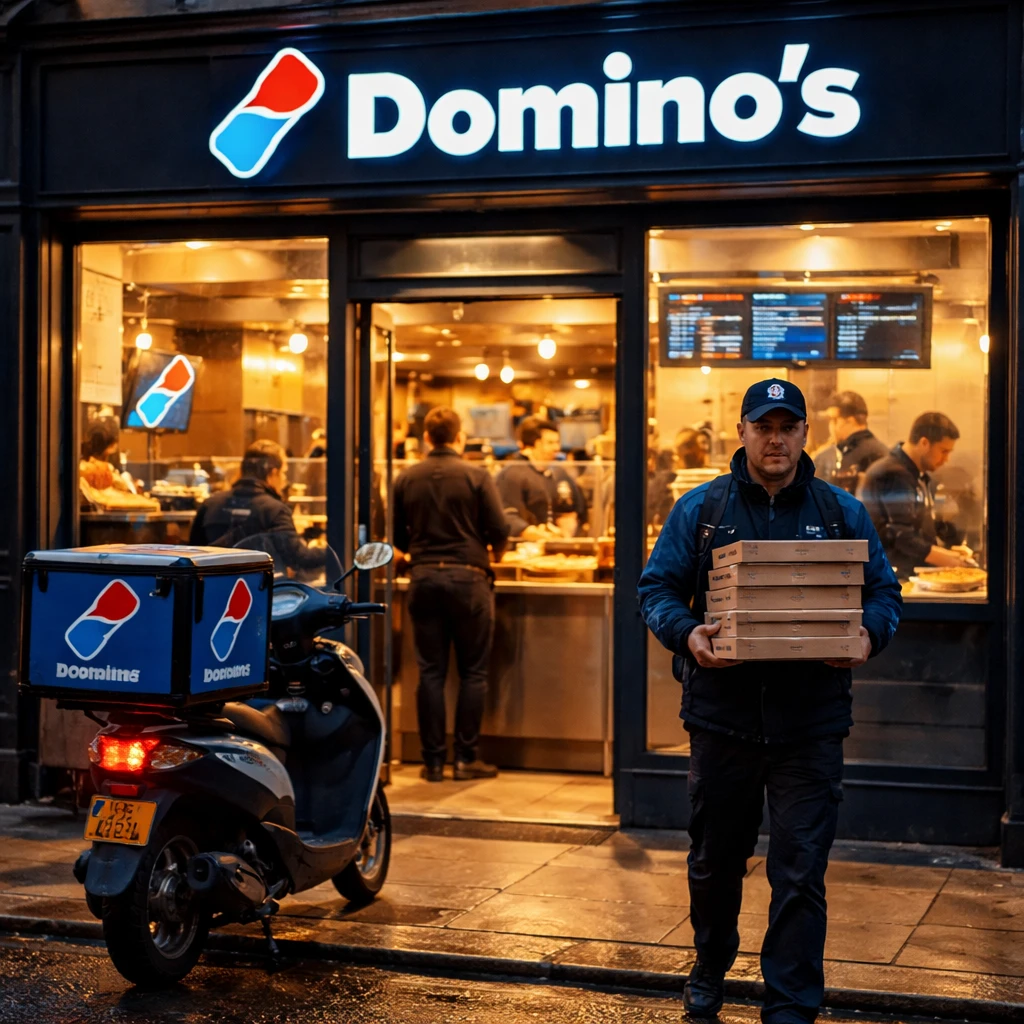
Hook - Thesis
Domino's Pizza Group has re-emerged as a textbook income-and-growth trade: a dominant delivery-first pizza franchise that reported a strong Q1 and now yields 5.65%. For investors who want steady cash flow and a defensive consumer exposure, Domino's combines brand advantage, recurring franchise royalties and a shareholder-friendly payout that is unusually attractive right now.
The trade: buy into Domino's Pizza Group around $28.00 with a clear downside stop at $24.00 and a first target at $36.00. This plan leans into the company’s Q1 momentum and dividend yield while capping risk with a defined stop. The objective is to collect yield and ride multiple expansion as earnings normalize through the year.
What the business does and why the market should care
Domino's Pizza Group is a market leader in quick-service pizza, with a business model that is heavily franchised and driven by delivery and digital ordering. That model generates recurring royalty and supply-chain revenue with limited capital intensity at the corporate level. In a macro environment where reliable cash flows and defensible margins matter, Domino's combines brand pricing power with recurring service demand. The immediate market reason to care is twofold: Q1 showed operational strength, and the current dividend yield of 5.65% materially enhances total-return potential for income-focused portfolios.
How Q1 and the yield drive the case
Management characterized the first quarter as firing on all cylinders, pointing to constructive same-store dynamics, resilient take-home demand, and improving mix from higher-margin delivery orders. That operational outperformance supports both the payout and the valuation upside story: with the stock yielding 5.65%, investors are being paid meaningfully while they wait for continued earnings-normalization and margin recovery.
Support for the argument - what matters from recent data
The two numbers that drive the trade are simple and powerful: a strong-sounding Q1 operational message and a 5.65% yield. Together they create a classic income-with-upside opportunity. The franchise-heavy model means corporate earnings are less volatile than a company that owns all its stores, and the yield provides an immediate return cushion should short-term macro noise pressure the share price.
Valuation framing
Without relying on a specific peer multiple, valuation here is best thought of qualitatively: Domino's trades like an income-generating, defensible consumer brand. A 5.65% yield is well above the average yield on large-cap consumer names and compares favorably to other yield plays in the market. If the company sustains mid-single-digit same-store sales growth and maintains margin discipline, the yield should compress as multiples re-rate toward peers and as capital returns remain credible. Put differently, the share price doesn't need to leapfrog to deliver attractive forward returns—collecting a high yield while operating performance normalizes already makes the expected return attractive.
Catalysts (2-5)
- Continued quarterly beats or upgraded guidance supporting margin recovery and cash generation.
- Improving digital order mix and delivery efficiency that expand franchisee profitability and corporate royalty base.
- Investor attention on high-yield, defensive consumer names as market volatility increases (yield chasing could re-rate the stock).
- Any announcement on buybacks or special dividends that would signal confidence in free cash flow.
Trade plan - entry, targets, stops and horizon
This is a directional long in a high-yield, dividend-growth name. I recommend the following mechanical plan:
| Action | Price | Rationale |
|---|---|---|
| Entry | $28.00 | Near current consolidation; reasonable yield pickup and favorable risk/reward. |
| Stop Loss | $24.00 | Cuts losses if operational weakness or dividend stress emerges. |
| Target 1 | $36.00 | First take-profit on multiple re-rating and continued execution. |
| Target 2 (stretch) | $44.00 | Capture larger re-rating or multiple expansion if management signals stronger long-term guidance or capital returns. |
Time horizon
I view this as a long-term trade: hold for up to 180 trading days (long term - 180 trading days). That timeframe gives the company two to three additional reporting cycles to prove that Q1 momentum is sustainable, allows for dividend payments to compound, and provides time for the market to re-rate the name if fundamentals improve. If you prefer a shorter look, consider a mid-term version of the trade with the same entry and stop but plan to exit at Target 1 within 45 trading days if catalysts materialize quickly.
Position sizing and risk management
Given the yield and the stop level, risk per share is $4.00 on an entry at $28.00. Determine position size so that a full stop-hit represents a comfortable percentage of your portfolio risk tolerance (for example, risking no more than 1-2% of portfolio capital on this single trade). Revisit position sizing if dividend policy changes or if franchisee economics deteriorate.
Risks and counterarguments
- Macro-sensitive consumer spending - While delivery pizza is relatively resilient, a sharp deterioration in consumer discretionary spending could pressure transactions and average check, hurting top-line and royalties.
- Franchisee economics - The model depends on healthy franchisees. If input-cost inflation (labor, ingredients, fuel) squeezes franchise margins, there could be pressure on royalty collection or requests for support that hit corporate cash flow.
- Dividend sustainability - A 5.65% yield is large enough to raise questions about sustainability. Any cut or pause would likely trigger a meaningful rerating lower, so the trade must watch payout coverage closely.
- Competition and pricing pressure - The quick-service space is crowded. Promotional wars or aggressive pricing by competitors could erode margin recovery and same-store sales.
- Operational shocks - Supply-chain disruptions, significant franchisee insolvencies or regulatory actions in key markets could materially impact results.
Counterargument: skeptics will say a 5.65% yield signals distress or that market-share gains are saturated. That is a fair point; high yields can reflect increased risk. However, the counter to that argument is the company’s franchise-heavy model which reduces corporate capital intensity and helps preserve free cash flow even in tougher months. If Q1 momentum continues into subsequent quarters — and management reiterates its commitment to the dividend and cash returns — the yield will likely compress as downside risk falls and multiples expand.
What would change my mind
I would reduce or abandon this thesis if any of the following occur: a) management explicitly states the dividend is under review or must be cut to support operations, b) sustained negative same-store sales across multiple quarters, or c) material dilution via unexpected capital raise or sustained share issuance that suggests capital stress. Conversely, continued quarter-over-quarter improvement in margins, an announced buyback acceleration, or clear evidence of improving franchisee profitability would reinforce the trade.
Conclusion
Domino's Pizza Group presents a pragmatic, income-forward long opportunity right now. The combination of a 5.65% yield and positive Q1 commentary gives investors the ability to earn a high cash return while waiting for fundamentals to catch up. The trade I outlined is explicit: buy around $28.00, stop at $24.00, and look for $36.00 as a first take-profit with a stretch to $44.00. Keep position sizes calibrated to the stop, track franchisee health and dividend coverage closely, and be prepared to act if management signals stress or a change in capital allocation.
Key catalysts to monitor: upcoming quarterly releases, management commentary on dividend/buybacks, same-store sales data, and any signs of franchisee margin stress.