
Hook / Thesis
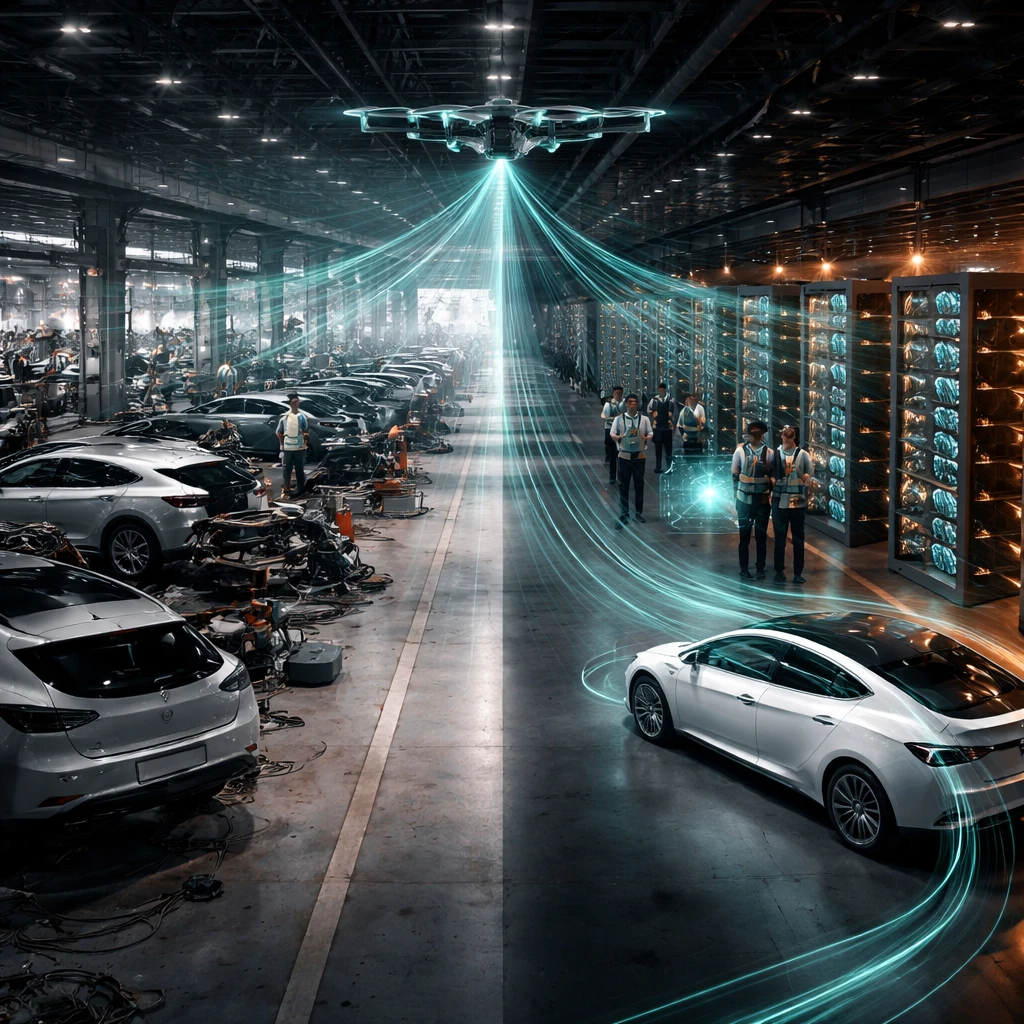
Tesla is no longer merely an automaker; it is deliberately turning its manufacturing muscle into an AI infrastructure and services company. The practical signposts of that transition are factory retooling plans, growing emphasis on Dojo and Full Self-Driving (FSD) stacks, and a strategic willingness to wind down low-margin legacy auto programs in favor of recurring, software-based revenue.
The trade here is simple: buy the re-rating that comes as the market recognizes Tesla's revenue mix shifting from one-time vehicle sales to high-margin, repeatable software and compute revenue. That thesis is risky and binary in some respects, but the upside — if Tesla executes robotaxi commercialization and Dojo monetization — is large relative to durable downside that can be controlled with a clear stop.
What Tesla actually does and why the market should care
Tesla makes cars, sells energy products, and — increasingly — sells software and compute. The legacy auto business generated headline volumes and brand momentum, but it is commoditizing: competitors and regulatory pressures incrementally compress margins on the hardware side. The new strategic play is monetizing intelligence: a fleet-as-a-service robotaxi platform, recurring FSD subscriptions, licensing or selling Dojo compute for AI training, and software updates that improve margins without incremental manufacturing cost.
Why should the market care? Because the market values recurring, high-margin revenue at materially higher multiples than low-margin hardware one-offs. If Tesla can pivot its narrative and revenue mix toward services and AI compute, the company can justify a multiple expansion analogous to enterprise software firms — and that is what this trade attempts to capture.
How to think about the economics
The math here is a qualitative one rooted in margin expansion. Hardware sales scale but have limited margin upside absent price increases. Software and compute can scale with much higher incremental margins once fixed R&D and capex are covered. A successful robotaxi or Dojo commercialization converts vehicles and data into recurring cash flows: subscription fees, per-trip revenue, compute-as-a-service, and licensing. That structural change is the fundamental driver of valuation upside, not temporary cyclical demand for cars.
Valuation framing
Tesla historically traded like a growth company with optionality priced in for autonomous mobility and energy. The correct way to frame valuation now is to treat the company as a hybrid: a declining hardware margin business on one axis and a nascent AI platform with optional upside on the other. That dichotomy explains wide price swings — the market is trying to arbitrage execution risk versus option value.
For traders, the relevant question is whether near-term share price action is reflecting a permanent loss of option value or an opportunity to buy ahead of monetization catalysts. This trade assumes the market has priced in much of the downside and underestimates speed of transition to software/AI recurring revenue. We size the position knowing execution risk remains high but reward asymmetry is attractive if core AI milestones are met.
Trade plan (actionable)
Trade direction: Long.
Entry price: $180.00.
Primary target: $270.00. Secondary target (stretch): $340.00.
Stop loss: $150.00.
Positioning and horizon:
- Short term (10 trading days) - Use this window to reduce exposure if the stock gaps materially below the stop or if a clear negative catalyst appears (regulatory setback, major hardware recall). Expect volatile intraday swings tied to headlines.
- Mid term (45 trading days) - Watch for early revenue signals like pilot robotaxi usage metrics, new FSD subscription rollouts, or publicized Dojo commercial engagements. Reassess position sizing here; consider taking partial profits into the first target.
- Long term (180 trading days) - This is the primary holding period for the thesis. Over 180 trading days the market should start to price in recurring software/compute revenue as pilots scale, factories are retooled, and argox-level margins start to shift.
Catalysts that validate the trade
- Public launch or credible pilot metrics for robotaxi service demonstrating paying trips and clear per-trip economics.
- Commercialization or external sales of Dojo compute capacity or licensing partnerships with large AI buyers.
- Noticeable reallocation of capex from high-volume legacy auto lines to AI compute, robotics, or retrofit programs.
- FSD subscription growth or an announced pricing model that produces predictable recurring revenue.
Risks and counterarguments
This is not a low-risk trade. Consider these potential failure modes and counterarguments:
- Regulatory and legal risk - Autonomous mobility is tightly regulated. A single high-profile incident or adverse regulation can halt robotaxi commercialization and wipe out expected recurring revenue.
- Execution risk - Delivering safe, reliable autonomous driving and scaling Dojo commercialization are hard engineering problems. Delays, inflated costs, or underwhelming performance could push expected revenue years out.
- Competition and pricing pressure - Big cloud players and legacy automakers are heavily investing into autonomous and AI compute markets. Price competition could compress margins on Dojo-like services.
- Demand-side risk for vehicles - If Tesla decommissions some legacy vehicle SKUs before fully ramping services, revenue gaps could appear that the AI business does not immediately fill.
- Counterargument: The pivot is too speculative - Tesla may simply be an innovator with impressive prototypes but limited commercial moat in AI services. Execution could be slower and more capital intensive than the market expects, meaning the hardware cash cow remains the key value driver for much longer.
What would change my mind
I would reduce or exit this long if Tesla publicly defers or abandons material robotaxi commercialization, if Dojo engagements do not materialize into paid contracts within the next 6-9 months, or if Tesla re-announces a major increase in manufacturing capacity focused on low-margin models without a parallel software monetization roadmap. Conversely, stronger-than-expected subscription pickup, confirmed pilot economics for robotaxi trips, or announced third-party Dojo customers would make me add to the position.
Execution notes and sizing
Size the trade knowing volatility will be elevated. Use the stop at $150.00 strictly to protect capital - tight stops protect against binary outcomes tied to regulatory shocks. Consider pyramiding into strength: take partial profits at $270.00 and add only if the company reports measurable recurring revenue growth or blemish-free pilot runs.
Bottom line
Tesla's most important strategic shift is subtle: it is actively turning scarcity of high-quality vehicle data and its internal AI stack into a product rather than a byproduct. The trade is an explicit bet that the market will pay for predictable, recurring revenue from AI services at materially higher multiples than legacy auto profits. That re-rating is not guaranteed, and the path is noisy. But with a disciplined entry at $180.00, a protective stop at $150.00, and clear catalysts to watch, the risk/reward is compelling for a long-term (180 trading days) holder who believes in the economics of AI-driven recurring revenue.