
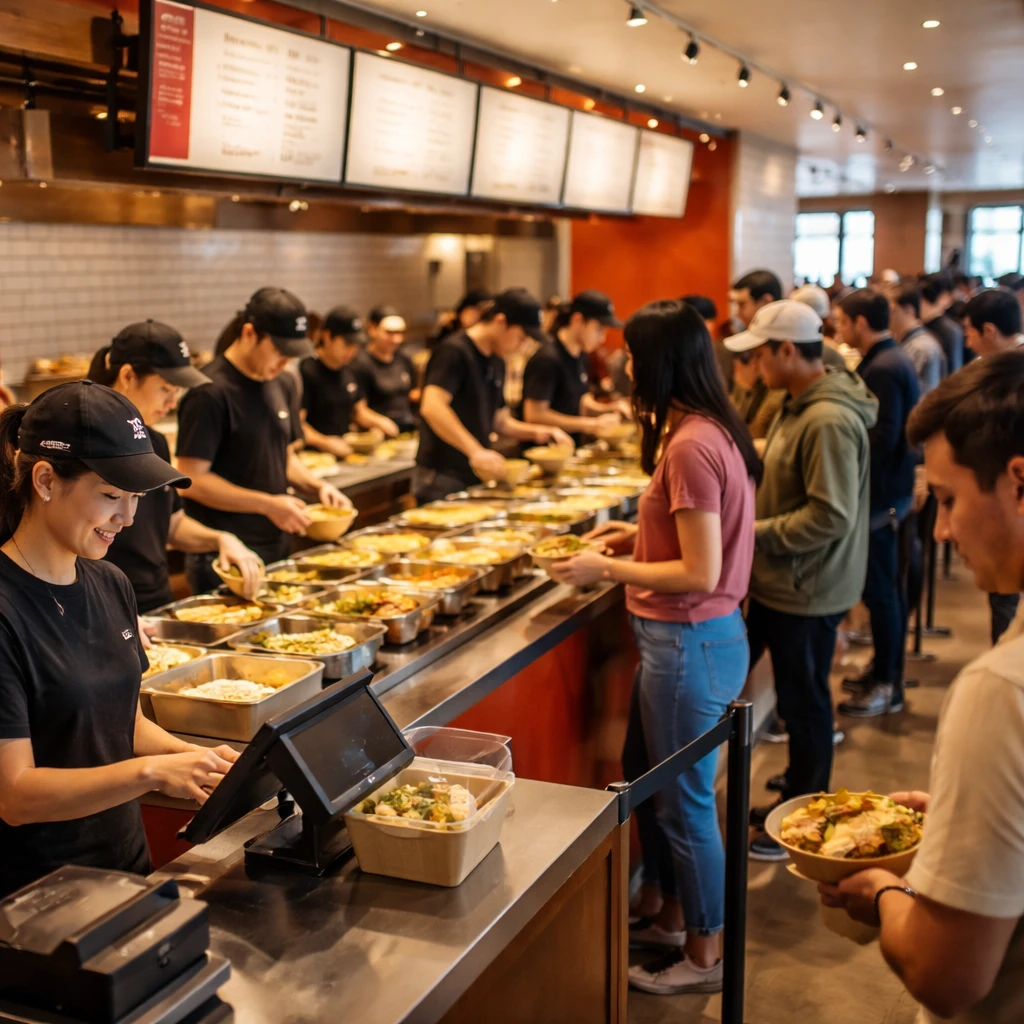
Hook & thesis
Chipotle is entering Q1 2026 results week with an obvious focal point: transactions. Management and the market have to square two facts — a still‑healthy unit expansion plan (350-370 new restaurants in 2026) and a consumer backdrop that pressured comps in 2025 (same‑store sales down ~1.7%). If transactions show clear recovery, revenue and margin leverage follow quickly; if they don't, the stock is likely to remain rangebound or slide toward last year's lows.
My trade idea: take a mid‑term long position that assumes the company delivers sequential improvement in daily transaction trends and gives constructive commentary on traffic, digital mix, and menu cadence. Entry, stop, and a $45 target are sized to reflect an event-driven swing that should resolve within roughly 45 trading days.
What Chipotle does and why transactions matter
Chipotle develops and operates fast‑casual restaurants serving burritos, bowls, tacos, and salads. The business is driven by two levers: average check (ticket) and transactions (guest counts). Over multi‑year cycles, unit growth compounds the top line, but in the near term transactions determine whether new stores and menu moves actually translate into revenue and margin upside. For a sizable, cash‑generative chain with a market cap near $47 billion and free cash flow north of $1.44 billion, a swing in transaction growth can quickly change investor sentiment.
Key fundamentals and valuation framing
| Metric | Value |
|---|---|
| Current price | $34.20 |
| Market cap | $46.97B |
| EPS (TTM) | $1.18 |
| P/E | ~29 |
| Price / Sales | 3.7 |
| Free cash flow | $1.447B |
| EV / EBITDA | ~19 |
Valuation has compressed from peak levels. Consensus and commentary point out that P/E is roughly 29 today versus a five‑year median that was meaningfully higher; some sell‑side notes in March pushed targets into the $50s as a recovery scenario. That said, the multiple is still a premium to many restaurant peers because of Chipotle's operating margins, return on equity (north of 50%), and predictable cash flow profile.
Support for the transaction‑recovery thesis
- Menu and traffic signals: The reintroduction of Chicken al Pastor (reported 03/24/2026) is already cited by management and some buy‑side notes as bringing incremental foot traffic — a concrete, restaurant‑level transaction catalyst.
- Institutional conviction: Recent disclosures show large funds building positions, and several analysts upgraded coverage after seeing early traffic improvement and stabilization initiatives.
- Operational runway: Management has guided to aggressive unit openings (350-370 restaurants in 2026). If transactions per store resume growth, unit economics and revenue leverage will be powerful.
- Technicals: Momentum indicators are not overheated (RSI ~48) and MACD shows a small bullish bias — conditions amenable to a trend reversal if the prints are positive.
Catalysts (near term)
- Q1 2026 results and management commentary (transactions, digital mix, weather/disruption commentary).
- Same‑store transaction trend updates and any revisions to unit guidance or margin outlook.
- Follow‑through from menu promotions (Chicken al Pastor) and analyst revisions after Q1 results.
- Macro signals on discretionary spending and gasoline prices that affect restaurant traffic.
Trade plan (actionable)
Trade direction: Long
Entry price: $34.20
Stop loss: $31.50
Target: $45.00
Horizon: mid term (45 trading days). This trade is built to capture an earnings‑driven re‑rating following the Q1 print and management commentary. If transactions accelerate materially and guidance stabilizes or improves, expect the trade to resolve toward the target within this window. If momentum stalls but the company still serially improves comps, consider converting to a longer holding period with a tighter position size.
Rationale for sizing and levels: entry sits near the recent trading range and today's price. Stop at $31.50 protects against a deeper break toward the 52‑week low ($29.75) while leaving room for day‑to‑day noise. The $45 target implies a re‑rating toward mid‑cycle multiples given accelerating transactions and renewed margin leverage — still well below the old highs near $58, but a realistic recovery if the company demonstrates durable traffic growth and guidance improvement.
Why the market should care — the cash and growth equation
Chipotle produces meaningful free cash flow ($1.447B) and has historically earned high returns on capital. The combination of continued unit growth and a recovering transactions trend would convert that cash flow into incremental shareholder value quickly. The current market cap near $47B already prices in a fair amount of long‑run store growth, but it discounts some near‑term traffic weakness; that gap is the trade's payoff.
Risks and counterarguments
- Macro / consumer risk: A renewed slowdown in discretionary spending or higher gasoline prices could suppress visits, negating the transaction recovery thesis.
- Menu execution and sustainability: A single promotional reintroduction (e.g., Chicken al Pastor) could produce a temporary traffic bump without sustainable lift to transactions.
- Margin pressure from costs: Labor and commodity inflation can erode the margin uplift from any transaction recovery, keeping EPS growth muted even if comps improve.
- Unit growth trade‑off: Aggressive new openings (350-370 in 2026) could temporarily depress comps if cannibalization or supply constraints emerge.
- Valuation complacency: The market could already be pricing in a transaction rebound — in that scenario, positive results produce only a muted move while any disappointment is punished sharply.
Counterargument: It is reasonable to argue the recovery is already priced in — several sell‑side upgrades in March and institutional buys in recent filings indicate optimism. Given the compressed P/E and analyst targets that stretch into the $50s, the path to $45 may be narrower than it appears if investors demand proof of sustained transactions improvement rather than one‑quarter beats.
What will change my mind
- I will become more bullish if the company reports clear sequential improvement in transactions, raises or narrows guidance with constructive commentary on digital and loyalty trends, and shows margin recovery consistent with stronger throughput in restaurants.
- I will turn cautious or bearish if the quarter shows continued negative or flat transactions, margin guidance slips, or if unit openings are shown to be dilutive to comps without compensating ticket growth.
Conclusion
This trade is an event‑driven, mid‑term long that bets on a measurable recovery in guest counts. The company still carries high returns, strong cash flow, and a sensible long‑run growth plan; the near‑term question is whether transactions come back fast enough to re‑rate the stock. Entry at $34.20 with a $31.50 stop and $45 target gives a risk profile that is attractive if you believe management can translate menu momentum and digital initiatives into sustained traffic. If Q1 confirms that trajectory, the market is likely to reward Chipotle; if it doesn't, the stop protects capital while leaving room to reassess on any subsequent guidance changes.
Quick checklist before entering
- Confirm pre‑announcement or morning trade reaction to Q1 print — avoid legging in on materially higher prices.
- Watch management language on transactions, comps, and unit economics.
- Monitor macro datapoints (consumer confidence, gasoline) that could swing discretionary visits.