
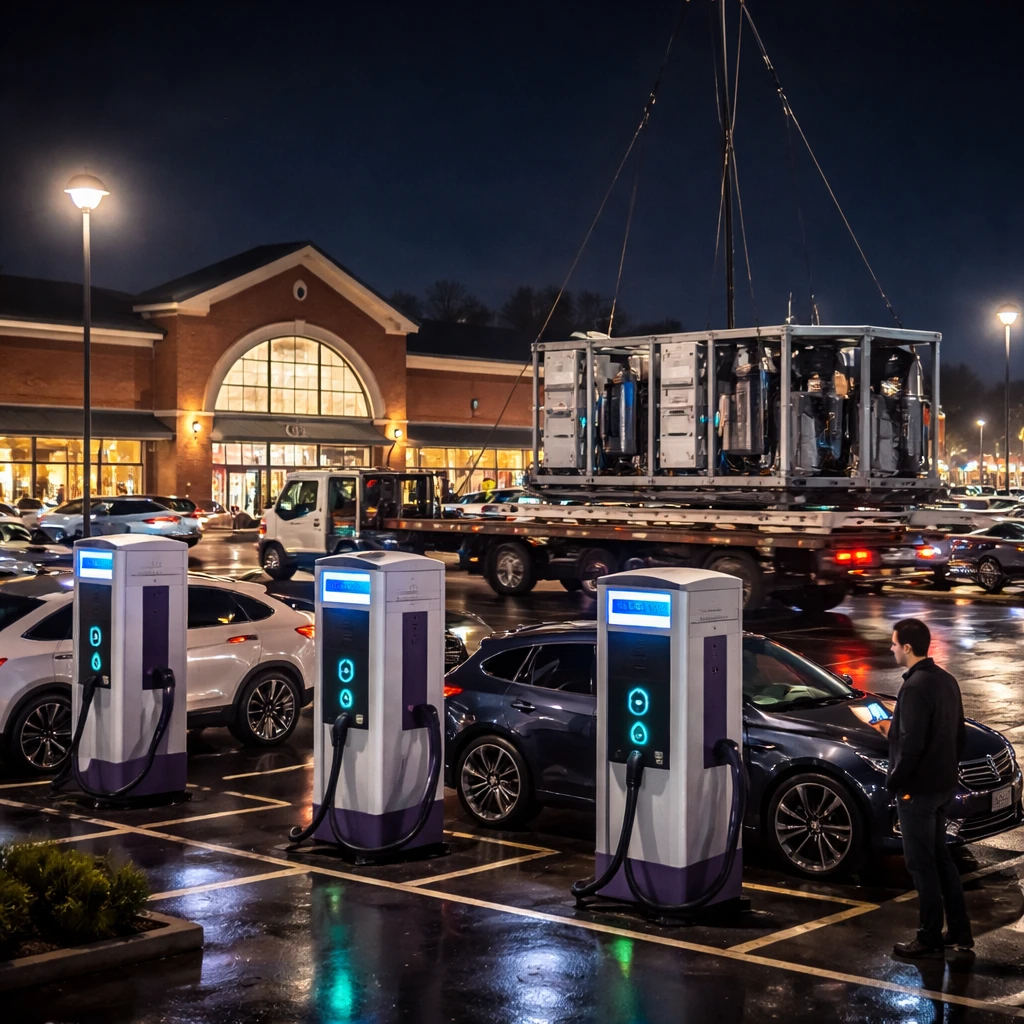
Hook & thesis
EVgo is an ugly-but-interesting infrastructure growth story: the company is demonstrably expanding its public DC fast-charging footprint, building product features that stick (Autocharge+ has topped 5 million sessions), and signing merchant partnerships that create embedded site economics (notably a Kroger agreement to build 150+ stalls a year). Yet the financials are blunt: negative free cash flow of $124.4 million and negative EPS. My working thesis is that EVgo likely will not be cash-flow positive until around 2031, but the business is building durable network assets and commercial relationships that justify a patient, long-biased trade at current prices.
In plain terms: if you believe public fast charging will be a multi-trillion-dollar market over decades and that a national network with high uptime and convenient locations captures real pricing power, EVgo looks cheap-ish relative to that optionality. If you instead believe capex and low utilization keep losses high for years, the equity could halve. This idea treats the stock as a high-conviction, long-term growth bet with a specific entry, stop and target to manage downside.
The business and why it matters
EVgo operates a national DC fast-charging network and sells ancillary services (home/work charging solutions, subscription plans). The company has shifted from pure build-out to a more integrated commercial model: merchant-host partnerships, Autocharge+ (streamlined customer authentication and payments), and a push to support the NACS connector standard for broader vehicle compatibility.
Why the market should care: fast charging is the bottleneck for long-distance EV adoption and for drivers without reliable home charging. Companies that deploy and operate reliable, high-utilization fast chargers at convenient retail locations can capture recurring revenue from charging sessions, partnerships and software services. EVgo is executing in three areas that matter:
- Network expansion at scale - EVgo is accelerating NACS deployment with nearly 100 NACS stalls live and a plan to exceed 500 by year-end (news item dated 02/20/2026).
- Retail partnerships - a Kroger Family of Stores partnership commits at least 150 fast charging stalls annually through 2035 (02/20/2026), anchoring site economics with foot traffic and leased locations.
- Operational efficiency - prefabricated charging skids reduced installation time and cost, with >40% of 2025 deployments using modular skids (12/16/2025).
What the numbers say
At the current price of $2.18, the headline market reflects deep skepticism but not total dismissal of the business. Relevant metrics:
| Metric | Value |
|---|---|
| Current price | $2.18 |
| 52-week range | $1.64 - $5.18 |
| Market cap (approx.) | $700M |
| Enterprise value | $411M |
| Price / Sales | 0.78 |
| EV / Sales | 1.07 |
| Free cash flow (TTM) | -$124.4M |
| Cash per share | $1.12 |
| EPS (TTM) | -$0.29 |
Two observations: first, EVgo still burns meaningful cash and reported negative free cash flow of $124.4 million in the most recent period. Second, balance-sheet cash per share of roughly $1.12 gives a partial cushion to the equity at current prices (cash composes a material portion of the $2+ stock price). Price-to-sales of ~0.8 and EV/sales of ~1.07 show the market prices the company closer to early-revenue multiples than a mature utility.
Valuation framing
EVgo is not a traditional multiple story you can back into a quick fair value. The equity is priced for a slow ramp to utilization: investors are implicitly valuing the network by discounted optionality rather than current profits. With current EV penetration still low relative to long-term projections, a reasonable bull-case path is multiple years of network growth with improving utilization and installation cost declines via prefabricated skids and host partnerships. That path would take many quarters of positive operating leverage to reach cash-flow breakeven.
Relative to peers in public charging (not provided here), EVgo trades like a growth operator with capital intensity - cheaper than some hardware-heavy peers on a price-to-sales basis but pricier than a pure services play. The key valuation lever is utilization: small increases in average monthly kWh sold per stall materially improve margin profiles because much of the cost is fixed once a site is live.
Catalysts to re-rate the stock
- Execution on Kroger rollouts - rapid activation of 150+ stalls per year at grocery locations would materially increase throughput and merchant economics (02/20/2026 news).
- Falling installation costs - wider use of prefabricated modular skids (over 40% of 2025 deployments) and improved permitting could compress build costs and shorten payback.
- Autocharge+ adoption - scaling sessions beyond 5 million (12/03/2025 item) and higher subscriptions increase recurring revenue and customer stickiness.
- Meaningful utilization improvement - sustained rise in charging sessions per stall drives operating leverage and narrows the path to positive free cash flow.
- Favorable regulatory or OEM partnerships - accelerated NACS adoption and OEM routing to public networks would boost session volumes (02/20/2026 note on NACS).
Trade plan - actionable and pragmatic
This is a directional long trade with the expectation that network effects and execution will improve financials over a multi-quarter horizon. Specific plan:
- Entry price: 2.10
- Target price: 4.50
- Stop loss: 1.64
- Horizon: long term (180 trading days) - allow time for deployments to show throughput improvement, at least one quarterly report to show operating trends, and continued build momentum from merchant partnerships.
Why these levels? Entry at $2.10 sits just below the current price and offers a reasonable cushion to the recent trading range. The stop loss at $1.64 is the 52-week low and represents a clear technical and fundamental line - breach suggests either capital runout or a structural demand problem. The $4.50 target reflects roughly 100%+ upside that would be consistent with improving utilization and a partial re-rating nearer to mid-growth multiples if EVgo begins to demonstrate positive operating leverage.
Position sizing: treat this as a higher-risk allocation - consider 1-3% of portfolio capital given execution and macro risks. Re-evaluate after quarterly results or any material partnership progress or setback.
Risks and counterarguments
- Capital intensity and prolonged negative cash flow - Free cash flow remains negative (-$124.4M). If capex and maintenance costs persist at current levels, EVgo may require equity raises that dilute holders and compress returns.
- Utilization may lag - faster rollouts don’t guarantee proportional revenue per stall. Underutilized sites turn growth into a money-losing engine.
- Competition and pricing pressure - incumbents (OEM networks, oil majors, and other charging operators) could push pricing or exclusive access, limiting EVgo’s pricing power.
- Execution risk on partnerships - the Kroger cadence is multi-year; slow installations, permitting issues or site economics that miss could delay cash flow improvements.
- Market / macro risk - lower EV adoption due to incentives, price movements or macro weakness would directly reduce throughput growth assumptions.
- Funding risk - if cash burn continues and capital markets tighten, EVgo could be forced to raise capital on unfavorable terms.
Counterargument (why the bears have a point): public fast charging is an infrastructure-heavy, low-margin business until utilization and uptime optimize. EVgo's losses and negative FCF mean that even strong growth in stall count can produce little short-term profitability. A slow-growth or capital-starved scenario could drive the stock well below the current price.
What would change my mind
I will downgrade the trade if any of the following occur:
- Material slowdown or cancellations in the Kroger rollout cadence or other merchant-host agreements.
- Quarterly results show flat-to-declining throughput per stall despite network additions, implying poor utilization.
- Cash burn accelerates materially without commensurate installation efficiencies or new committed capital, raising the likelihood of dilutive financings.
Conversely, I would add conviction if EVgo demonstrates sustained sequential improvement in charging revenue per stall, posts narrower losses or reduced FCF burn, or announces additional long-term host partnerships that move the revenue needle.
Conclusion
EVgo is a classic high-upside, high-risk infrastructure growth trade. It is likely not cash-flow positive until around 2031 under current trends, but the company is executing on multiple fronts that could materially shorten that timeline: faster modular installations, Autocharge+ adoption, and sticky retailer partnerships. At an entry of $2.10 with a hard stop at $1.64 and a target of $4.50 over 180 trading days, this trade offers an asymmetric bet: limited downside (given cash per share and a low absolute price) and meaningful upside if the company proves operating leverage and utilization can improve.
This is not a trade for yield-seeking or short-horizon traders. It is for investors who accept elevated execution risk in exchange for the chance to own a national EV charging operator at a price that assumes many years of heavy capex and slow monetization. If EVgo nails execution and leverage, the current price will look cheap. If it doesn’t, the stop protects capital and forces discipline.