
Hook and thesis
Carnival Corporation's core business is cruising, and right now that business is performing. Management reported record Q1 2026 revenue of $6.2 billion alongside a roughly 50% jump in adjusted EPS, and its PROPEL plan calls for more than 50% earnings growth through fiscal 2029 with $14 billion of shareholder returns. The market has priced in a fair bit of risk: CCL trades at roughly $27 with a market cap near $37.1 billion and a P/E around 12, a discount to the broad market and to many travel peers.
That disconnect creates a pragmatic trade setup. We are initiating a buy on Carnival with a clear entry, stop and target. The upside case rests on continued demand for cruises, leverage to improving yields and unit economics, and an appealing valuation supported by strong free cash flow generation.
What Carnival does and why the market should care
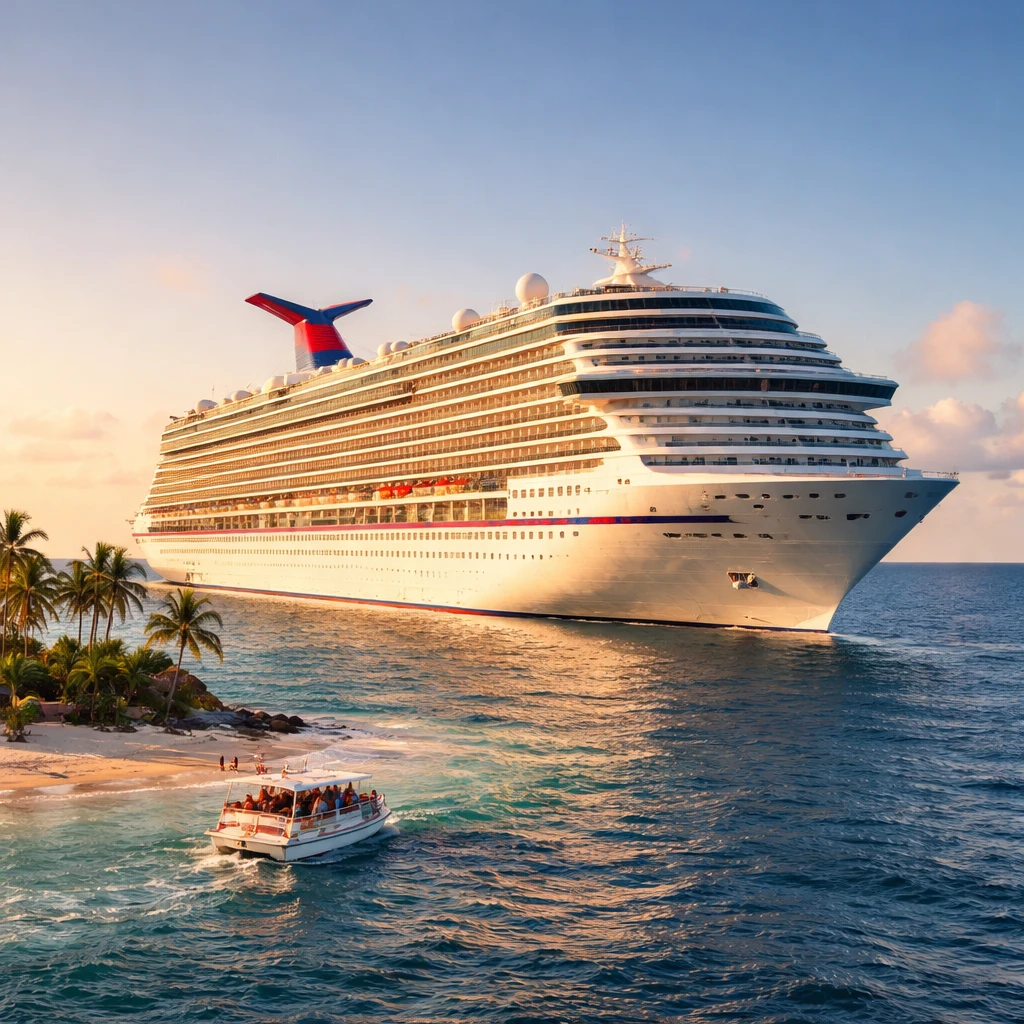
Carnival operates one of the world's largest cruise fleets under multiple brands across North America and Europe, plus support businesses that include ports and private islands. The company’s scale gives it pricing flexibility and a broad product set from mass-market to premium-lite brands.
Why investors should care: cruising is a discretionary, experience-driven category where pricing and occupancy trends matter directly to margins and cash flow. After pandemic-related normalization, demand recovery has translated into record revenue and margin expansion for the major cruise operators. For Carnival, record top-line prints and a renewed focus on returning capital to shareholders via PROPEL are the immediate fundamental drivers investors should focus on.
Key fundamentals that support the buy thesis
| Metric | Value |
|---|---|
| Current Price | $26.77 |
| Market Cap | $37.08B |
| Enterprise Value | $60.95B |
| P/E (TTM) | ~12 |
| EV/EBITDA | ~9.1 |
| Free Cash Flow | $2.99B |
| Debt / Equity | ~1.94 |
| 52-Week Range | $17.33 - $34.03 |
Two numbers stand out: free cash flow near $3.0 billion and a P/E of roughly 12. Free cash flow gives Carnival optionality to reduce leverage, accelerate buybacks under the PROPEL program, or invest in yield-accretive capacity. A mid-single-digit EV/EBITDA multiple compression story would require either materially weaker yields or higher structural costs; neither is our base case today.
How the market is pricing risk
Carnival's valuation shows wariness: a P/E near 12 and price-to-sales roughly 1.37 imply the market is not fully pricing multi-year earnings growth. Short interest and short volume data show persistent, but not extreme, bearish positioning - days-to-cover sits around 1.68 on recent settlements and short volume has been meaningful on high-volume days. Technically, the stock is near its 10/20/50-day moving averages with RSI around 48 and a slightly negative MACD histogram, suggesting the market is in a consolidation phase rather than an outright breakdown.
Valuation framing
At a market cap of about $37.1 billion and enterprise value close to $61.0 billion, Carnival trades at an EV/EBITDA near 9.1 and a P/E around 12. Those multiples are modest for a company with near-term positive free cash flow and a visible demand recovery. Management’s PROPEL guidance (greater than 50% EPS growth through 2029 and $14 billion in shareholder returns) creates an expectation of improving returns on capital. Compared to the S&P 500 (P/E ≈ 25.4 in recent commentary) Carnival is materially cheaper, although cyclicality and leverage justify some discount.
Put simply: if Carnival executes on yield, keeps occupancy healthy, and sustains FCF, the market should be willing to pay up from current levels. If those conditions hold, yesterday's $34 52-week high is a realistic first target for a recovery trade.
Catalysts to watch (2-5)
- Quarterly results and guidance that continue to show revenue growth and margin expansion - management already reported record Q1 revenue of $6.2 billion and meaningful EPS growth.
- Lower fuel costs or constructive fuel hedging updates - significant declines in crude would give an immediate boost to margins.
- PROPEL execution - visible capital returns or acceleration of buybacks would rerate the stock.
- Positive booking trends for peak summer and holiday itineraries, particularly in North America and Europe.
- Macro tailwinds such as lower recession risk or easing geopolitical tensions that reduce travel hesitancy.
Trade plan - actionable entry, stop, target and horizon
Entry: Buy at $27.00.
Stop loss: $24.50.
Target: $34.00.
Trade direction: Long.
Horizon: Long term (180 trading days) - we expect the trade to play out over the next several quarters as seasonal booking momentum, potential share repurchases, and margin tailwinds compound into higher earnings and multiple expansion.
Rationale for levels: entry near $27 captures the current consolidation band around the stock's shorter-term moving averages. The stop at $24.50 limits downside if yields deteriorate or if bookings materially soften. The $34 target is grounded in the stock's 52-week high and reflects a multiple re-rating toward mid-teens P/E assuming execution and improving margins.
Position sizing and risk management
This is a medium-risk, value-oriented trade. Use position sizing consistent with a risk tolerance that accepts potential volatility from fuel prices and macro swings. Consider scaling in on weakness toward $25 and trimming into strength above $30. Trailing stops can be used once the trade moves in your favor to protect gains.
Risks and counterarguments
- Fuel cost volatility: Rising crude materially increases operating costs. Carnival has less fuel hedging than some peers, and sustained $90+ crude could compress margins and lower EPS.
- Leverage and balance sheet risk: Debt-to-equity around 1.94 and an enterprise value near $61 billion mean Carnival is sensitive to rising rates or prolonged revenue weakness. Higher leverage limits flexibility for buybacks if cash flow deteriorates.
- Macro and demand shock: Cruises are discretionary. Recessionary pressures, weaker consumer spending, or travel restrictions could hit bookings and yields faster than management's plan assumes.
- Geopolitical disruptions: Events that affect travel corridors (for example, disruptions to maritime routes or cruise itineraries) can quickly erode yields and force itinerary changes that weigh on revenue.
- Analyst downgrades and margin pressure: Several institutions have flagged higher fuel as a near-term headwind. If analysts materially cut 2026/2027 estimates, multiple contraction could outpace earnings recovery.
Counterargument to our thesis: The main counterargument is that higher fuel and weakening yields create a one-two punch: operating costs rise while pricing power softens, resulting in lower-than-expected EPS. If fuel remains elevated and Carnival cannot reprice itineraries or contain costs, the stock could trade below our stop. We price that risk into the stop and the 180-day horizon; the trade requires visible signs of continued demand and cost control to remain valid.
Conclusion - what would change my mind
My base case is that Carnival's core cruise demand will remain resilient, enabling earnings growth and multiple expansion. The initiation at $27 is a calculated value trade: attractive free cash flow, a modest P/E, and a realistic path to $34 if PROPEL execution stays on track.
What would change my view negatively: a sustained jump in fuel above $90/bbl with no hedges, clear deterioration in booking curves for peak seasons, or management materially pulling back on capital return plans. Conversely, what would strengthen the bull case is an accelerated buyback program, positive surprise on net yields, or meaningful debt paydown that materially reduces the company's leverage profile.
Trade summary: Initiate long CCL at $27.00 with a stop at $24.50 and a target at $34.00. Horizon: long term (180 trading days). Risk level: medium. This is a fundamentally supported, actionable trade that bets on durable consumer demand for cruising and a re-rating from current, conservative multiples.
Key tactical watch items: next quarterly results, booking cadence for the summer season, and any updates to fuel hedging or capital return programs.