
Terra Innovatum is broadening how it presents its SOLO microreactor, shifting from a single-unit 1 megawatt-electric (MWe) offering to a modular power architecture intended for larger commercial users. The company has introduced two linked concepts - SOLO Nodes and SOLO Load Coverage - aimed at aligning the microreactor design with how large electricity consumers expand and manage loads.
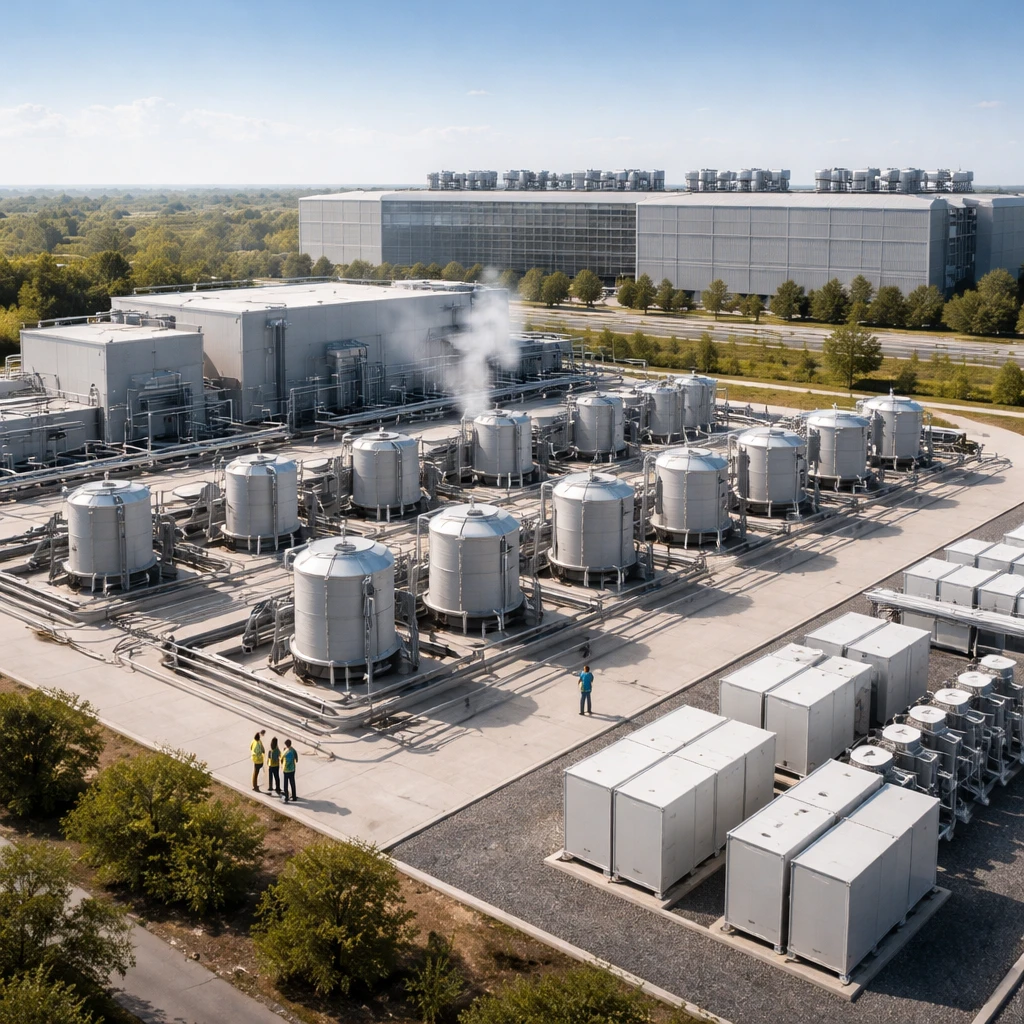
The SOLO Node concept groups multiple reactor cores so they can share power conversion and balance-of-plant systems instead of replicating those plant systems for every reactor. That architecture, the company says, enables standardized reactor cores while allowing overall power installations to scale to meet larger behind-the-meter needs.
Terra describes deployment pathways that begin with a single 1 MWe SOLO unit and scale upward to combinations delivering 25 MWe, 50 MWe and 100 MWe. The approach preserves a common reactor module while changing how peripheral equipment is organized to serve higher aggregate output.
Complementing the node architecture is a SOLO Load Coverage concept that targets real operating conditions at data centers. Rather than relying on variable-output generation, the model pairs the steady output of the reactors with a relatively small storage layer to absorb rapid swings in load. In the company’s illustrative example, a 97 MWe data-center demand is matched by a 97 MWe SOLO fleet, with capacitors and battery storage sized at about 100 kilowatt-hours per MWe to smooth high-frequency demand fluctuations.
"SOLO is not just a reactor; it is a modular power architecture. The node concept lets us scale for industrial and data-center customers without giving up standardization, while the load-coverage model is designed around how those customers actually consume power," the company’s co-founder and CEO Alessandro Petruzzi said.
The move recasts the SOLO microreactor as a building block inside a larger, integrated power system for customers that require continuous, dense, and reliable on-site electricity. By emphasizing shared balance-of-plant systems and a storage layer tuned to high-frequency demand swings, Terra aims to address both the physical and operational scaling questions large consumers face.
The announcement arrives against a backdrop of heightened investor interest in nuclear technologies. The article referenced a December IAEA commentary noting that, when it comes to AI, "Nuclear is the only energy source that can 'meet combined demands of low-carbon generation, 24/7 reliability, massive power density, grid stability and genuine scalability.'"
The company’s dual-concept framing - nodes plus load coverage - is presented as a response to how industrial and data-center customers expand capacity and manage moment-to-moment electricity needs. The material provided by Terra details the shared-systems approach, specific scaling milestones and an example storage sizing, but does not provide additional operational performance data or deployment timelines in the material reviewed.
Summary
Terra Innovatum is repositioning its SOLO microreactor from a single 1 MWe unit to a modular power system for larger customers. SOLO Nodes let multiple reactor cores share plant systems, enabling standardized reactors to scale to 25 MWe, 50 MWe and 100 MWe configurations. SOLO Load Coverage pairs steady reactor output with modest storage - roughly 100 kWh per MWe in a cited example - to smooth rapid load swings typical at data centers. CEO Alessandro Petruzzi characterized the approach as central to the company’s industrial strategy. The announcement coincides with rising investor interest in nuclear power and an IAEA remark on nuclear’s fit for AI-era demands.
Key points
- Terra introduced SOLO Nodes to allow multiple reactor cores to share power conversion and balance-of-plant systems, maintaining reactor standardization while scaling aggregate capacity.
- Deployment pathways cited range from a single 1 MWe unit up to aggregate configurations of 25 MWe, 50 MWe and 100 MWe aimed at behind-the-meter industrial and data-center customers.
- The SOLO Load Coverage model pairs steady reactor output with a small storage layer - an example uses about 100 kilowatt-hours per MWe - to handle rapid load swings seen in data centers.
Risks and uncertainties
- Uncertainty about how shared power-conversion and balance-of-plant systems will perform operationally at larger aggregated scales, since the material describes the architecture but does not provide operational results.
- Storage sizing in the example is presented as roughly 100 kWh per MWe; it is unclear from the provided information whether that level of storage will match the range of load profiles across different data-center or industrial customers.
- The company’s descriptions outline concepts and deployment pathways but do not include specific deployment timetables or performance data in the reviewed material, leaving timing and operational outcomes uncertain.