
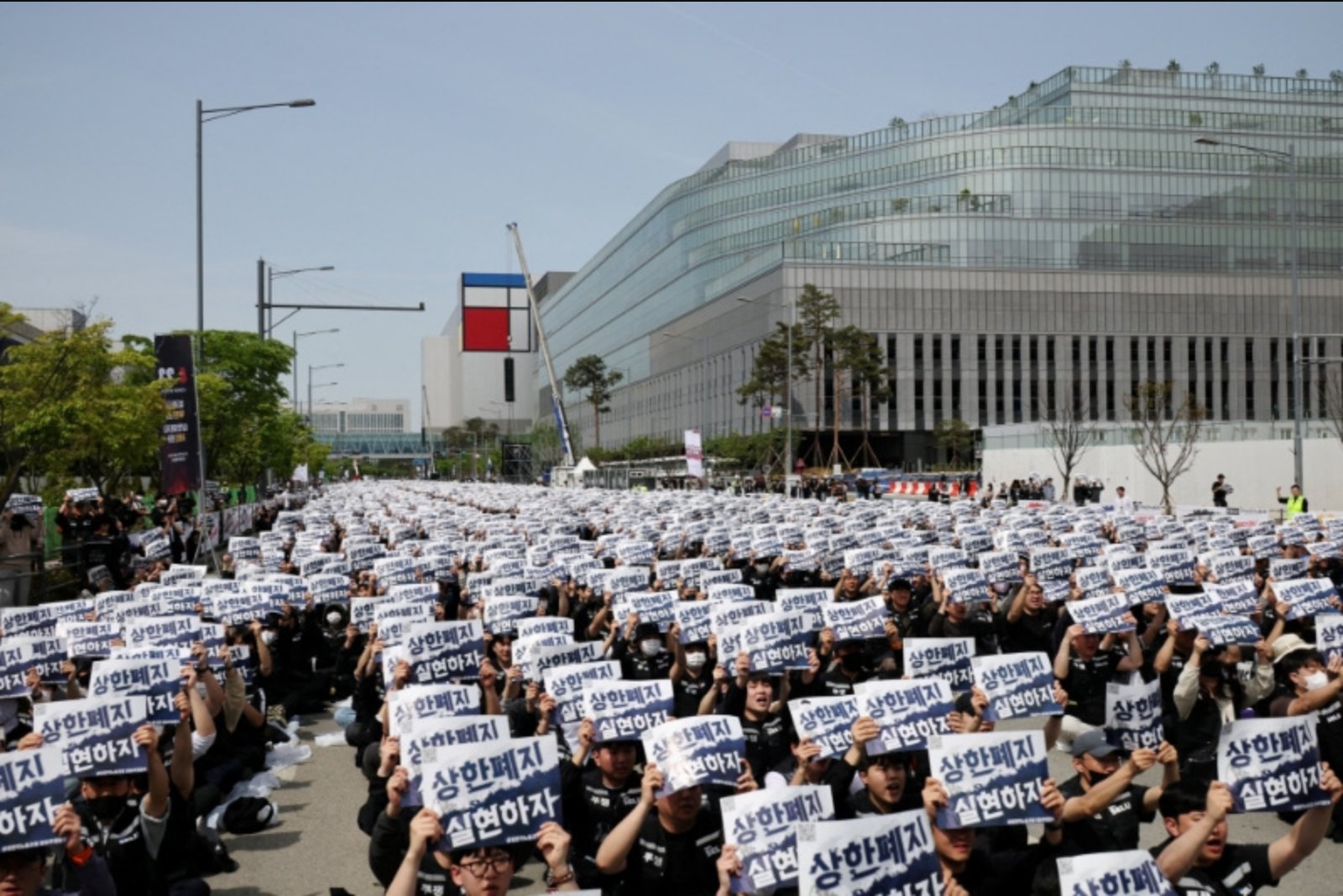
More than 45,000 Samsung employees have signalled their intention to strike for 18 days, starting May 21, in what would be the largest industrial action in the conglomerate’s history. The standoff, driven by disagreement over bonus distribution tied to surging profits from the global AI-led memory shortage, has unsettled government officials, unnerved foreign investors and raised alarms about potential disruptions to global tech supply chains.
The core contention is simple yet consequential: how should the gains from the AI boom be shared across Samsung’s Device Solutions Division, where profit outcomes have diverged sharply? Samsung has proposed robust bonus awards to its memory-chip workforce but has also drawn a clear line in proposing much smaller payouts for employees in the company’s logic-chip design and foundry businesses.
Under the company’s latest proposal, roughly 27,000 staff tied to memory-chip production would receive bonuses that are many times larger than those proposed for the roughly 23,000 employees in logic and foundry roles. Transcripts of internal wage negotiations show management suggested that memory workers be paid around 607% of their annual salary in bonuses, while many employees working on logic chips - including base die and foundry tasks that are essential to AI accelerator production - would be set to receive bonuses in the 50% to 100% range.
Union leaders and rank-and-file workers argue that the arrangement would create a two-tier workforce within the same facilities and materially increase attrition from logic and foundry teams. According to the union, the disparity risks hollowing out areas of the business that have borne losses in recent years, even as memory profits have funded corporate investment.
Those opposing the pay split point to several concrete concerns. First, the bonus differential could accelerate a transfer of talent from logic and foundry roles either into Samsung’s memory division or out of the company altogether. Several employees told investigators that a number of colleagues already have moved to memory or to rival firms following stronger pay signals elsewhere. Second, union negotiators want Samsung to abolish a company bonus cap set at 50% of annual salary and to dedicate 15% of annual operating profit to a bonus pool distributed to workers; management has argued that bonus awards should be merit-based and tied to each business’ performance.
Samsung executives, while defending the proposal, emphasised what they describe as the business rationale: the logic-chip business has posted significant losses in past years and required continued investment to remain viable. Management negotiators noted that investments in logic and foundry facilities have been underwritten by profits from the memory division and asserted that blanket bonus awards would ignore these performance differences.
Those internal dialogues, captured in hundreds of pages of transcripts reviewed for this report, also reveal concern at senior levels about the strategic consequences of the dispute. Samsung’s Device Solutions Division comprises memory, system LSI - the logic and chip-design arm - and foundry operations. The division’s mixed profitability profile, catalysed by a steep AI-driven demand for memory, has exacerbated tensions between units that historically shared more aligned compensation practices.
Analysts and insiders warn the impasse is not merely a labor issue confined to pay tables. JPMorgan analysts estimated the potential operating profit hit from a strike at between 21 trillion won and 31 trillion won, with possible sales losses near 4.5 trillion won. Samsung leadership warned in an internal memo that a strike could precipitate capital outflows, reduce tax revenue and weaken the won - outcomes that would ripple across Korea’s broader economy.
Labor market dynamics elsewhere are already influencing Samsung’s workforce decisions. Rival SK Hynix removed a decade-long pay cap and subsequently awarded bonuses more than three times the level of Samsung’s awards, a change that reportedly prompted some Samsung employees to leave. Samsung’s proposal to top SK Hynix’s bonuses for its memory staff appears to be an effort to stem that outflow in the memory business, but it also heightens pressure on logic and foundry teams that historically received parity.
Union leaders have presented their case forcefully during negotiations. One union negotiator asked how employees in loss-making foundry operations could be expected to remain motivated if memory staff were to receive far larger awards. The concern is not abstract: employees in logic and foundry roles reported that teams have already shrunk in recent years as colleagues moved to memory or to rival companies. At least one foundry engineer in Pyeongtaek, identified only by his surname, said his team had contracted sharply and that many colleagues were applying to work at SK Hynix or other firms.
From the company’s perspective, executives said they have continued to invest in logic and foundry operations despite multi-year losses, and that those investments are central to their long-term strategic goals. The company reiterated the strategic significance of those businesses and said its latest compensation proposal would deliver industry-leading pay for employees. Management also warned that a strike could cause customers to lose trust should deliveries be disrupted.
The labor dispute has drawn attention beyond Samsung’s walls. South Korea’s president at the time made public comments suggesting some unions were making excessive demands; those remarks were widely viewed in the context of the Samsung dispute. The American Chamber of Commerce in Korea said the dispute could undermine confidence in Korea’s reliability as a manufacturing partner, and legal and corporate observers noted that the outcome could set a precedent affecting future labor-management negotiations throughout the country.
For Samsung, the tension hits at a central strategic aim: to be the only global semiconductor company able to offer an end-to-end portfolio spanning memory, logic and foundry services. Observers say that the appeal of this one-stop model rests on sustaining viable teams across all component businesses; a sectoral imbalance that accelerates talent concentration in memory risks undermining the integrated approach Samsung seeks to maintain.
Employee sentiment at rallies and on the shop floor illustrates the intensity of the dispute. Roughly 40,000 workers attended a large rally in late April where speakers and participants voiced frustration with the company’s handling of compensation and career prospects. Workers told investigators they felt their contributions to Samsung’s rise to a world-leading technology position were being overlooked, and at least one long-tenured researcher said he had applied for a job at a competitor after losing pride in his current employer.
Management, government officials and investors are watching the negotiations closely. Some corporate observers worry that if the union succeeds through strike action in forcing large concessions, it could embolden other unions and alter bargaining dynamics across Korean industry. Conversely, a heavy-handed managerial response or a breakdown in talks threatens immediate operational disruption at facilities that produce critical components for AI data centres, smartphones and laptops.
As talks continued, both sides presented disparate views of fairness and sustainability. Union leaders emphasised retention, equitable reward for employees working together in the same facilities, and the need to protect loss-making units that serve Samsung’s long-term strategic objectives. Company negotiators stressed merit-based awards and the financial reality that one business has carried the burden of reinvestment for the rest.
The outcome of the negotiations will determine whether the strike proceeds as threatened. If it does, the short-term consequences may include significant production slowdowns in memory and related components, near-term profit hits and broader economic implications described by corporate leaders and external analysts. If the strike is averted through compromise, the company will still face the longer-term task of reconciling a business model in which AI-driven demand has made different units wildly unequal in profitability while preserving the integrated semiconductor vision that Samsung leadership has pursued.
Contextual note: This piece draws exclusively on internal negotiation transcripts and interviews with employees and sources familiar with the discussions. It reports the positions presented by Samsung management and union representatives on bonus proposals, the scale of the potential strike, and assessments made by financial analysts and corporate leaders as documented in those materials.