
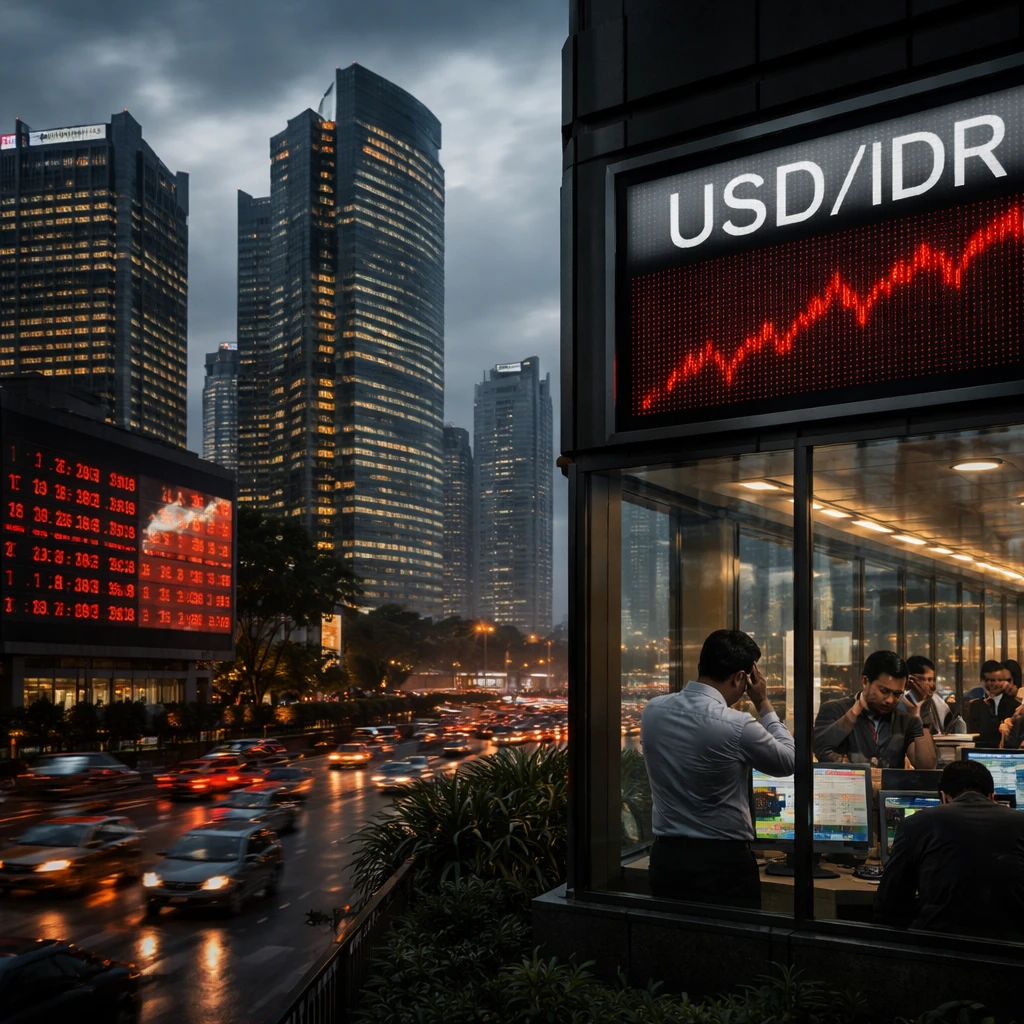
Market snapshot
The US Dollar-Indonesian Rupiah exchange rate climbed sharply in today’s trading, rising +1.22% to 17,654.9 and touching an intraday peak of 17,680 as the rupiah reached a record low. The move coincided with declines in local equities and a rise in bond yields as domestic markets reopened after a two-day holiday and were swept into a global risk-off wave driven by inflation concerns.
Immediate drivers
Traders pointed to the market reopening into a deeply negative international backdrop as the immediate trigger for the rupiah’s drop. Escalating conflict in the Middle East and the reported rejection by the US of Iran’s peace proposal were cited as the major external factor weighing on the currency.
Index mechanics and foreign flows
A significant secondary factor was MSCI’s May 2026 index review, which removed 18 Indonesian stocks from the index - a deletion tally reportedly much larger than authorities expected. The outcome raised concerns about concentrated ownership among large listed companies and the potential for rating pressures. Foreign investors reacted with heavy selling, curtailing dollar inflows and amplifying stress on the foreign exchange market.
Reserves and capital outflows
Compounding the strain on the currency, Indonesia’s foreign exchange reserves have declined for the fourth month running, falling to $146.2 billion in April 2026 from $148.2 billion in March. The drop was attributed to debt service and the rising costs of currency intervention.
On the equity side, the Jakarta Composite Index (JCI) was expected to continue its slide after a 3.53% fall the prior week to 6,723.32. Foreign funds exiting the Indonesian stock market amounted to IDR 3.2 trillion last week, while cumulative outflows since the start of the year reached IDR 56.46 trillion.
Monetary policy backdrop
Market participants were also focused on Bank Indonesia’s forthcoming policy decision. Jefferies estimated a 60% probability that Bank Indonesia would raise its policy rate by 25 basis points to 5.00% from the current 4.75% - the level it has maintained since October. The remaining 40% probability assigned by Jefferies was that Bank Indonesia would persist with a dual-track tightening approach, lifting only non-BI Rate instruments to support the rupiah.
At the same time, the US Federal Reserve’s commitment to a higher-for-longer interest rate stance, with the federal funds rate held at 3.75%, and a rise in US 10-year Treasury yields narrowed the interest-rate advantage of Indonesian assets versus US instruments. That dynamic reduced carry appeal and heightened capital outflow risks.
Fiscal sensitivity
Beyond immediate market moves, there are fiscal implications. Under the 2026 state budget's Rp 16,500-per-dollar assumption, the Finance Ministry’s sensitivity estimates indicate that each 100-rupiah deviation from that rate increases the fiscal deficit by about Rp 800 billion. The article notes that the current deviations imply fiscal pressure already measured in the trillions of rupiah, highlighting consequences that extend beyond the currency market.
How the pieces fit together
In summary, the post-holiday catch-up selloff, large-scale MSCI-driven foreign divestment, dwindling reserves and a relatively hawkish Fed combined to create intense downward pressure on the rupiah. These factors operated together to push USD/IDR to 52-week highs and generate broader market stress.
Key data referenced
- USD/IDR rose +1.22% to 17,654.9; intraday high 17,680.
- Jakarta Composite Index (JCI) fell 3.53% the prior week to 6,723.32.
- Foreign funds exited Indonesian equities by IDR 3.2 trillion last week; cumulative outflows YTD IDR 56.46 trillion.
- Indonesia FX reserves dropped to $146.2 billion in April 2026 from $148.2 billion in the prior month - fourth straight monthly decline.
- Jefferies assigns a 60% probability to a 25 bps BI rate hike to 5.00% and 40% to BI maintaining dual-track tightening.
- US Federal Reserve rate held at 3.75% and US 10-year Treasury yields rose, narrowing yield differentials.