
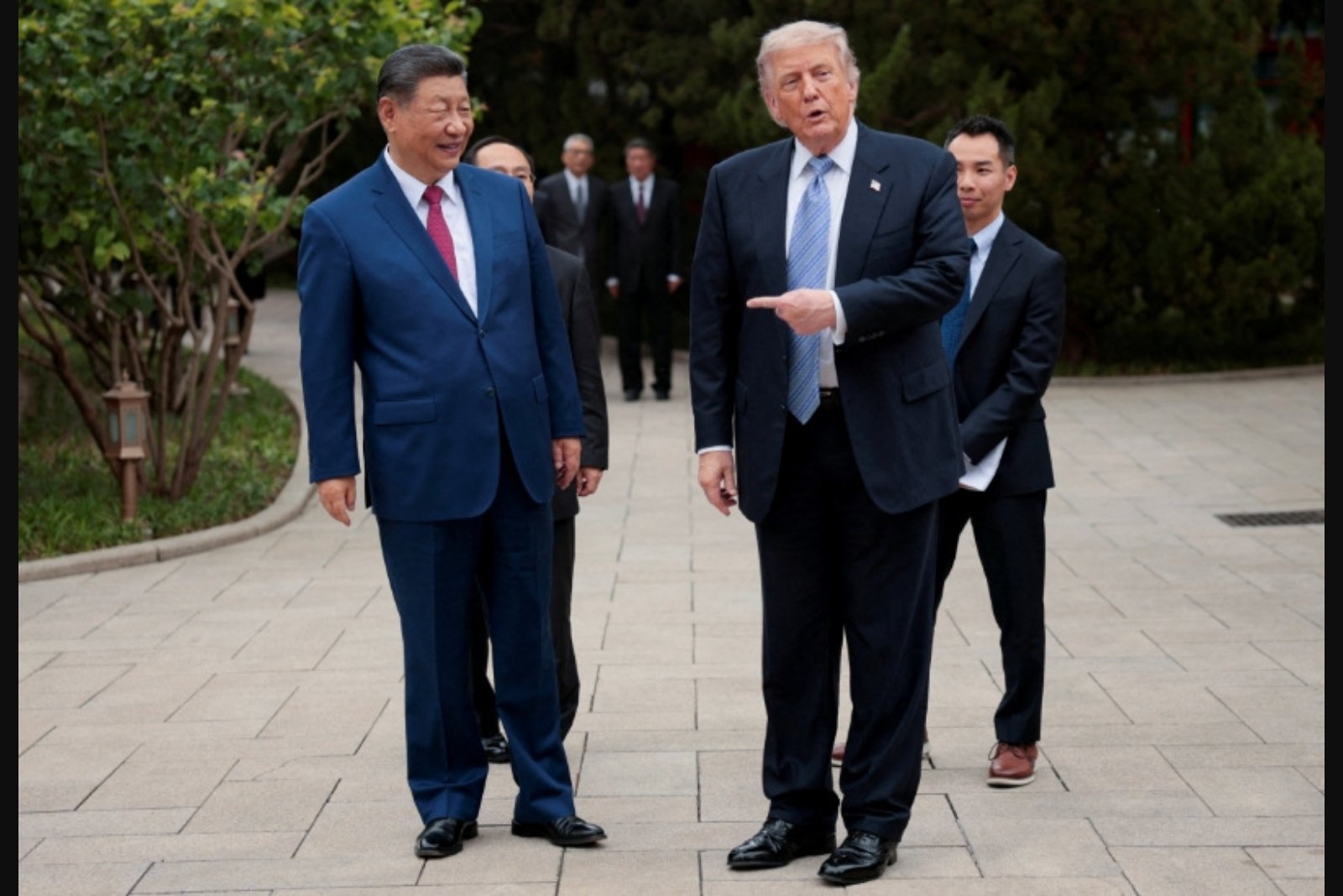
China and U.S. leaders used the summit in Beijing to underline a focus on "strategic stability," a shift that is likely to temper Sino-American geopolitical risk for Chinese markets in the near term. Yet the gathering produced scant progress on trade and offered no clear avenue toward resolving the war involving Iran, a conflict that has disrupted global markets and kept energy prices elevated.
President Trump’s trip to Beijing - his first since 2017 - concluded on Friday without any major trade breakthroughs and without concrete assistance from China to calm the more than two-month-old U.S.-Israeli war on Iran. Investors had entered the talks with limited expectations but with a hope that the discussions might help steer the region toward a diplomatic resolution that could alleviate pressure on energy markets.
Markets quickly shifted focus away from the summit. On Monday the Chinese yuan slipped to a near two-week low against the U.S. dollar, while Chinese equities were largely flat after tumbling more than 1% on Friday, as global risk-off sentiment re-emerged. The move came amid a broader bond market selloff tied to inflation concerns and renewed indications of tension in the Middle East.
William Bratton, head of cash equity research for Asia-Pacific at BNP Paribas, said the summit was unlikely to deliver immediate gains for equity investors but viewed the longer-term implications as constructive for reducing geopolitical risk. "This should, in turn, alter investor risk perceptions and may encourage U.S. capital to revisit the relative attractiveness of Chinese investment opportunities," he said.
Bratton added that U.S. investor sentiment toward Chinese equities has been incrementally more positive year-to-date and that trend could continue if bilateral relations between the two powers stabilise or at least become more predictable.
The market’s muted response to the summit was compounded by disappointing domestic data from China. April readings showed a slowdown in growth momentum, with industrial output and retail sales both falling short of expectations, reinforcing caution among investors who had hoped for clearer policy or economic catalysts from the talks.
Analysts at Capital Economics offered a measured interpretation, noting that while there were no headline breakthroughs, the summit appeared to cement a trade truce and to reduce the immediate risk of renewed escalation. They highlighted that Trump inviting Xi to visit the United States in September increases the prospect that relations will be managed with a degree of composure in the months ahead.
Despite these stabilising signals, analysts warned that key geopolitical issues remain unresolved and could continue to unsettle markets. Investors had speculated that the summit could help pave the way for some form of peace in the Middle East. Those hopes dimmed when China - the world’s largest importer of Iranian oil - did not signal any willingness to intervene to change the trajectory of the conflict.
The gulf in public positions between Washington and Beijing on the Iran war and the security of the Strait of Hormuz - the passage for roughly a fifth of global oil and liquefied natural gas - was especially apparent. President Trump said Xi had agreed Tehran must reopen that critical waterway, while Xi did not publicly discuss his conversations about Iran. China’s Ministry of Foreign Affairs described the conflict as one "which should never have happened, has no reason to continue."
Charu Chanana, chief investment strategist at Saxo, cautioned that without further tangible follow-through on trade, Taiwan, or the Iran conflict, the summit risks being remembered as largely symbolic: beneficial for sentiment but insufficient to alter the broader market backdrop. "That is where the risk still sits," she said, adding that investors may be underpricing the possibility that the Iran conflict keeps oil prices elevated, which would sustain sticky inflation expectations and higher bond yields for longer.
Taiwan remains another persistent flashpoint. Xi told Trump that mishandling the island could lead to direct conflict between the two powers, according to public accounts of the meeting. Observers are watching whether the U.S. administration will approve a proposed $14 billion arms sale to Taiwan - a step that could strain relations with Beijing if the White House proceeds. Sam Jochim, an economist at Swiss private bank EFG International, noted that authorising such a sale would be significant, with the potential to unsettle the relationship between Trump and Xi. Trump himself contributed to that uncertainty on Friday by saying he had not decided whether to proceed with the major weapons sale.
Trade policy clarity also remained elusive. A truce covering tit-for-tat trade measures between the U.S. and China is due to expire later this year, and ambiguity over tariffs discussed at the summit has continued to weigh on investor appetite. Even a deal described publicly as the summit’s largest single deliverable disappointed market participants: Boeing shares fell after Trump said China would buy 200 of the company’s jets, a figure investors considered well below expectations.
Nomura’s chief China economist, Ting Lu, described the summit as an exercise in "economic and political risk containment," arguing that although the meeting did not generate substantive trade concessions, it provided short-term stabilisation for both governments. He said that for the remainder of 2026 the two leading powers have effectively agreed to act as rivals who are at least predictable, transactional, and tightly managed - language that echoes a phrase President Trump used about the relationship in October.
For investors, the net effect of the summit appears to be a reduction in headline geopolitical unpredictability paired with lingering concerns that unresolved conflict in the Middle East and insufficient trade progress will continue to constrain market upside. The combination of sticky energy-driven inflation risk and the potential for renewed tariff or Taiwan-related tensions means asset allocators may remain selective when reassessing exposure to Chinese equities and related sectors.
Summary
The Trump-Xi summit emphasised "strategic stability," which reduced immediate geopolitical risk perceptions for China-related markets, yet the meeting failed to produce significant trade concessions or Chinese engagement to de-escalate the Iran conflict. Markets reacted cautiously: the yuan weakened, Chinese stocks were flat after recent declines, and bond markets were pressured by inflation fears and fresh Middle East tensions.
- Key points:
- The summit lowered near-term Sino-U.S. geopolitical unpredictability but did not deliver concrete trade breakthroughs.
- Investors remain concerned that the Iran war will keep energy prices high, sustaining inflation pressures and pressuring bond yields.
- Taiwan and potential U.S. arms sales remain significant bilateral risks that could affect market sentiment and geopolitical stability.
- Risks and uncertainties
- Continuation of the Iran conflict could maintain elevated oil prices and sticky inflation, impacting energy, consumer prices, and bond markets.
- Ambiguity around trade policy and the upcoming expiry of the trade truce may keep tariff-related downside risk for exporters, manufacturing, and capital flows to China.
- Decisions on arms sales to Taiwan could destabilise U.S.-China relations and affect defense-related equities and regional risk premia.