
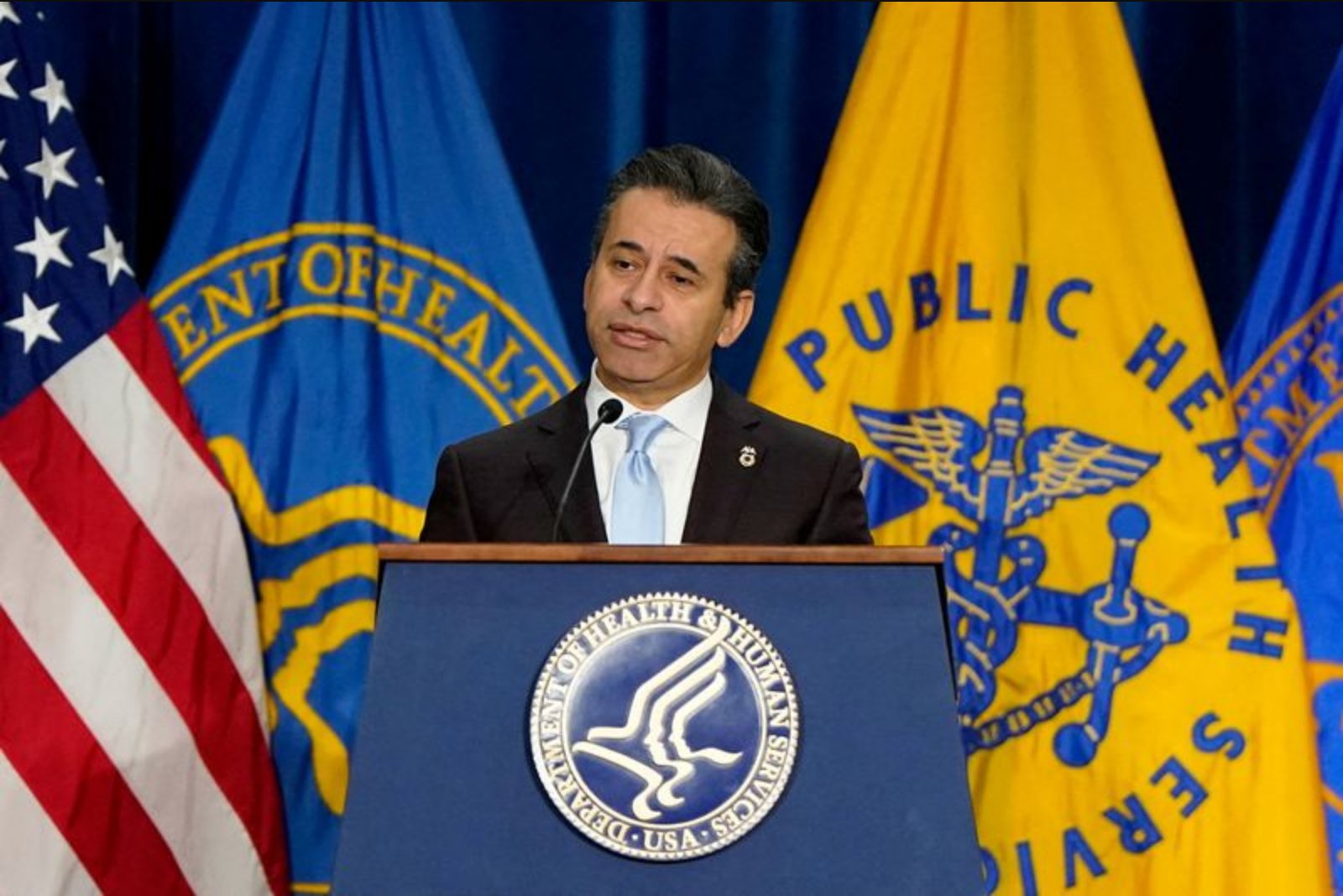
Dr. Marty Makary's decision to leave the U.S. Food and Drug Administration appears to have provoked an immediate, if likely temporary, positive response from biotechnology investors, while raising new questions about how long the agency will operate without permanent leadership.
President Donald Trump said on Tuesday that Makary would step down after facing weeks of criticism from influential Republicans and anti-abortion groups related to a series of contested decisions on drug approvals. The Nasdaq biotechnology index closed up 1% on Tuesday, reflecting some investor optimism tied to the change at the agency's top.
Trump also indicated that Deputy Commissioner for Food Kyle Diamantas would assume leadership of the FDA in an acting capacity. Reuters has reported that several former agency officials, including former FDA Commissioner Steve Hahn and former acting commissioner and Assistant Health Secretary Brett Giroir, are among those being considered for the permanent position.
Market participants flagged two competing themes arising from the resignation. On one hand, the departure was expected to prompt an immediate favorable market reaction because Makary had been viewed by some as less industry-friendly. Truist analysts said the exit was likely to trigger an initial "positive knee-jerk reaction" from investors, noting perceptions that Makary had been critical of certain industry submissions.
On the other hand, analysts warned that the lack of a settled, technocratic leadership team could prolong uncertainty. Patrice Mesnier, founding partner at Oldenburg Capital Partners, cautioned that "If the next commissioner is perceived as ideological, rather than technocratic, biotech volatility could extend materially." Mesnier added that markets will focus less on individual company results and more on what an appointment signals about the FDA's future direction.
Makary had drawn criticism for public disputes with several drugmakers, including Replimune, Sarepta and Moderna, over how the agency reviewed potentially lifesaving medicines and vaccines. Truist analysts pointed out that Makary had publicly questioned the clinical dataset Dutch gene therapy developer uniQure submitted for its Huntington's disease therapy, and that this skepticism had contributed to views that he was not aligned with industry priorities.
Those factors appear to have helped certain names in the sector: shares of uniQure rose 5% and Replimune's stock jumped nearly 10% at Tuesday's close. Replimune extended gains into Wednesday afternoon, trading about 28% higher and moving toward a second consecutive day of strong performance.
But the personnel change also compounds an already unsettled leadership environment at the agency. Truist analysts noted that two top positions responsible for drug oversight are currently filled by acting officials and must be replaced, a situation that could encourage "more delays and unpredictability" at the FDA and limit its ability to provide clear guidance or make credible policy commitments.
Brian Abrahams, an analyst at RBC Capital Markets, said the continued absence of steady leadership poses a challenge to "investability across the biopharma ecosystem." Abrahams acknowledged that Makary's exit might help companies that had clashed publicly with the commissioner, such as uniQure and Replimune, but he also emphasized that the change renews uncertainty at a time when biopharma had been performing relatively well.
Abrahams also observed that Makary had, at least nominally, provided a degree of stability at the agency through some pro-industry programs intended to expedite drug development and had struck "a mostly appropriate balance between forward-thinking and scientifically defensible" approaches.
For now, investors and industry watchers will be monitoring how quickly a permanent replacement is nominated and confirmed, and whether that individual is perceived as a technocratic steward of regulatory science or as aligned with particular ideological priorities. Until those questions are resolved, analysts expect the sector to react not only to corporate fundamentals but also to signals about the FDA's future leadership and policy orientation.