
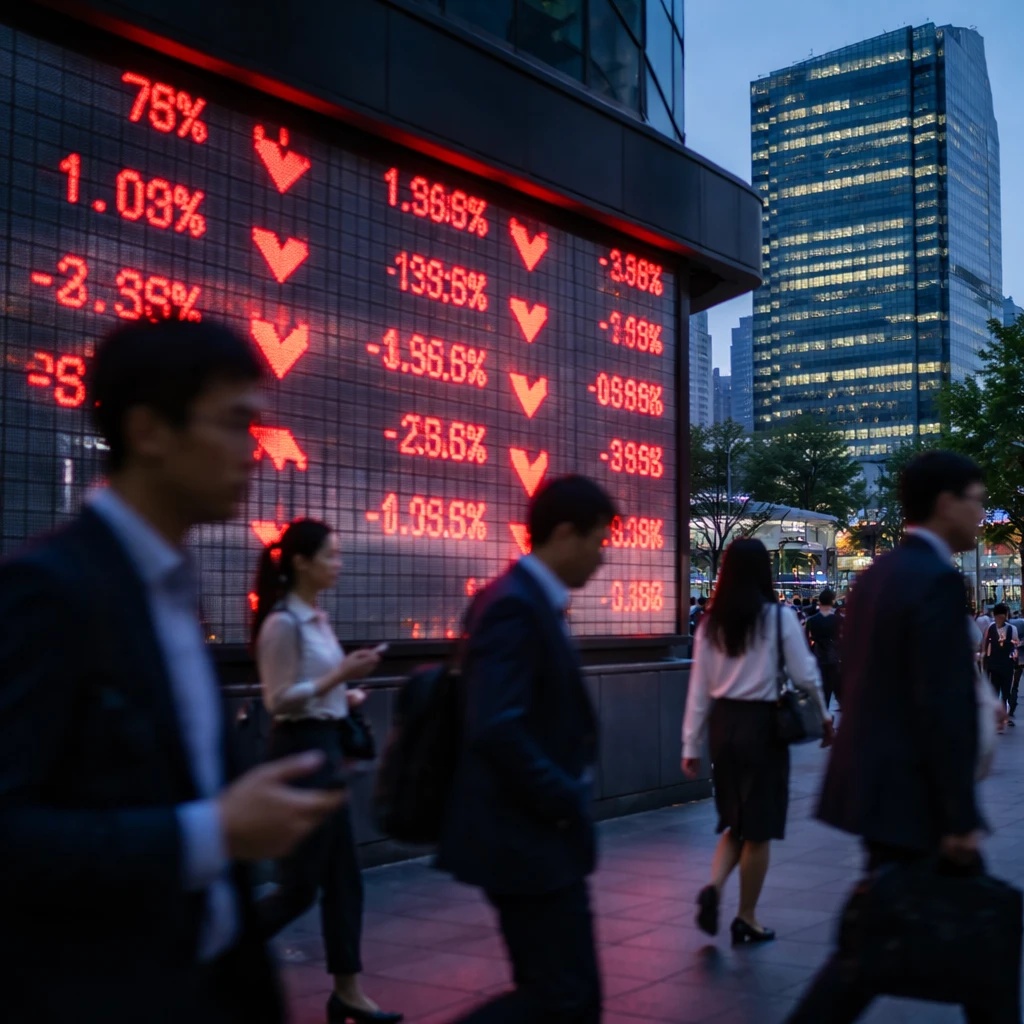
South Korea's main stock index experienced a sharp retreat on Friday, reversing recent gains after touching a record high above 8,000 earlier in the week. The KOSPI dropped 6.12% to close at 7,493.18, recording its largest single-day fall in roughly two months. The small-cap KOSDAQ declined 2.61%.
Market participants had their attention on the second day of elevated-level meetings between U.S. President Donald Trump and Chinese President Xi Jinping in Beijing. The leaders addressed the sensitive topic of Taiwan. President Xi warned that mishandling Taiwan independence could trigger "clashes and even conflicts," and said that failure to handle the matter "properly" could place "the entire relationship in great jeopardy."
President Trump traveled to Beijing on Wednesday accompanied by a delegation of American business leaders, among them Tesla chief Elon Musk and Nvidia CEO Jensen Huang.
Until this pullback, the KOSPI had been on a sustained upward trajectory, clearing the 7,000 level for the first time on May 5. That advance had been supported in part by an unprecedented rally in Samsung Electronics, which crossed the $1 trillion market capitalisation mark. Together with SK Hynix, the two memory chip giants made up a record 42.2% of the index in May, according to Manulife Investment Management.
Both chipmakers suffered heavy losses on Friday. Samsung Electronics shares plunged 8.6% after the company's labour union reaffirmed plans for an 18-day strike beginning May 21, despite the company offering to restart pay negotiations without preconditions. Negotiations mediated by the government over wages and bonuses had broken down earlier in the week. The union said it would be open to fresh discussions after June 7 but maintained that it was not withdrawing support for the planned walkout, which could disrupt output at the world's largest memory chipmaker.
SK Hynix shares slid 7.7%.
The weakness in Seoul was mirrored elsewhere in the region. China's CSI300 fell 1.1%, Hong Kong's Hang Seng index lost 1.6%, and Japan's Nikkei 225 declined 2% on the day.
Friday's moves underline the concentration risk in the KOSPI from a handful of dominant names in the semiconductor sector as well as the sensitivity of markets to geopolitical developments involving major powers. The combination of corporate labour tensions at leading manufacturers and high-level diplomatic discussions has coincided with one of the most pronounced daily drops for South Korea's benchmark in recent months.
Market snapshot
- KOSPI: 7,493.18, down 6.12%
- KOSDAQ: down 2.61%
- Samsung Electronics: down 8.6%
- SK Hynix: down 7.7%
- Other Asia indices: CSI300 -1.1%, Hang Seng -1.6%, Nikkei 225 -2%