
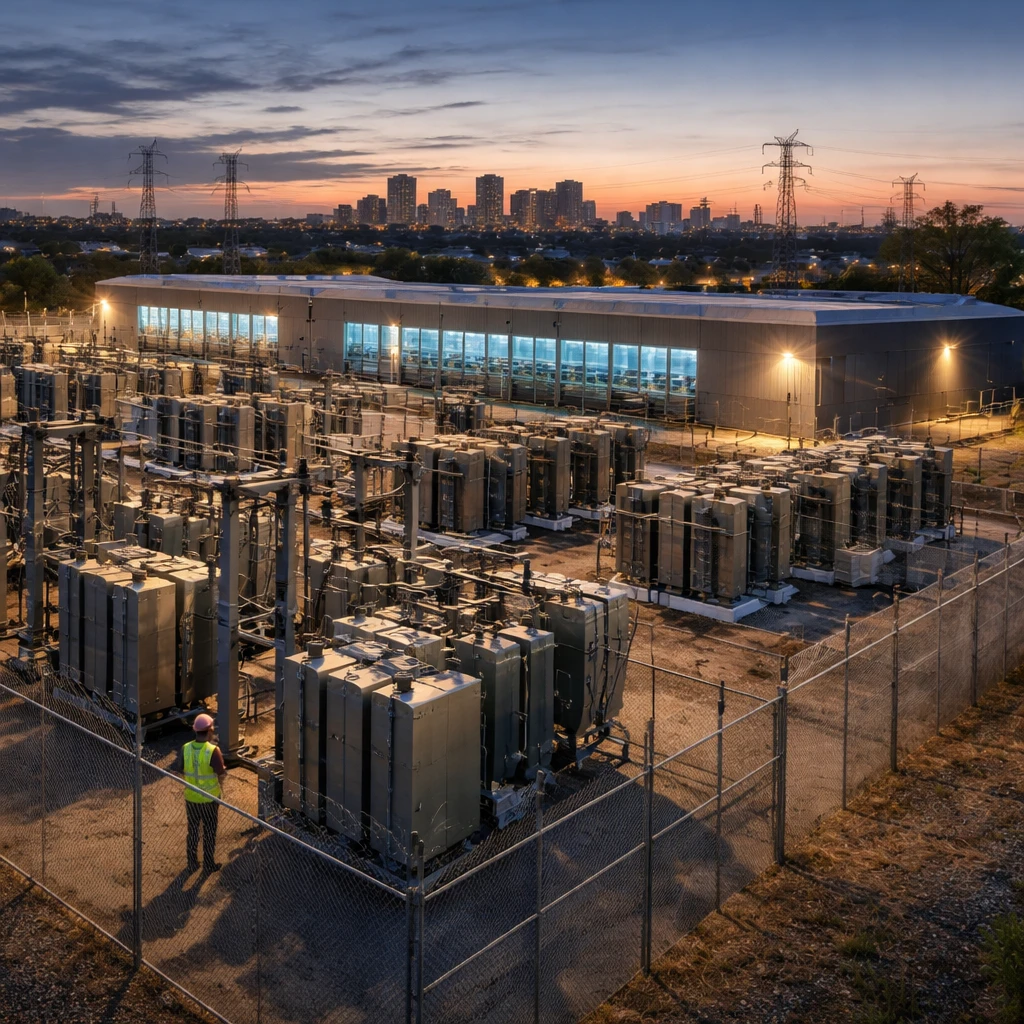
The recent spike in AI-driven computing demand is creating a new subset of infrastructure winners: firms that already control substantial energized power and can convert it into data center capacity. Former Bitcoin mining campuses are at the center of this transition, with operators repositioning sites to serve hyperscalers seeking capacity in an environment where power availability, permitting and construction timelines are tightly constrained.
Jefferies' analysis points to three attributes that will differentiate successful operators in the sector - tenant quality, financing flexibility and execution capability. Within that framework, the firm highlights four companies that stand out as early leaders in the AI data center market.
Cipher Digital (CIFR)
Jefferies regards Cipher Digital as the cleanest institutional-quality story among the peer set. The company has secured leases with multiple high-quality tenants, including AWS, Google-backed Fluidstack and another investment-grade hyperscaler, which together produce one of the strongest tenant rosters in the group. According to Jefferies, that tenant mix should improve the company’s ability to access financing and reduce execution risk. Cipher Digital is targeting nearly 400 MW of capacity online in 2026; if it meets those delivery timelines, Jefferies suggests the company could see a valuation shift from a speculative miner toward a recognized digital infrastructure platform.
Core Scientific (CORZ)
Core Scientific is identified as the operational leader among the BTC-to-AI converters. Jefferies notes that Core Scientific has already delivered more AI capacity than its peers and has executed a favorable commercial arrangement with CoreWeave in which the tenant funded the majority of the capital expenditure. The firm sees substantial upside potential for Core Scientific if it broadens its tenant base beyond CoreWeave and secures at least one investment-grade hyperscaler as a customer. However, Jefferies underscores tenant concentration as Core Scientific’s principal risk.
Hut 8 (HUT)
Hut 8’s distinguishing feature, in Jefferies' view, is the quality of its financing. The company has obtained a fully Google-backstopped Fluidstack agreement and a separate lease with an investment-grade hyperscaler, which together create a strong credit profile relative to peers. In an industry where capital costs are a major driver of returns, securing lower-cost financing can meaningfully enhance project economics. Hut 8 still must demonstrate large-scale delivery execution, but Jefferies characterizes it as one of the highest-quality long-term platforms in the space.
TeraWulf (WULF)
Jefferies describes TeraWulf as potentially the most underrated name in the sector. Unlike several peers, TeraWulf is already generating AI data center revenue and has shown commercial flexibility through partnerships with Fluidstack and Core42. Its Lake Mariner campus, positioned near New York and Toronto, offers attractive long-term placement as AI workloads increasingly shift toward inference and other lower-latency applications. Jefferies highlights TeraWulf’s combination of improving execution credibility and remaining power capacity to monetize as key strengths.
Across the group, Jefferies emphasizes that execution on build schedules and the ability to attract investment-grade tenants will be decisive as hyperscalers compete to lock in capacity. The firm’s recommendations reflect a view that operators who can pair large, energized power footprints with strong tenant commitments and access to capital will be best positioned to benefit from secular AI demand.
Context limitations
The analysis focuses on the cited companies’ positioning based on tenant agreements, financing arrangements and early execution metrics. Where details are not provided about future tenant additions, financing structures beyond noted agreements or exact project timelines beyond the referenced 2026 capacity expectation for one company, the report does not speculate and limits its observations to the facts described above.