
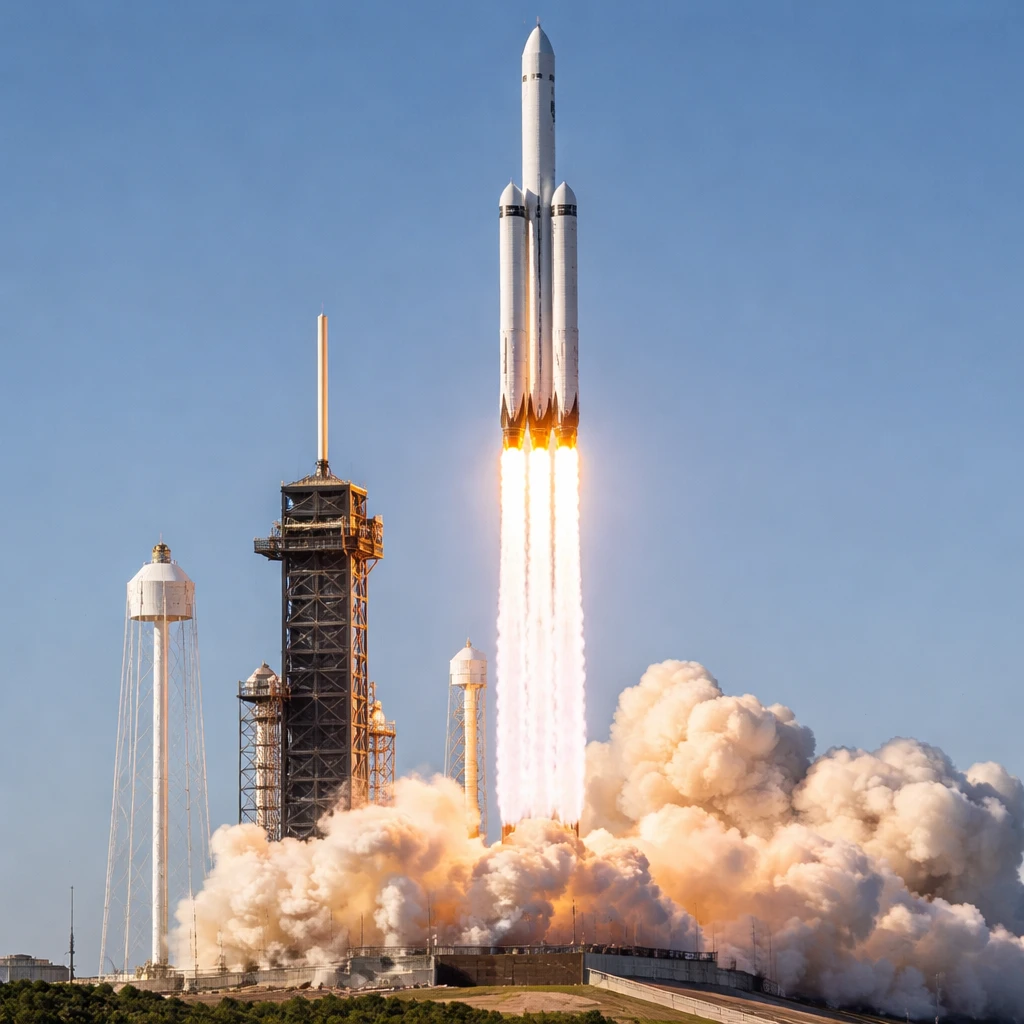
Boeing’s ViaSat-3 F3 satellite lifted off Wednesday from NASA’s Kennedy Space Center in Florida atop a SpaceX Falcon Heavy vehicle at 10:13 a.m. ET and is reported to be functioning normally as it makes its way toward geostationary orbit, roughly 22,000 miles above the Earth’s surface.
Mission teams confirmed the spacecraft detached from the rocket approximately five hours after launch. Following separation, Boeing’s Mission Control in El Segundo, California acquired the satellite’s signal and established command capability. Controllers then began initial spacecraft activation and configuration tasks.
The ViaSat-3 F3 is the third satellite to fly for the ViaSat-3 program and is configured to supply broadband services across the Asia-Pacific region. Its capabilities are intended to serve commercial mobility customers, fixed service subscribers and defense users. The satellite is built on Boeing’s 702MP+ platform.
Ryan Reid, president of Boeing Satellite Systems International, characterized the project as a significant step in Boeing’s relationship with Viasat, saying: "The launch of Viasat-3 F3 marks a major milestone in our partnership with Viasat. By combining Boeing’s best-in-class satellite platform with Viasat’s innovative payload, we’re delivering the highest capacity communication satellites ever launched."
The 702MP+ bus incorporates upgraded structural, power, thermal and attitude control systems designed to support demanding payloads. The satellite will use electric propulsion to reach geostationary orbit, a choice noted for its greater fuel efficiency compared with conventional chemical propulsion.
Before initiating orbit raising maneuvers, Boeing controllers will deploy solar arrays produced by Spectrolab, a Boeing subsidiary, and a radiator panel. Once the spacecraft arrives in its geostationary slot and completes the scheduled on-orbit testing sequence, Boeing plans to transfer operational control of the satellite to Viasat for entry into service.
Next steps: completion of solar array and radiator deployment, orbit raising via electric propulsion, on-orbit testing, and transfer to the service operator.