
SINGAPORE, May 6 - Asian stock markets rallied in the morning session on Wednesday as a tandem of geopolitical calm and amplified AI-related buying pushed indexes higher. U.S. commentary indicating "great progress" toward a "final agreement" with Tehran weighed on energy risk premiums, while investor appetite for technology and semiconductor exposure continued to gather momentum.
U.S. President Donald Trump said there had been "great progress" toward a "final agreement" with Tehran and that an operation escorting ships through the Strait of Hormuz would be briefly paused. The strait, which channels roughly one-fifth of global oil supplies and has been blockaded by Iran since late February, had been a flash point in the recent energy crisis. The announcement coincided with a drop in Brent crude, which fell 1.2% to $108.51 per barrel.
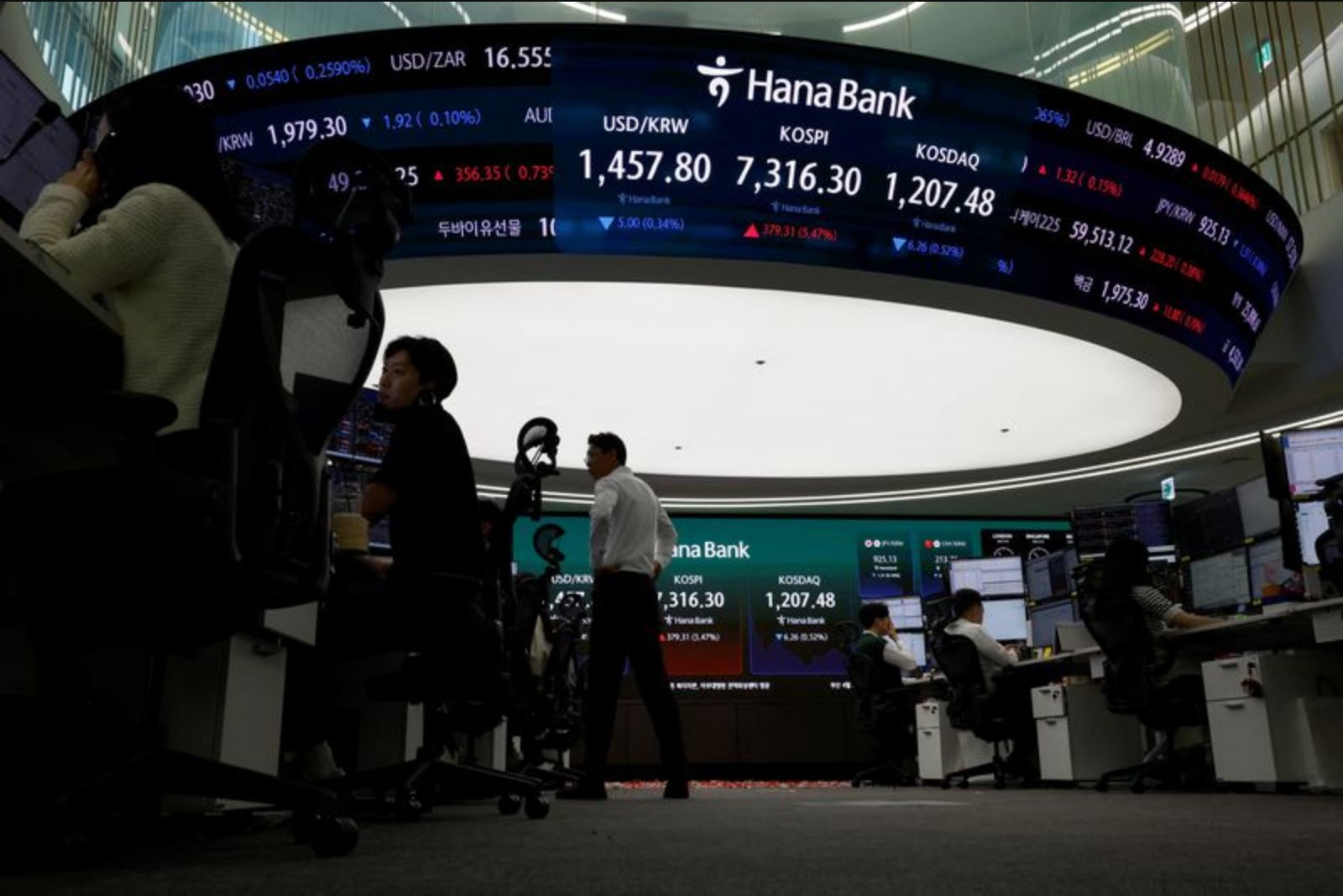
Futures trading reflected the improved sentiment in equity markets, with S&P 500 e-mini futures up 0.3% while global equity benchmarks climbed. MSCI’s broadest index of Asia-Pacific shares outside Japan jumped 2.3% to a record, paced by a 5.1% advance in South Korea’s Kospi, which cleared the 7,000 mark for the first time.
Analysts at Westpac captured the market mood in a research note, saying: "Markets embraced a sense of calm and stability overnight, with the risk of escalation in the Middle East conflict viewed as having diminished after U.S. Defence Secretary Pete Hegseth ensured the ceasefire was still in place, despite the U.S. and Iran trading blows yesterday. This put some wind in the sails for risk sentiment, supporting a rebound in equities across the U.S. and Europe at the same time as crude oil prices partially unwound yesterday’s climb."
Wall Street had closed higher the previous day, with the S&P 500 rising 0.8% and the Nasdaq Composite gaining 1%. Market participants cited an ongoing rotation and accumulation of positions into names they view as key beneficiaries of the AI investment cycle.
"Investors bought and continue to add to positioning in the 2026 winners," said Chris Weston, head of research at Pepperstone Group Ltd in Melbourne. "There has been some buying in S&P 500 materials stocks, but it’s tech that continues to attract the bulk of flows, notably in Apple and the memory plays."
As markets in Seoul resumed trading after a holiday, Samsung Electronics surged 12%, pushing its market value above $1 trillion and overtaking Berkshire Hathaway while closing in on Walmart in market capitalisation terms. The rally in semiconductors extended beyond Samsung: Advanced Micro Devices jumped 16.5% in extended trading after forecasting second-quarter revenue above Wall Street expectations, driven by strong demand for its data-center chips as cloud players accelerate AI infrastructure spending.
"Due to the capex spend we are seeing from hyperscalers in the U.S., the earnings growth trajectory for sectors such as semiconductors, tech hardware, industrials and materials in Asia exceeds anything I have seen in a long-time," said Rushil Khanna, head of equity investments for Asia at Ostrum. "This capex is leading to material value creation in Asia as the provider of the picks and shovels to the AI ecosystem," he said.
Sector flows were consistent with those observations, with technology and memory-related names drawing meaningful allocations. Markets broadly interpreted the combined backdrop of reduced geopolitical risk and strong demand for AI-related hardware as supportive of cyclicals and capital goods in the region.
In currency markets the U.S. dollar index, which measures the greenback against a basket of six currencies, ended a three-day winning run and eased about 0.1% to 98.236. The euro traded at $1.1724 and sterling at $1.3577, each up roughly 0.3% on the day. The Australian dollar strengthened to $0.7227, up about 0.6% and reaching its strongest level since June 2022, helped by firmer risk appetite and underpinned by a third straight interest-rate increase reported a day earlier.
Fixed income moves were modest: the yield on the U.S. 10-year Treasury was essentially flat at 4.424%.
Commodities displayed diverging moves. Brent crude's decline reflected the market reaction to the U.S. statement on naval escorts. Gold rose 1.2% to $4,609.59 as some investors sought safe-haven exposure amid the market repositioning. In cryptocurrencies, bitcoin slipped 0.9% to $80,881.12 while ether fell about 1% to $2,358.09.
Taken together, the market action on the Asian session underscored how a combination of geopolitical developments and concentrated flows into AI-sensitive sectors can quickly reshape risk appetite across asset classes. Equity gains were led by technology and semiconductors, bond yields were stable and commodity markets adjusted to the lower near-term risk premium on oil.
Market snapshot
- Brent crude: down 1.2% to $108.51 per barrel
- S&P 500 e-mini futures: up 0.3%
- MSCI Asia-Pacific ex-Japan: up 2.3% to a record
- Kospi: up 5.1%, clearing 7,000
- Samsung Electronics: up 12%, market cap above $1 trillion
- AMD: jumped 16.5% in extended trading after raising revenue guidance