
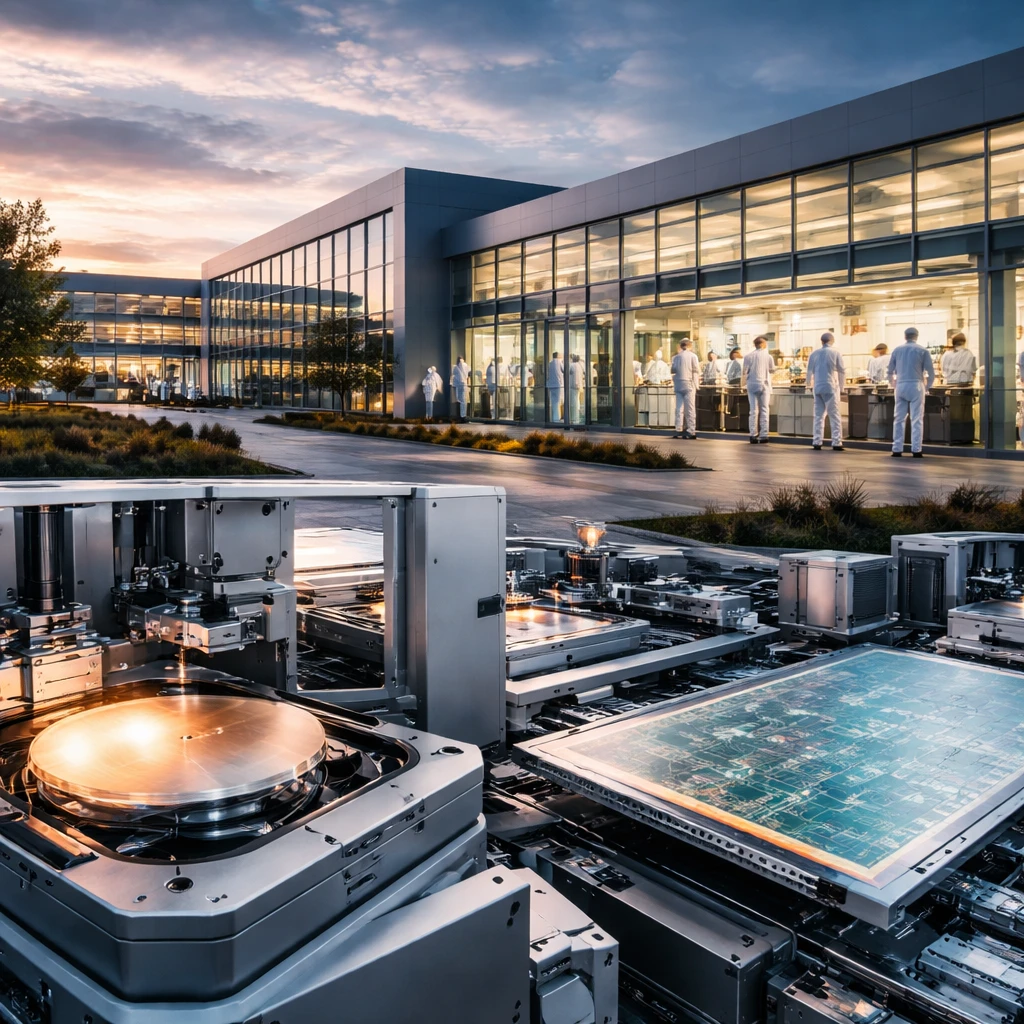
Applied Materials stock climbed sharply in afternoon trading, advancing roughly 5.5% to reach $412.82, after the company confirmed a definitive agreement to acquire the NEXX business from ASMPT Limited. The purchase brings NEXX’s team and its large-area advanced packaging deposition equipment into Applied’s portfolio, a move the company says will expand its capabilities in panel-level advanced packaging technologies.
The addition of NEXX is intended to enable chipmakers to build larger-body AI accelerators that deliver improved energy efficiency, according to the transaction description. Rising AI workloads are driving demand for bigger chiplet-based designs that integrate more GPUs, high-bandwidth memory stacks and I/O chips. These designs are scaling into more complex 2.5D and 3D chiplet stacking architectures, increasing the need for larger interposers and more advanced substrates - areas where NEXX’s equipment is focused.
Investor reaction to the deal was amplified by a cluster of bullish analyst moves. B. Riley Securities raised its price target to $485, while Susquehanna moved its target to $500 and maintained a Positive rating. Seaport Research initiated coverage of Applied Materials with a Buy rating and a $500 price objective. Those actions contributed to upward momentum in the shares as market participants assessed the strategic value of the acquisition.
Executives involved with the deal also endorsed its potential. ASMPT NEXX President Jarek Pisera was quoted as saying the combined businesses can "accelerate the computing industry’s adoption of large-format advanced packaging technologies." The transaction is expected to close within several months, subject to customary closing conditions.
Additional strategic developments were noted alongside the acquisition. Goldman Sachs named Applied Materials a top pick, and Advantest Corporation joined Applied’s EPIC platform and opened an Innovation Center on Applied’s Silicon Valley R&D campus in April 2026, moves cited as further deepening Applied’s AI ecosystem. Those ecosystem relationships were highlighted as another supportive element for the company’s positioning in advanced packaging and AI-related markets.
The broader market provided a constructive backdrop for growth and technology names. On the session in question, the S&P 500 rose by 0.87%, the Nasdaq advanced 1.04% and the Dow Jones gained 0.64%. Semiconductor names have been performing well this spring amid continued strength in AI-driven demand, and April was described as one of the sector’s stronger months.
Historical seasonality for certain semiconductor-related stocks was noted in the market commentary: Applied Materials and Broadcom have been among the better-performing S&P 500 constituents in May over the past decade, reportedly finishing the month positive 90% of the time with an average gain of 7.6% in those years.
Macro optimism was also mentioned as a supporting factor for risk-on sentiment, with an anticipated diplomatic summit between U.S. President Trump and Chinese President Xi Jinping scheduled for May 2026. That meeting was framed as arriving amid a turbulent period in U.S.-China trade relations following more than a year of escalating tariff disputes and continuing negotiations.
Taken together, the NEXX acquisition, the flow of analyst price target revisions and a generally favorable market session helped push Applied Materials shares to a session high of $414.09, bringing the stock closer to its 52-week high of $420.50. The company is preparing to report earnings on May 14, 2026, and while concerns around valuation and geopolitical risk remain, the immediate market response favored the recent catalysts.
Context and product implications
For chipmakers focused on the next wave of AI hardware, panel-level advanced packaging and large-format interposers are practical enablers of larger, more energy-efficient accelerator packages. The acquisition of NEXX is positioned to extend Applied’s product set in these areas - a product-first rationale that aligns with the market’s push toward larger chiplet-based architectures integrating multiple high-performance components.