
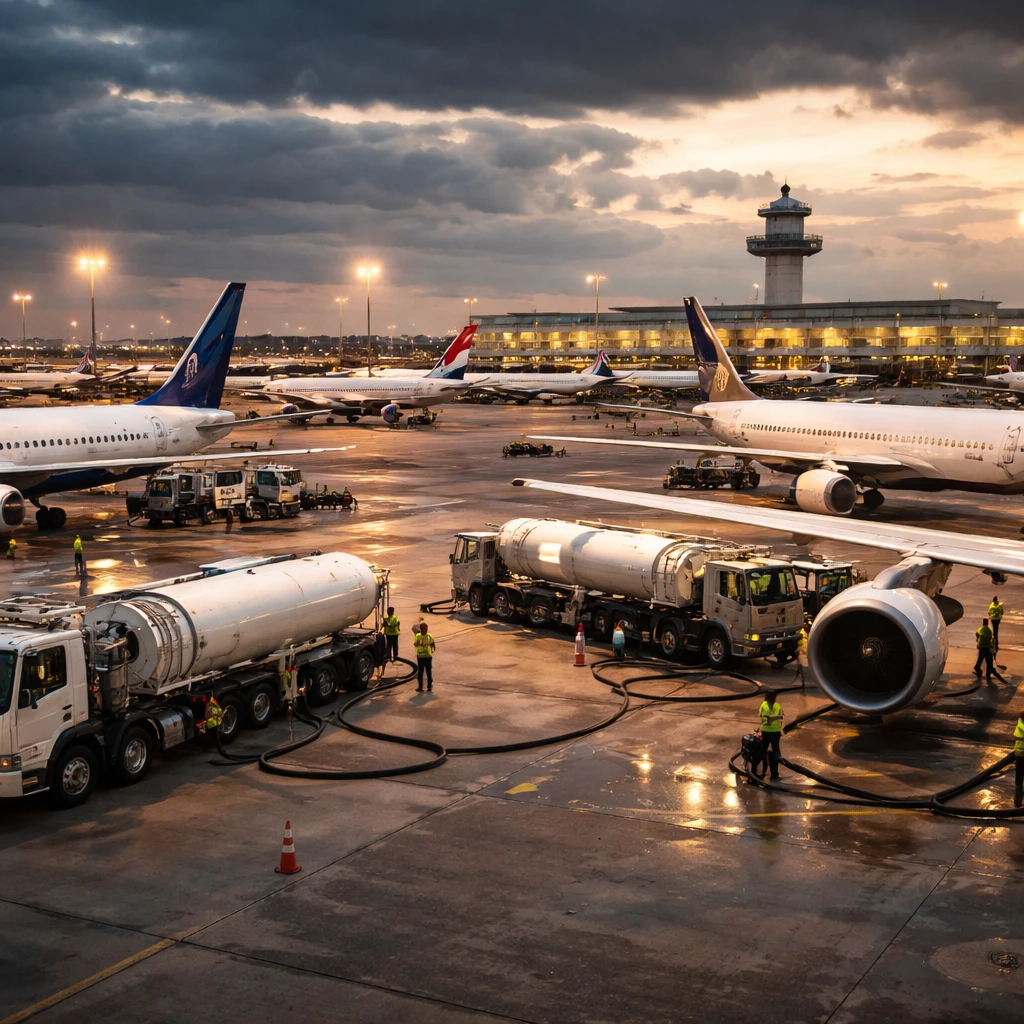
Jet fuel costs have surged from an estimated $85-$90 a barrel to between $150 and $200 a barrel in the wake of the U.S.-Israeli war on Iran. With fuel representing as much as a quarter of airlines' operating expenses, carriers around the world have adopted a range of measures - from higher ticket prices and explicit fuel surcharges to capacity cuts and suspensions of financial guidance - to limit the blow to margins.
The following entries, arranged alphabetically, summarize actions and statements by individual airlines and airline groups as they confront sharply elevated jet fuel prices and related operational impacts.
AEGEAN AIRLINES
The Greek carrier has warned that the suspension of flights to the Middle East and the jump in fuel costs will have a "notable impact" on its first-quarter results.
AIRASIA X
Executives at the Malaysian long-haul low-cost group have said the airline cut about 10% of flights within the group and implemented a roughly 20% general fuel surcharge.
AIR CANADA
Canada's largest airline has suspended its full-year guidance because of volatility in jet fuel prices. It previously said it would reduce service by trimming four of 38 daily flights to New York as a response to higher fuel costs.
AIR CHINA, CHINA SOUTHERN AIRLINES, CHINA EASTERN AIRLINES
The three major Chinese carriers jointly lifted fuel surcharges on domestic routes to 60 yuan for flights under 800 km and 120 yuan for flights over 800 km, up from 10 yuan and 20 yuan respectively.
AIR FRANCE-KLM
The airline group said it expects its fuel bill to rise by $2.4 billion this year and reduced its capacity outlook for 2025 to a 2% - 4% increase, down from a prior forecast of 3% - 5%.
Airline market tickers and intraday moves appearing in market data
EZJ+7.87% LHAG+6.6% AIRF+8.44% TUI1n+7.67% JBLU+5.68% LUV+3.63% DAL+4.69% UAL+5.71% ICAG+6.97% THYAO+3.07% AC+2.18% ALK+5.34% LTM0.00% AGNr+5.06% AIR+2.38% 003490+0.2% 004870-6.34% 020560-0.57% AAL+4.04% 0753+1.42% 0670+1.74% 1055+2.21% CEB-2.14% THAI+1.68% 601021-0.02% AIRX+2.46% INGL+6.65% TRZ0.00% QAN+2.03% VJC+0.28% HVN+0.67% ULCC+8.24%
The Air France-KLM group also said it would raise long-haul ticket prices, including a cabin fare increase of 50 euros per round trip, and that KLM intends to cancel 160 flights within Europe in the coming month due to fuel costs.
AIR INDIA
The Indian state carrier said it will change its domestic fuel surcharge from a flat fee to a distance-based grid and noted that surcharges on international routes did not cover the exponential rise in fuel prices.
AIR NEW ZEALAND
One of the earliest carriers to announce broad ticket increases after the conflict began, Air New Zealand said on April 7 it would cut flights through May and June and lift fares. The carrier also suspended its full-year earnings forecast amid jet fuel price volatility.
AIR TRANSAT
The Canadian leisure carrier announced it will reduce planned capacity by 6% between May and October, with cuts expected on routes to Europe and the Caribbean and continued suspension of service to Cuba until October.
AKASA AIR
India's Akasa Air introduced a fuel surcharge ranging from 199 to 1,300 Indian rupees ($2 to $14) for domestic and international flights.
ALASKA AIR
Confronted with margin pressure from rising jet fuel costs, the U.S. carrier launched a $500 million debt offering. The airline had previously withdrawn its full-year profit forecast, warned of significant second-quarter earnings pressure and trimmed capacity in certain markets.
AMERICAN AIRLINES
American Airlines lowered its 2026 profit forecast, moving the low end into a potential loss, and said it expects its jet fuel bill to rise by more than $4 billion this year. The carrier increased checked baggage fees by $10 for the first and second bags and by $150 for the third bag on domestic and short-haul international flights, and cut some economy passenger benefits.
ANA
Japan's All Nippon Airways said higher fuel costs would raise expenses by about 140 billion yen this year, though hedges, fare increases and cost reductions are expected to limit the net impact to roughly 60 billion yen. The carrier said it is considering a domestic fuel surcharge from the financial year starting April 2027.
ASIANA AIRLINES
South Korea's Asiana plans to cancel 22 flights between April and July as a reaction to higher fuel costs, according to Newsis.
CEBU AIR
The Philippines-based airline identified the sharp rise in fuel prices as a major concern and said it will continue to reassess its pricing and network strategies to mitigate the impact.
DELTA AIR LINES
Delta said it will reduce capacity by about 3.5 percentage points from its original plan and will raise checked-bag fees to help offset higher jet fuel bills, increasing charges by $10 for the first and second checked bags and $50 for the third. The carrier pulled all planned capacity growth for the current quarter and projected profit below Wall Street expectations.
EASYJET
EasyJet warned it expects a larger half-year pre-tax loss of between 540 million and 560 million pounds, including an additional 25 million pounds in fuel costs in March. It previously announced plans to increase long-haul ticket prices and set cabin fares higher by 50 euros per round trip.
FRONTIER AIRLINES
A consortium of U.S. budget carriers including Frontier reportedly proposed a $2.5 billion relief plan to the U.S. government to cover higher expected jet fuel costs compared with earlier forecasts. Frontier said it is reviewing its full-year outlook as fuel prices have moved substantially since it issued guidance.
GREATER BAY AIRLINES
The Hong Kong-based carrier said it would raise fuel surcharges on most routes from April 1, while keeping surcharges unchanged for routes to mainland China and Japan.
HONG KONG AIRLINES
The airline raised fuel surcharges by up to 35% from March 12, with the largest increases on routes between Hong Kong and the Maldives, Bangladesh and Nepal, where surcharges rose to HK$384 from HK$284.
IAG
Owner of British Airways, IAG said it will increase ticket prices to reflect higher jet fuel costs and acknowledged that despite hedging it is not immune to the wider effects of fuel price volatility.
INDIGO
India's largest carrier said it planned to introduce fuel charges on domestic and international flights starting March 14, including a 900 rupee charge for Middle East flights and a 2,300 rupee charge for flights to Europe.
JETBLUE AIRWAYS
JetBlue said it would slow hiring, reduce capacity and increase fares to cushion the impact of rising jet fuel costs. The carrier's CEO announced on an earnings call that it had suspended its full-year outlook.
KOREAN AIR
South Korea's flag carrier said it would enter emergency management mode from April as higher oil prices increase costs, according to a source familiar with the matter.
LATAM AIRLINES
The Chile-based airline lowered its 2026 core earnings forecast after higher jet fuel prices pushed up costs.
LUFTHANSA
The German group said it expects a 1.7 billion euro hit from jet fuel in 2026. Its subsidiary ITA Airways will raise ticket prices by 5% to 10% in 2026 to offset rising fuel costs. The group also introduced a new lower-cost "Economy Basic" fare for short- and medium-haul flights that restricts complimentary carry-on baggage to a laptop bag or small backpack. The airline group had previously said it would remove 20,000 short-haul flights from its schedule through October, an amount the company equated to around 40,000 metric tons of jet fuel.
PAKISTAN INTERNATIONAL AIRLINES
The carrier said it would increase domestic fares by $20 and international fares by up to $100, attributing the changes to higher fuel surcharges.
QANTAS AIRWAYS
Qantas delayed a planned A$150 million buyback and raised its estimate for the second half of 2026 fuel bill to A$3.1 billion-A$3.3 billion, up from a prior A$2.5 billion forecast.
SAS
Scandinavian Airlines said it would cancel 1,000 flights in April due to high oil and jet fuel prices, after already cancelling "a couple hundred" flights in March.
SPIRIT AIRLINES
The U.S. low-cost carrier abruptly shut down after collapsing under financial pressures, among which the sharp rise in fuel costs related to the Iran war was cited.
SPRING AIRLINES
The Chinese budget carrier announced plans to raise fuel surcharges on domestic flights from April 5, with further details to be provided later.
SOUTHWEST AIRLINES
Southwest forecast second-quarter profit below market expectations and its CEO warned that the jet fuel spike would represent a billion-dollar headwind for the quarter. The carrier had earlier increased checked-bag fees by $10 for the first and second bags, bringing the first bag charge to $45 and the second bag to $55.
TAP
Portugal's flag carrier said fare increases will partially offset the revenue impact of changing fuel prices.
THAI AIRASIA
The Thai low-cost carrier plans to cut overall seat capacity by an average of 30% between May and June to respond to rising aviation fuel prices and weakening demand.
THAI AIRWAYS
Thai Airways said it will raise fares by 10% to 15% as a response to higher fuel costs.
TUI
The European airline and tour operator reduced its full-year underlying profit outlook and suspended revenue guidance, saying the war led to roughly 40 million euros in extra costs in March, including repatriation and operational disruptions.
TURKISH AIRLINES, LUFTHANSA SunExpress
SunExpress, the joint venture between Turkish Airlines and Lufthansa, said it will apply a temporary fuel surcharge of 10 euros per passenger on routes between Turkey and mainland Europe for bookings made on or after April 1 for departures on or after May 1. Turkish Airlines also said on April 10 it will not distribute any dividend from 2025 net profit, choosing to retain earnings to conserve cash.
T'WAY AIR
The South Korean low-cost carrier said it plans to furlough some cabin crew without pay in May and June as part of measures addressing the impact of the war.
UNITED AIRLINES
United's CEO said ticket prices could need to rise by as much as 15% to 20% to offset a surge in jet fuel costs. The company implemented five fare increases late in the first quarter and raised baggage fees; management said these measures have started to offset rising fuel costs. United forecast second-quarter and full-year profits below Wall Street estimates and said it expects to recover only 40% - 50% of the increase in fuel prices through fares and other revenue efforts in the second quarter, improving to 70% - 80% in the third quarter and to as much as 85% - 100% by the fourth quarter.
VIETJET
The Vietnamese budget airline adjusted flight frequency on selected routes because of potential fuel shortages.
VIETNAM AIRLINES
Vietnam's flag carrier will cancel 23 domestic flights per week from April, following a request to the government for assistance to remove an environmental tax on jet fuel, according to the nation's aviation authority.
VIRGIN ATLANTIC
Virgin Atlantic is charging fuel surcharges to fares but the airline said it will still struggle to return to profitability this year, according to a statement from its CEO.
VIRGIN AUSTRALIA
Virgin Australia expects a rise in jet fuel costs of about A$30 million-A$40 million for the second half of this fiscal year, and projects a 1% capacity reduction in the fourth quarter.
VOLOTEA
The Spanish low-cost carrier introduced a new pricing policy tying ticket prices to fuel costs, potentially adding a post-purchase surcharge of up to 14 euros per passenger, per flight.
WESTJET
Canada's WestJet has reduced seat capacity for June, and reports indicate it added a C$60 fuel surcharge to some bookings and has been combining flights as costs rose.
Currency conversion reference
($1 = 157.1700 yen/6.8300 Chinese yuan renminbi/0.8539 euros/95.0875 Indian rupees/0.7378 pounds/1.3910 Australian dollars/1.3601 Canadian dollars)
This compilation reflects the specific operational and commercial responses that carriers have announced publicly as the jet fuel market moves sharply higher. Many airlines have deployed a combination of measures - ticket price increases, explicit fuel surcharges, capacity reductions, revised earnings guidance and cost-saving measures - to limit the immediate financial impact. Several carriers also signaled that recovery of escalating fuel costs via fares and ancillary charges would be partial in the near term, improving over successive quarters in some cases.