
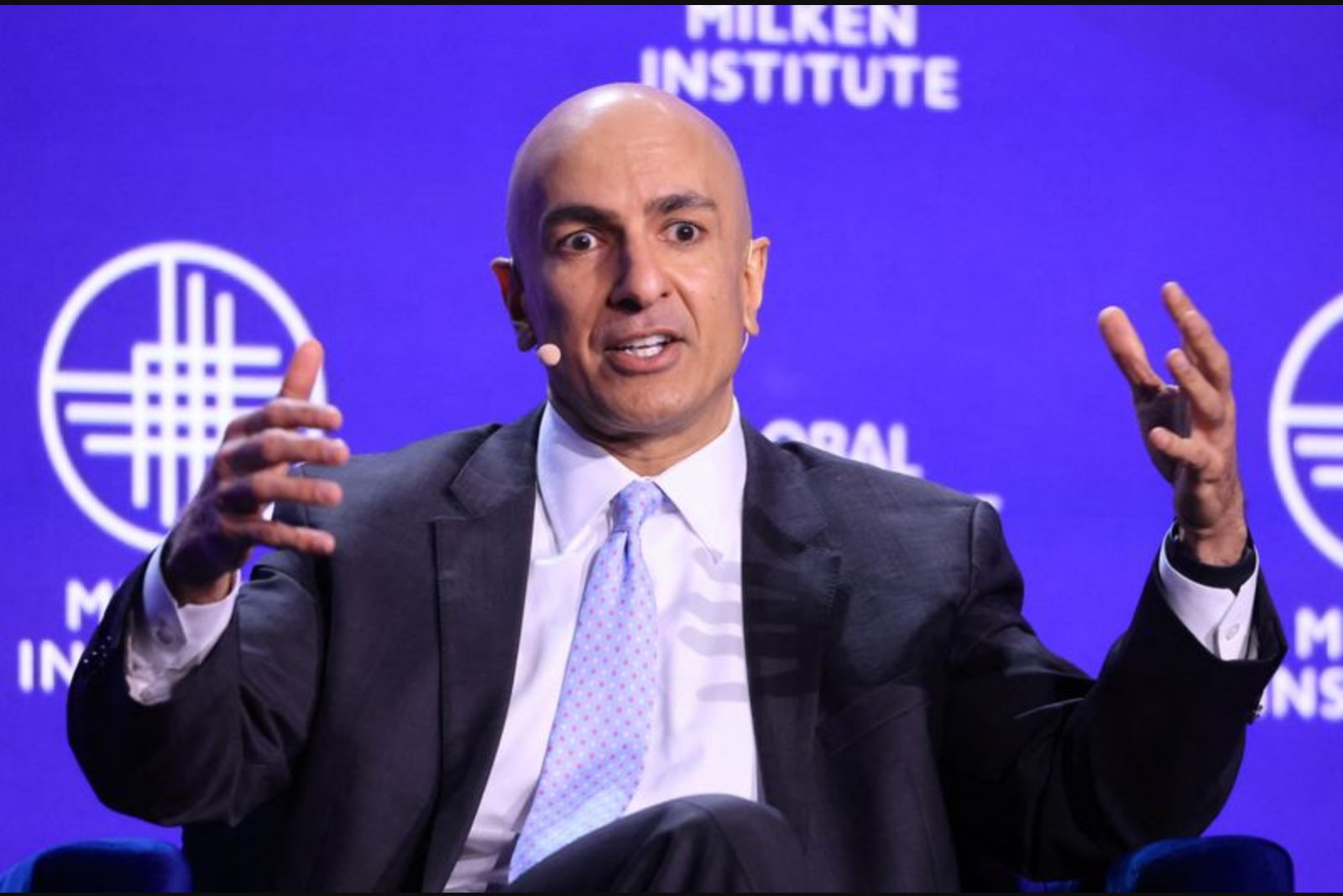
WASHINGTON, May 1 - Neel Kashkari, president of the Federal Reserve Bank of Minneapolis, said in explaining his dissent at this week's Federal Open Market Committee meeting that uncertainty from the U.S.-backed war with Iran could alter the inflation outlook enough to require "potentially a series" of interest rate hikes to defend the central bank's 2% inflation target.
In a statement released after the meeting's communication blackout lifted, Kashkari said that a prolonged closure of the Strait of Hormuz and the risk of additional damage to energy and commodity infrastructure in the Middle East could generate a "price shock wave" substantially larger than currently anticipated.
"With an extended closure of the Strait of Hormuz and potentially further damage to energy and commodity infrastructure in the Middle East...the price shock wave could be much larger than is currently expected," he wrote. Kashkari added that the Fed "would likely have to follow through with a strong policy response...Federal funds rate increases, potentially a series of them, could be warranted even at the risk of further weakness to the labor market."
Kashkari was one of four dissents at this week's Fed meeting, marking the most divided policy vote since 1992. The policy statement that received approval on an 8-4 vote kept existing language that Kashkari and two of his colleagues opposed because it signals an "easing bias." The fourth dissent opposed that position and instead favored a rate cut.
While Kashkari said he did not object to leaving the policy rate unchanged at the meeting, he argued that the risks stemming from the conflict in Iran have risen to the point where the Fed should stop implying in its statement that the next move would be a reduction in rates. He noted that although the current statement language "is not a commitment to make further cuts...it is widely interpreted...to indicate the committee's expectation that the next adjustment to the federal funds rate would be a cut."
He urged the central bank to present a policy outlook that reflects the high degree of uncertainty and signals that the next rate change could be either a cut or a hike. "Given recent economic developments and geopolitical developments and the high level of uncertainty," he wrote, the Fed "should offer a policy outlook that signals that the next rate change could be either a cut or a hike."
Kashkari also set out a scenario he described as "benign," in which the Strait of Hormuz reopens relatively soon and oil and other global commodity flows resume. Even under that scenario, he said underlying inflation in the United States would remain at 3% for the year - notably above the Fed's 2% target and high enough, in his view, to justify keeping the policy rate unchanged.
The latest moves in global energy markets were referenced in his statement: threats to shipping through the Strait of Hormuz and to energy infrastructure have pushed global crude well above $100 a barrel for several weeks, with prices touching $126 this week compared with about $70 at the start of the conflict. Those price dynamics are central to Kashkari's warning that inflation could reaccelerate.
Context and implications
Kashkari's public dissent underscores the degree of uncertainty policymakers face as geopolitical shocks intersect with domestic inflation dynamics. His call to remove language that implies the next action would be a rate cut is aimed at ensuring the Federal Reserve's forward guidance aligns with the range of plausible outcomes, including elevated inflation driven by energy price shocks.
At the core of his argument is a trade-off: the Fed may need to accept further labor market weakness to bring inflation back toward its target if a significant oil price shock materializes. Kashkari's position reflects a willingness to prioritize the inflation goal even at the expense of additional downside risk to employment.
For now, the committee's majority left the post-meeting statement intact, but Kashkari's dissent adds public weight to the view that central bank policy remains subject to swift change should geopolitical developments amplify price pressures.