
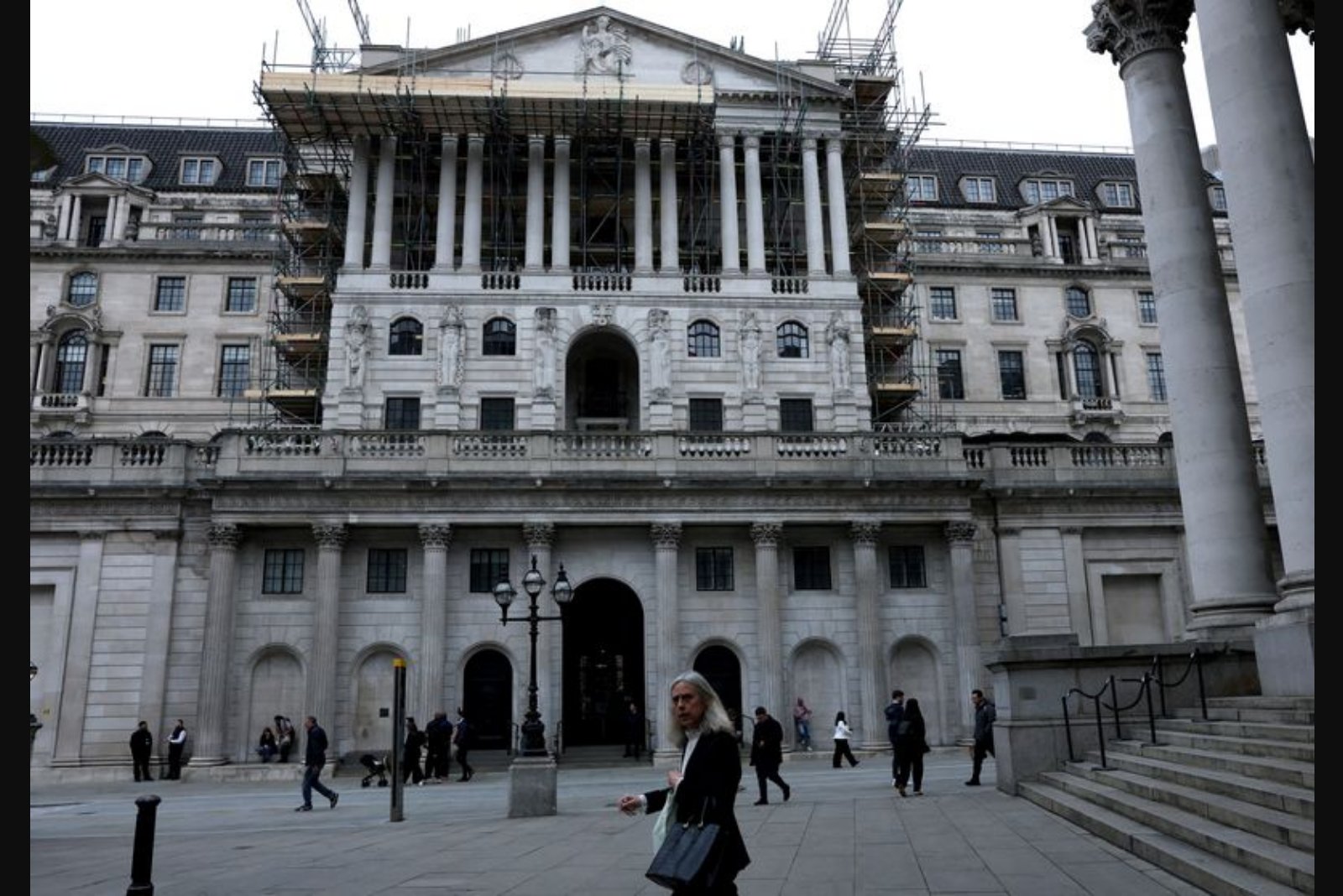
The Bank of England is expected to maintain its current Bank Rate at 3.75% when the Monetary Policy Committee (MPC) issues its decision on Thursday, with monetary authorities and market participants alike monitoring the economic fallout from the war in Iran.
Like the U.S. Federal Reserve, which kept rates unchanged on Wednesday, and the European Central Bank, which is also widely expected to hold steady, the BoE faces a central dilemma: whether the recent run-up in energy prices will prove to be a source of prolonged inflationary pressure, or whether it will instead squeeze demand and further slow an economy that was already weak.
All 62 economists surveyed by Reuters forecast no change to Bank Rate at the conclusion of the MPC’s April meeting.
Vote dynamics and official views
Market observers expect the committee split to widen compared with March. After a unanimous 9-0 hold in the previous meeting, most analysts now see an 8-1 result, with the chief economist Huw Pill - who has cautioned about the risks of a "wait-and-see" approach - the most likely dissenting voter in favor of a hike.
By contrast, Governor Andrew Bailey has told investors that expectations of further rate hikes this year are premature in light of uncertainty about how long the conflict will last and how large its economic effects will be.
Market signals and economic readings
Analysts say financial markets already have a degree of tightening baked into prices, which is acting as a drag on activity. Andrew Wishart, senior UK economist at Berenberg, noted that the hikes priced into markets "were already weighing on the economy, reducing the likelihood that the BoE will actually have to raise Bank Rate, at least for now."
Wishart added that the BoE cannot stop a mechanical rise in inflation driven by higher petrol and utility bills: "The BoE cannot prevent a mechanical increase in inflation due to higher petrol and utility bill prices," he said. "Whether or not this triggers a renewed surge in wages and prices across the board will decide its response to the Iran war."
Not all forecasters take a dovish near-term view. BNP Paribas analysts project two rate increases in 2026 to counter a potential rise in inflation that could peak at 4.5% early next year, compared with a current reading of 3.3%.
Exposure to energy and business cost pressures
Investors see Britain as particularly exposed to the shock from higher energy prices because of its substantial reliance on natural gas. Recent data showed input costs for firms have risen and that companies' expectations for raising prices over the next 12 months climbed at a record pace.
Those trends have fed through to higher British government bond yields, which are now the highest among Group of Seven economies.
Growth outlook and other uncertainties
There are also worries that the conflict could sharply curtail growth. On Wednesday, the National Institute of Economic and Social Research released forecasts that Britain’s economy was on track to expand by 0.9% this year and by 1% in 2027 - down from its February projections of 1.4% and 1.3%, respectively. The think tank also said that inflation might not return to the BoE’s 2% target until 2028.
Beyond energy exposure, political uncertainty is flagged as another source of economic vulnerability. The article notes concerns about political developments in Downing Street and the implications for future fiscal plans.
What to watch at the decision
The BoE will publish its latest, and first comprehensive, forecasts since the outbreak of the Iran conflict at the time of the decision. Given high uncertainty around those projections, economists will be closely parsing how MPC members frame scenarios for growth and inflation and what rate paths they deem appropriate under each scenario.
Half an hour after the decision, at 1130 GMT, Governor Bailey and other senior officials are scheduled to hold a press conference during which they will discuss the minutes of the meeting and the new forecasts.
Markets and policymakers will be watching for any clues about the balance of risks between an energy-driven resurgence in inflation and a hit to growth stemming from the conflict, and how that balance might alter the timing and scale of future policy moves.