
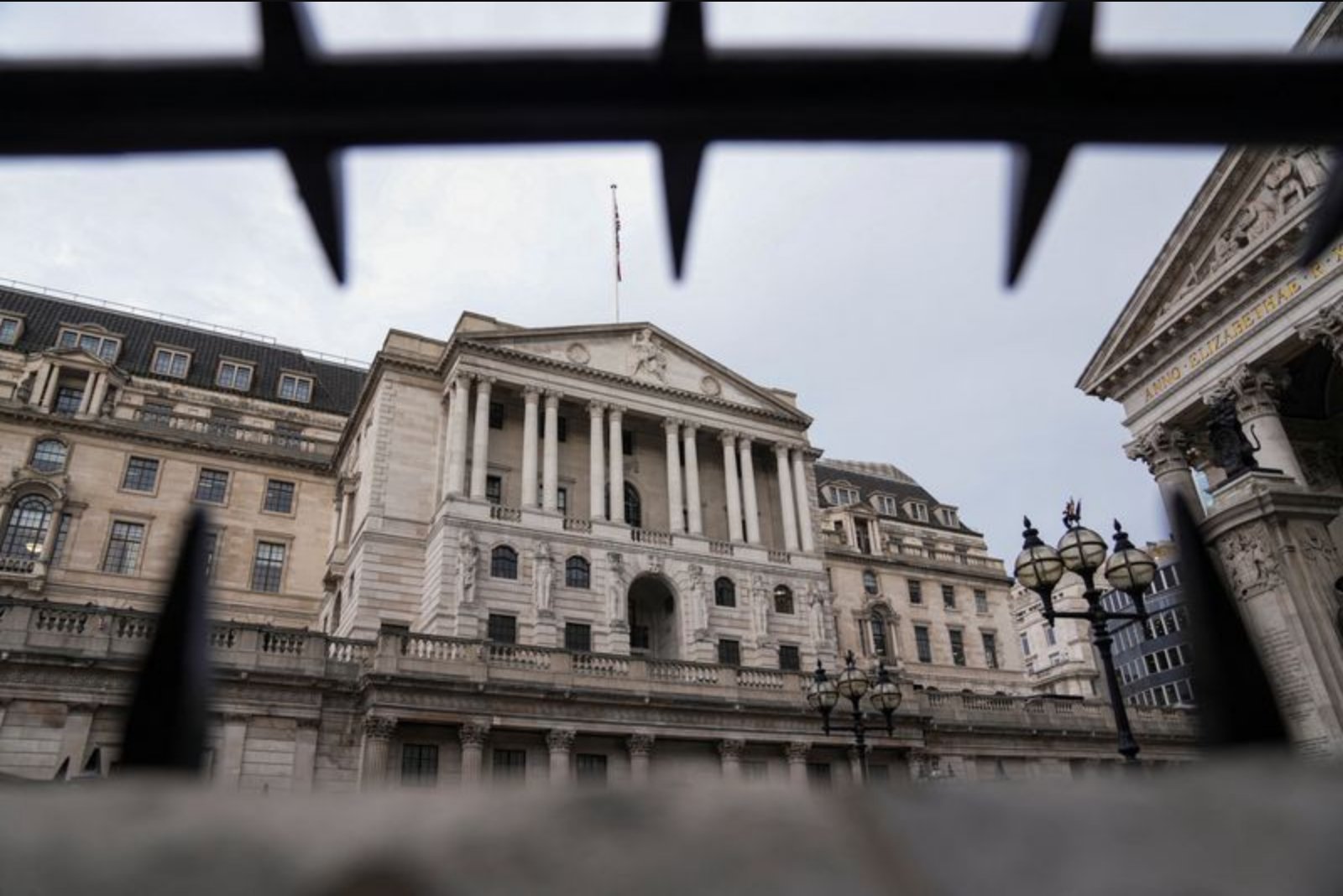
LONDON, April 30 - Citing the uncertainty generated by the Iran war, the Bank of England presented three separate forecast scenarios in its April 2026 Monetary Policy Report rather than publishing a single central projection. The report maps out three distinct paths for inflation, interest rates and economic activity depending on how energy costs evolve and how households react.
Scenario A - Least inflationary
Under the least inflationary path, oil and gas prices are assumed to track the levels implied by futures curves. Household spending is projected to fall by more than historical relationships with real incomes would suggest, reflecting a shift in priorities in household budgets. The report assumes this combination - a relatively short-lived energy shock plus softer demand - is sufficient to prevent notable second-round inflation effects. Inflation is forecast to peak at just above 3.5% at the end of 2026, then ease back to slightly below 2% around three years out. The Bank judges that achieving those outcomes would require interest rates over the next three years to be higher than markets were expecting in February.
Scenario B
In the middle path, energy prices peak at levels similar to those in Scenario A but remain elevated for longer. Household saving and spending behaviour is assumed to follow historical patterns rather than the larger spending shifts assumed in Scenario A. Second-round effects in this scenario are described as modest. Inflation in this projection likewise peaks at a little over 3.5% at the end of 2026 before declining to close to 2%. As with Scenario A, the Bank indicates that interest rates across the next three years would need to be higher than markets had expected in February.
Scenario C - Most inflationary
The third and most inflationary scenario assumes energy prices rise more sharply than in Scenarios A or B and remain high for an extended period. That prolonged increase in energy costs produces much stronger second-round effects than in Scenario B. Inflation in this pathway is projected to top 6% in early 2027 and to stand at about 2.5% - above the Bank's 2% target - at the end of the three-year horizon. To steer inflation back toward target under this scenario, the Bank says Bank Rate would need to be "materially higher" than financial markets had priced in during the 15 days to April 22. The outcome implied by that course would be weaker economic growth and higher unemployment.
The Bank's use of scenario analysis reflects the range of possible outcomes driven by energy-price dynamics and household responses, and underscores the potential need for tighter policy in several plausible paths.
Summary of scenarios
- Scenario A - Energy follows futures curves; larger-than-expected drop in household spending; peak inflation a little above 3.5% end-2026; falls to just below 2% in about three years; interest rates higher than markets expected in February.
- Scenario B - Energy peaks similarly but stays higher; household saving mirrors past behaviour; modest second-round effects; inflation peaks a little over 3.5% end-2026; returns close to 2%; interest rates higher than markets expected in February.
- Scenario C - Sharper, prolonged rise in energy prices; much stronger second-round effects; inflation peaks above 6% in early 2027 and is around 2.5% at the three-year mark; Bank Rate would need to be "materially higher" than market expectations in the 15 days to April 22, leading to weaker growth and higher unemployment.