
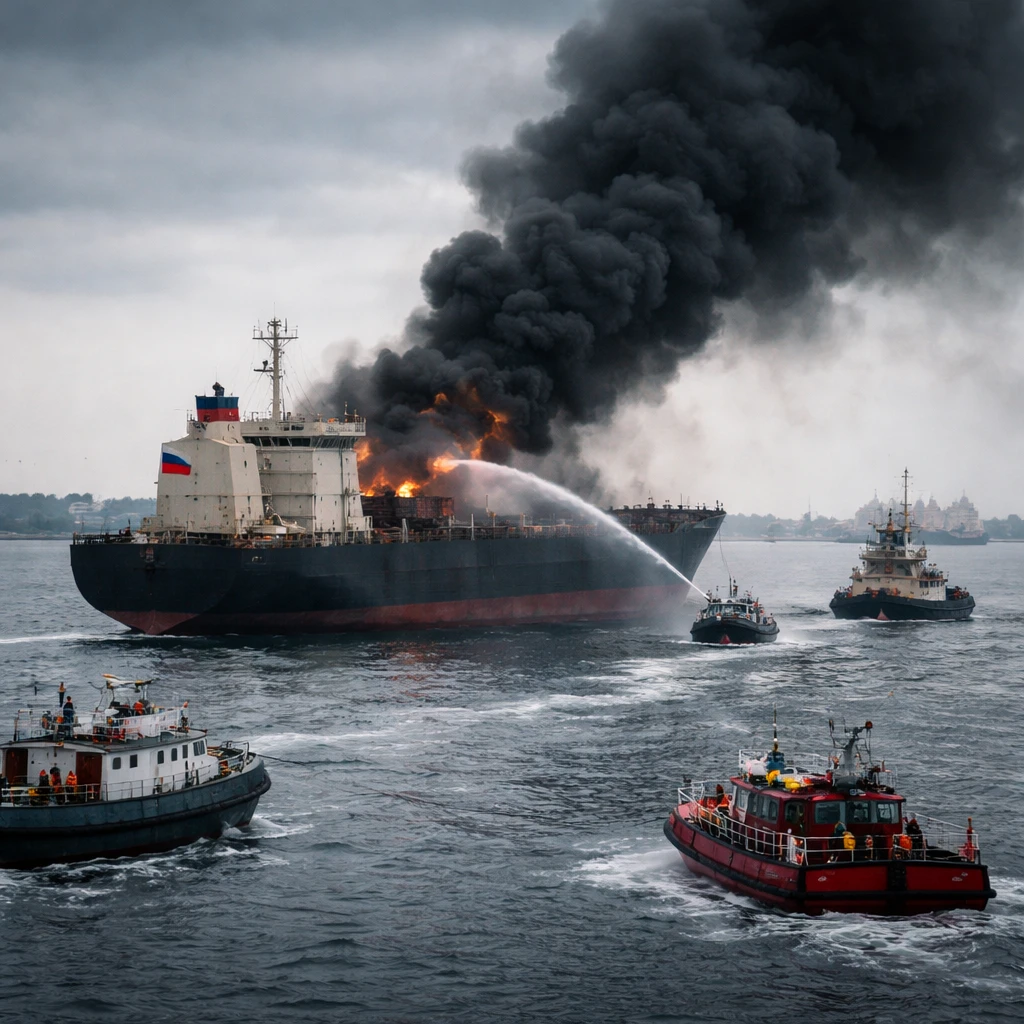
KYIV/OSLO - Ukrainian President Volodymyr Zelenskiy has confirmed his government was behind the drone strike on the Russian cargo vessel Sparta II in the Gulf of Finland last Saturday, saying the operation hit a lawful military target. The incident prompted a multinational maritime response to bring the fire under control, and the ship was later towed back into Russian waters and anchored near St Petersburg.
Zelenskiy told Bloomberg on Monday: "We did everything right." He added: "Every vessel with a Russian flag, everything that carries weapons or any sanctioned cargo that can carry God knows what, it is a legitimate target for us in Russian territorial or neutral waters."
The ship targeted, Sparta II, sails under the Russian flag and is owned by Oboronlogistika, a company that describes itself as providing logistics services for the Russian Defence Ministry on its website. Zelenskiy said the strike took place in Russian territorial waters and asserted Kyiv had the legal right to carry out the action. He also acknowledged that "some drift happened" and that questions remained, saying: "We had all the rights for that and then some drift happened and surely there are questions."
Following the attack, Finnish, Estonian and Russian vessels collaborated in a rescue effort to extinguish the blaze aboard the Sparta II. On Sunday, a Russian tug returned the vessel to Russian-controlled waters, where it is now anchored in the St Petersburg area.
Zelenskiy recognised that several European allies had expressed concern about operations in the Baltic Sea region. He said he had instructed Ukrainian ministers and military officials to increase communications with partner countries so "they have enough details and there are no surprises."
Norway urges caution and stresses stability
Norwegian Defence Minister Tore Sandvik, speaking on Tuesday, said Oslo was in active dialogue with Ukraine about "a need for stability in our near areas." He reiterated Norway's position that the broader conflict would end only if Russia ceased its campaign, saying: "All attacks would stop immediately if Russia stopped this war."
Sandvik emphasised Norway's expectation that Ukraine conduct operations in accordance with international law. "That said, we are focused on the fact that Ukraine must do this (these actions) within the rules of international law. So we take this matter up with them," he told reporters. He added: "We are also focused on the fact that they must respect our need for stability in our near areas and we have a good dialogue with the Ukrainians on that now."
The defence minister made these remarks after signing an agreement with his Ukrainian counterpart, Yevhenii Khmara, to broaden bilateral cooperation on an anti-drone system, intending to expand its deployment across more parts of Ukraine.
Sandvik did not say whether he raised the Gulf of Finland incident specifically during his meeting with Khmara.
Norway has established a long-term funding plan for Ukraine, with cross-party parliamentary backing, totaling about $27 billion from 2023 through 2030. That package makes Norway one of Ukraine's most generous supporters on a per capita basis.
Context provided by Ukrainian and Norwegian statements
The Ukrainian confirmation of responsibility and the subsequent Norwegian urging of restraint highlight tensions between Kyiv's military objectives and allied concerns about regional stability. Kyiv has described the target as connected to Russian military logistics, while Oslo has pressed for adherence to international law and clearer communication to avoid unintended escalation in nearby waters.
Separately, the Norwegian-Ukrainian agreement to enhance anti-drone capabilities underscores continuing defence cooperation, even as allies discuss the implications of offensive operations in sensitive maritime zones. Meanwhile, Russian forces have continued air attacks on Kyiv and other cities with near-daily strikes since September, according to statements included in the public record.
Questions remain about the exact circumstances of the Sparta II operation, the degree to which any "drift" affected the strike's location, and whether allied concerns will translate into limits on future Ukrainian actions at sea. Norway says it will continue dialogue with Ukraine to reconcile Kyiv's operational imperatives and the alliance's interest in stability in the Baltic-Black Sea approaches.