
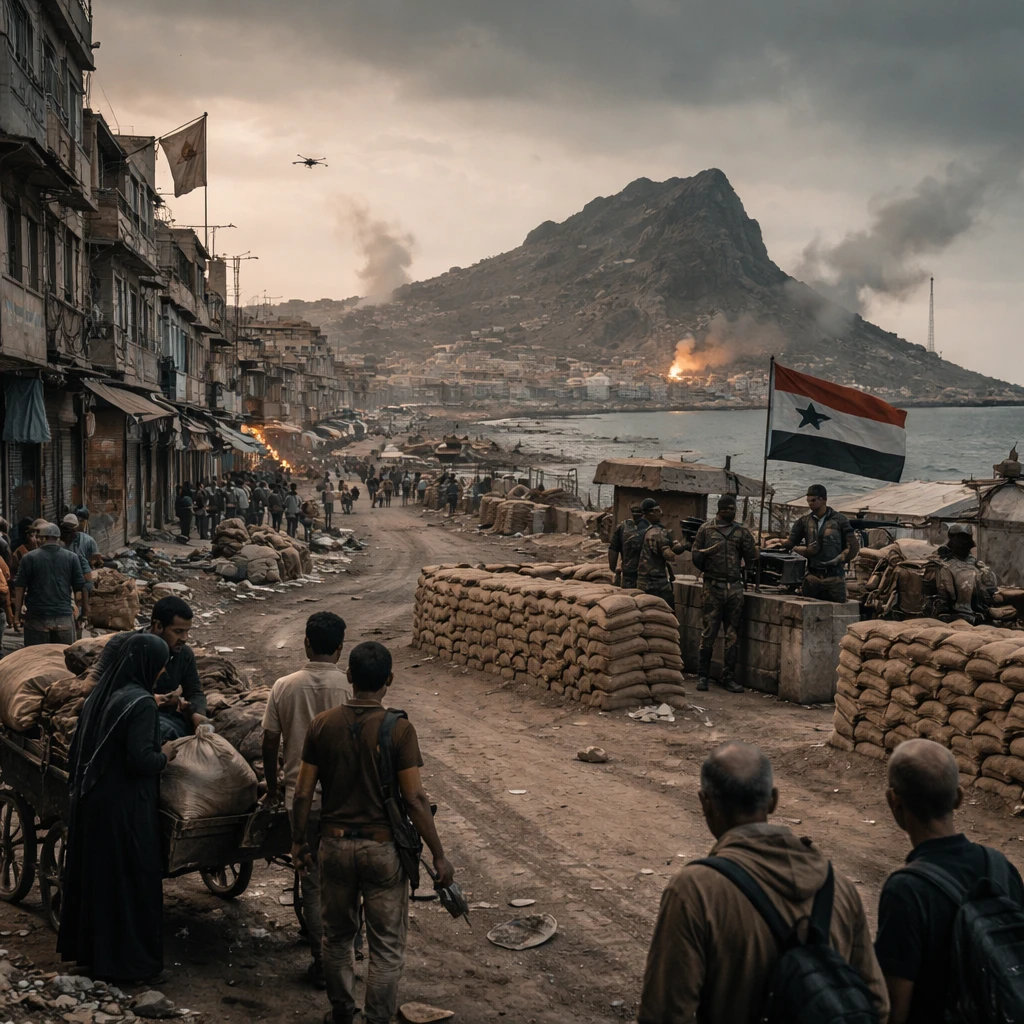
As Houthi fighters press closer to Aden, the southern port city that houses Yemen’s internationally recognised government, residents face a stark dilemma: remain under mounting missile and drone fire or leave for the hard-pressed countryside. Aden, which saw its last major urban fighting in 2015 when the government relocated there after fleeing Sanaa, is once again under attack and feeling the strain of an advancing front.
"Rockets are being fired into this city in a frightening way. People are in a state of constant anxiety," said Tariq Abdul Rahman, a former soldier who lives in Aden with his extended family. His comments reflect widespread fear among citizens encountering both the physical danger of strikes and the economic uncertainty that comes with renewed conflict.
Military picture on multiple fronts
Analysts and local sources describe a widening Houthi campaign after a four-year truce collapsed this summer. The rebels are pushing on almost every front, and positions north of Aden are now roughly 80 km from the city along the highlands. From the west, Houthi forces are about 110 km away along a desert route offering few natural barriers, according to the accounts provided by local military sources and residents.
Inside Aden, defensive preparations have intensified. Troops and paramilitary units have established checkpoints, called in reinforcements, dug trenches and placed earth barricades along roads leading toward the frontline. The city, built around an extinct volcanic cone projecting into the Indian Ocean, has adopted a defensive perimeter focused on slowing or disrupting any approaching columns.
Coordination and fracture among pro-government forces
Despite visible efforts to prepare the city, internal divisions among the disparate forces aligned with the recognised government have complicated defence planning. Analysts point to competing political objectives and divergent territorial priorities among the units arrayed against the Houthis, and to interference by rival Gulf backers, as factors that undermine unified action.
"These forces may share a common enemy in the Houthis, but they do not share the same political objectives, territorial priorities, or willingness to fight," said Mohammed al-Basha of the Royal United Services Institute. His assessment highlights how differing agendas among anti-Houthi groups can limit operational effectiveness even where coordination is attempted on the ground.
The internationally recognised government has rejected claims of disunity, saying forces defending Aden operate under a single strategic command. Emad Bamatraf, deputy head of the Yemeni mission in Washington, said in emailed comments that the Giants Brigades, the Homeland Shield Forces, the Emergency Forces, and units from the Third, Sixth and Seventh Military regions coordinate their actions in defence of Aden.
Flags, factions and contested loyalties
On Aden’s streets this week, soldiers manning checkpoints were displaying the flag of the former state of South Yemen - a banner widely seen across the city. Those flags signify political aspirations among some southern groups for a reversal of the 1990 unification with the north, and they underline how local identity and long-standing grievances shape the present alignments.
But differences among southern factions have at times spilled into direct conflict. Last winter, forces backed by two Gulf states fought for weeks over territory, and the confrontation concluded with the United Arab Emirates withdrawing from the military coalition confronting the Houthis and a Saudi-supported faction splitting away from the Southern Transitional Council (STC). The STC’s leadership subsequently stepped down from government positions.
Although the STC has not participated in the most recent frontline fighting against the Houthis, the movement maintains that it would defend Aden and the wider south if required. Anwar al-Tamimi, an STC spokesperson, said that on-the-ground coordination to defend the south continues, while also criticising the government’s ability to impose a clear command-and-control structure on anti-Houthi forces. He added that the STC’s political demands - notably a proposed referendum on southern secession - must be addressed as part of any broader settlement. "What we won’t do is send our soldiers into an offensive with no strategy and no route to a political settlement," he said.
Other southern groups, however, have rejected involvement in battles over territory that once belonged to the former north, further complicating the patchwork of loyalties and military commitments in and around Aden.
Civilians weigh safety, debt and displacement
On a personal level, the renewed danger has deepened anxieties for residents who already contend with limited wages, mounting debts and scarce services. Abdul Rahman, who served 30 years in the military and now shares a modest three-room home with eight relatives, described nights broken by explosions and days spent worrying about food, shelter and the welfare of his children.
"Shells are falling randomly on streets, markets, and homes. This terrifies people so much," he said, adding that sleep is rare and financial pressure constant. He said his family relies on unpaid credit extended by local shops, and that growing indebtedness compounds the emotional strain of living under bombardment. With options dwindling as fighting approaches, he said he did not know whether to remain in Aden or attempt to move to the countryside, and he expressed uncertainty about affording travel.
For many low-income workers, the security situation has directly reduced income opportunities. Khaled Abdo, a day labourer on construction sites in Aden, has not worked for more than a week and supports ten children. The decline in available work has heightened his sense of crisis. "We want security and stability and Yemen to go back to being a state, the way we used to live before," he said, articulating a desire for restored normalcy amid mounting peril.
Humanitarian displacement and the strain on aid
The conflict’s resurgence has produced large-scale displacement. Hundreds of thousands of people have been uprooted since fighting resumed, and many survive on meagre aid distributions. Numerous displaced families live in small tarpaulin camps in the hills around Taiz, Yemen’s third-largest city, which the article states is currently besieged by Houthi forces. Those camps and the broader humanitarian response are already under strain as the number of people fleeing frontline fighting grows.
The combination of incoming strikes, fractured military alignment among anti-Houthi forces, and economic hardship for ordinary residents has created an environment of deep uncertainty in Aden. With key questions about unified command on the battlefield and political demands left unresolved, the city’s future remains precarious as frontline movements continue to advance.
Outlook
Aden’s current condition is shaped by the convergence of military pressure from the north and west, internal divisions among its defenders, and mounting civilian hardship. Until political grievances among southern actors and the operational coherence of anti-Houthi forces are addressed, the city looks likely to remain under significant security and humanitarian strain.