
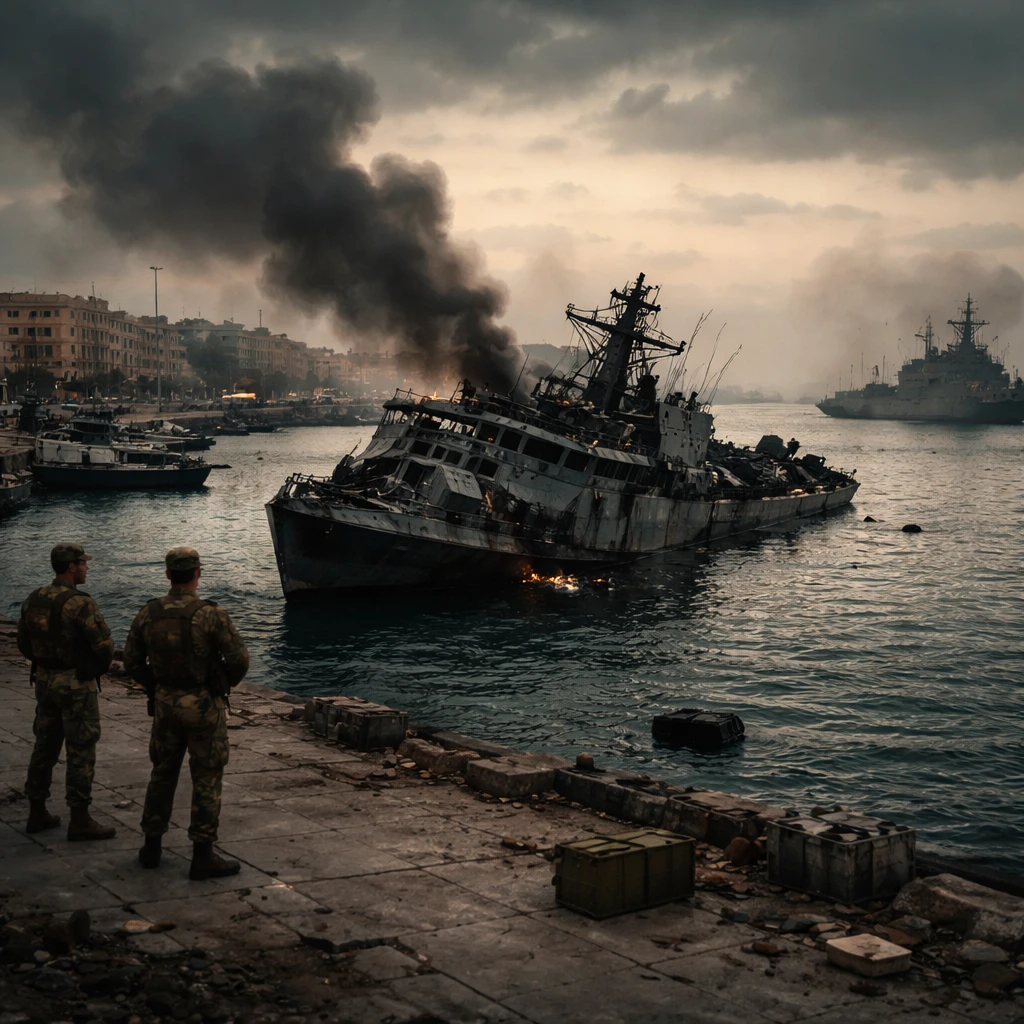
Nov 24 - The recent sinking of a Russian naval vessel in a Libyan port has served as a stark reminder that a conflict long reduced to a tense stalemate can still spark fresh instability. The incident highlights how a web of local rivalries and external interventions has left Libya fragmented since the fall of Muammar Gaddafi and vulnerable to episodic outbreaks of violence.
After the 2011 uprising that ended Gaddafi’s 42-year rule, Libya’s attempted transition did not result in a stable national order. Instead, armed groups that had helped overthrow the regime entrenched themselves locally, building military and economic power bases aligned with competing political factions. Those dynamics eroded efforts at a unified state and turned control of land and resources into a central axis of the dispute.
The post-2011 environment set the stage for a split that hardened in the 2010s. Following parliamentary elections in 2014, a majority of the newly elected members relocated to the east and recognised Khalifa Haftar as their military leader. That alignment produced a parallel administration based in the east and a division of authority that the state has never fully bridged.
A UN-backed political accord was later intended to reunify the rival administrations. Elements in the east rejected the deal and, in 2019, Haftar’s Libyan National Army launched an offensive against Tripoli. That campaign brought in substantial external support for Haftar from some regional backers, while forces defending the capital received backing from Turkey. The attack on Tripoli stalled and a 2020 ceasefire halted large-scale fighting, but it did not resolve the fundamental political disagreements.
Following the ceasefire, the United Nations supported the formation of an interim Government of National Unity and a roadmap towards elections in 2021. However, those planned elections were cancelled amid disputes over procedures and who could stand as candidates. With no binding settlement on a new political framework, Libya has remained divided. The Tripoli-based authority lacks effective control across much of the country and foreign forces and proxies remain entrenched in various regions.
Several external powers have significant footprints in Libya, backing rival sides and pursuing strategic interests that extend beyond the country’s borders. The presence of these actors complicates any attempt to restore unified governance.
Russia is among the most consequential outside players. Moscow backed Haftar early on. A 2019 panel of United Nations experts reported the presence of up to 1,200 Wagner mercenaries in Libya. In 2020, the United States said Russia had sent warplanes to the country, a claim Russia denied. After the 2020 ceasefire, Russia continued activity in areas controlled by the LNA, with the US National Geospatial-Intelligence Agency reporting that Moscow expanded facilities at six LNA-controlled airbases. Washington also reported Russian warships docking at LNA naval bases. Tripoli’s government has publicly called for a Russian withdrawal. The LNA itself rarely comments on the Russian presence, although its media has at times shown visits by Russian military officials.
Ukraine has also been reported to have a role, albeit in a different capacity. Two Libyan security officials said in March that Ukrainian personnel were operating out of western Libya. According to those officials, Ukrainians provided training to forces aligned with the Tripoli government and carried out operations targeting Russian assets. The Government of National Unity has not denied Ukrainian activity but has stated it will not allow Libyan territory to be used as a staging ground for attacks.
Turkey intervened directly in 2019 at the request of the internationally recognised government, deploying troops, drones and armoured vehicles to help defend Tripoli against Haftar’s offensive. Turkey maintains a military presence in western Libya that includes an airbase at al-Watiya and a naval base in Misrata. In 2019, Tripoli signed an agreement with Turkey on maritime boundaries in the eastern Mediterranean. That deal was rejected by Greece, Egypt and Israel, and initially met resistance from Libya’s eastern-based parliament. Turkey has since worked to improve relations with eastern factions and this year the eastern parliament approved the maritime agreement.
The United Arab Emirates has been associated with backing for Haftar since at least 2014, viewing him as a counterweight to forces linked to the Muslim Brotherhood. UN experts have said the UAE supplied drones, air defences and armoured vehicles to Haftar, and the Tripoli government accused the UAE in 2019 of conducting airstrikes and transporting African mercenaries into Libya. The UAE denied those allegations. Despite its longstanding ties to Haftar, the UAE has also developed relations with western political figures such as Dbeibah.
There are diplomatic efforts aimed at unifying Libya’s fractured institutions, but key obstacles remain. The US Libya envoy has been advancing an initiative that seeks to bring state institutions together as a preliminary step toward national elections. While the details of that initiative have not been publicly disclosed, the envoy has said the parties have agreed on a comprehensive framework for institutional unification.
Analysts familiar with the initiative indicate it may rest on a power-sharing formula between dominant families that control the east and west. That approach envisions the Haftar family, influential in the east, and the Dbeibah family, based in the west, making concessions to share authority. One proposal reviewed this year suggested Dbeibah would remain prime minister within a new governmental configuration while Saddam Haftar, the son of Khalifa Haftar, would head a presidential council.
Such an arrangement may alarm some Libyans. Critics fear that a settlement built around entrenched powerbrokers could preserve the status quo rather than open the way for competitive and meaningful elections that change how the country is governed.
Libya’s conflict has practical economic and regional consequences. Energy is central to those dynamics. The country is a major oil exporter and output has reached as much as 1.3 million barrels per day. Control over oil revenues has long been a primary objective for the main factions. Because most oil fields and export terminals are located in areas under LNA control in the east, those assets are valuable leverage. International agreements require that revenue from oil sales be channelled through the central bank in Tripoli, which is supposed to use the funds to provide state services nationwide.
That system has been vulnerable to disruption. Groups have periodically closed oil terminals or halted operations at fields to exert pressure on Tripoli, using the loss of revenue as a bargaining tool. Such tactics have direct implications for Libya’s public finances and for global oil markets when production and exports are curtailed.
Beyond energy, Libya’s geographical position also affects migration flows to Europe. The country remains a key departure point for migrants crossing the Mediterranean, a factor of concern for European states. That migration dimension links Libya’s internal instability to broader regional challenges.
For now, Libya remains a state divided in practice if not in name. The combination of unresolved political disputes, influential domestic powerbrokers and sustained foreign involvement has frozen the conflict into a tense equilibrium. Incidents such as the sinking of a naval vessel demonstrate that the situation can still produce sudden escalations with implications beyond the country’s borders.
Efforts at unification and elections face substantial hurdles. Any pathway that relies primarily on negotiated arrangements among the existing elites risks entrenching the patterns that have kept Libya fragmented. Until rival factions agree to transfer authority in a way that produces credible, accountable institutions, the divisions will be likely to persist and periodically spill over into regional instability.