
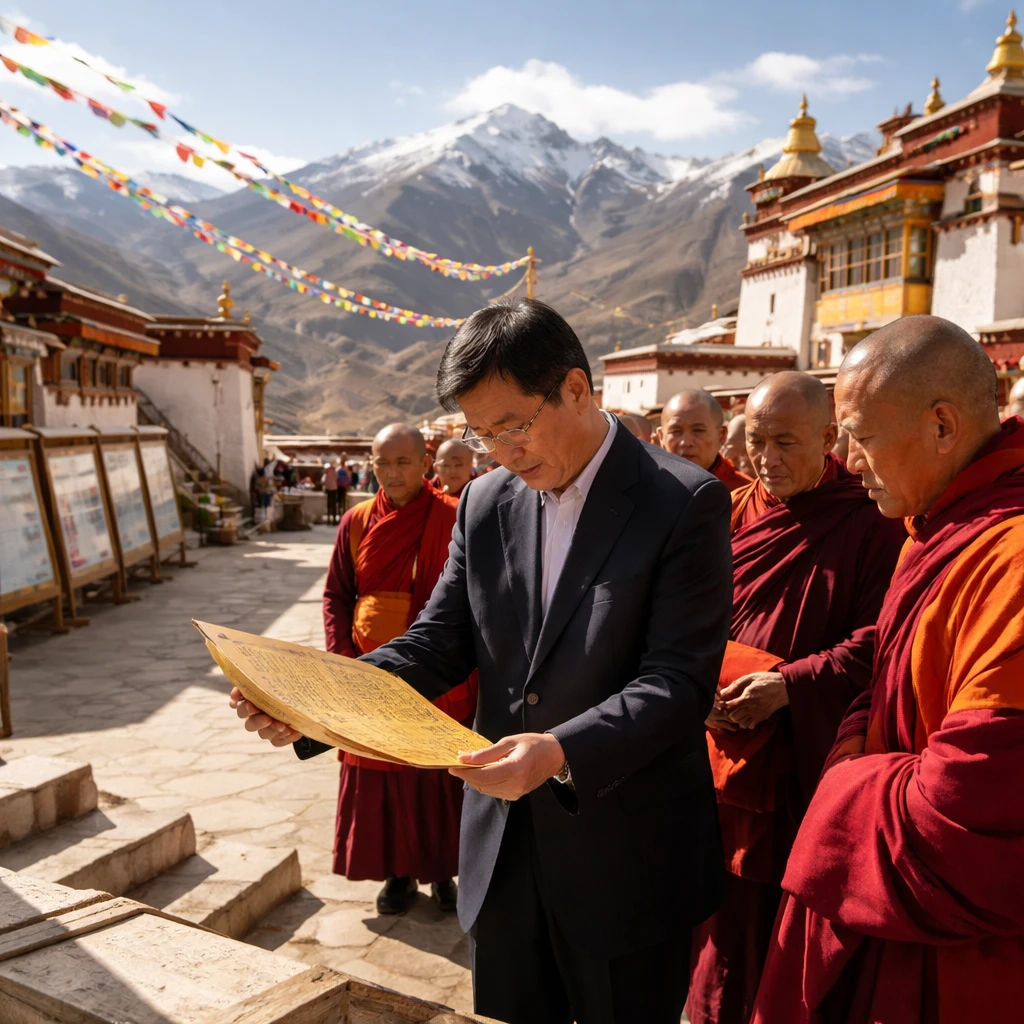
BEIJING, July 22 - China’s fourth-ranking leader, Wang Huning, urged authorities in the Tibet Autonomous Region to prioritise stability, enforce a recently enacted ethnic unity law and guide Tibetan Buddhism to conform more closely with Communist Party principles during a weeklong inspection of the region, state media reported.
Wang, who serves on the seven-member Politburo Standing Committee, visited both Lhasa, the regional capital, and the Ngari prefecture that borders India and Nepal on a four-day tour that concluded on Wednesday. Addressing local cadres, Wang said: "To govern Tibet is foremost to stabilise Tibet." He added that work should focus on "consolidat[ing] a political and social environment of unity and stability."
The trip took place weeks after a new national law on ethnic unity came into force on July 1. The legislation, which has attracted criticism from certain foreign governments, grants Chinese authorities legal grounds to take action against individuals outside China who are considered to have harmed "ethnic unity and progress or inciting ethnic separatism," according to descriptions of the law.
Wang told officials in Tibet that the law should be implemented in full. His remarks came in the same week a Tibetan man died after setting himself on fire near United Nations headquarters in New York; activists identified the man and said his action was an appeal for independence.
Guiding religion in line with party priorities
Wang emphasised the need to "continuously guide Tibetan Buddhism to adapt to socialist society in line with the requirement to ... systematically promote the Sinicisation of religion in China." He framed this direction as part of broader efforts to align religious practice more closely with Chinese culture and Communist Party doctrine.
As a senior party strategist who has counselled three successive Chinese leaders, Wang oversees ideological work and united front operations, which include ethnic and religious affairs. Observers noted parallels with his messaging during a visit to Xinjiang in June, where he similarly stressed stability and ethnic unity.
State broadcaster CCTV aired footage of Wang visiting a Tibetan Buddhist monastery, where he examined an early 15th century Ming dynasty imperial eulogy to the Buddhist canon. The broadcaster presented the historical text as aligning with a narrative that underscores historical ties between Tibet, Tibetan Buddhism and dynastic Chinese governance.
Inside the monastery compound, display boards visible in the CCTV footage promoted the Sinicisation of Tibetan Buddhism and urged "stepping up law-based management of temples and monasteries," according to the state footage. Wang also called for intensified publicity and education efforts aimed at forging a unified national identity "in a tangible, perceptible and effective way."
He instructed that "the party’s strategy for governing Tibet in the new era ... should be fully implemented," reiterating the central role of the Communist Party’s directives in regional governance.
Context and administrative framework
The Communist Party established the Tibet Autonomous Region in 1965 with a stated intent to provide ethnic minority groups such as Tibetans a greater voice in local policy areas, including freedom of religious belief. International human rights organisations and exile communities have frequently described China's administration of Tibet as "oppressive," a characterization Beijing rejects. The original reporting noted these contrasting perspectives without additional elaboration from local officials.
Wang’s visit underscored the party leadership’s continued focus on ideological cohesion, legal enforcement of ethnic unity, and efforts to manage religious institutions within a framework aligned to party objectives.