
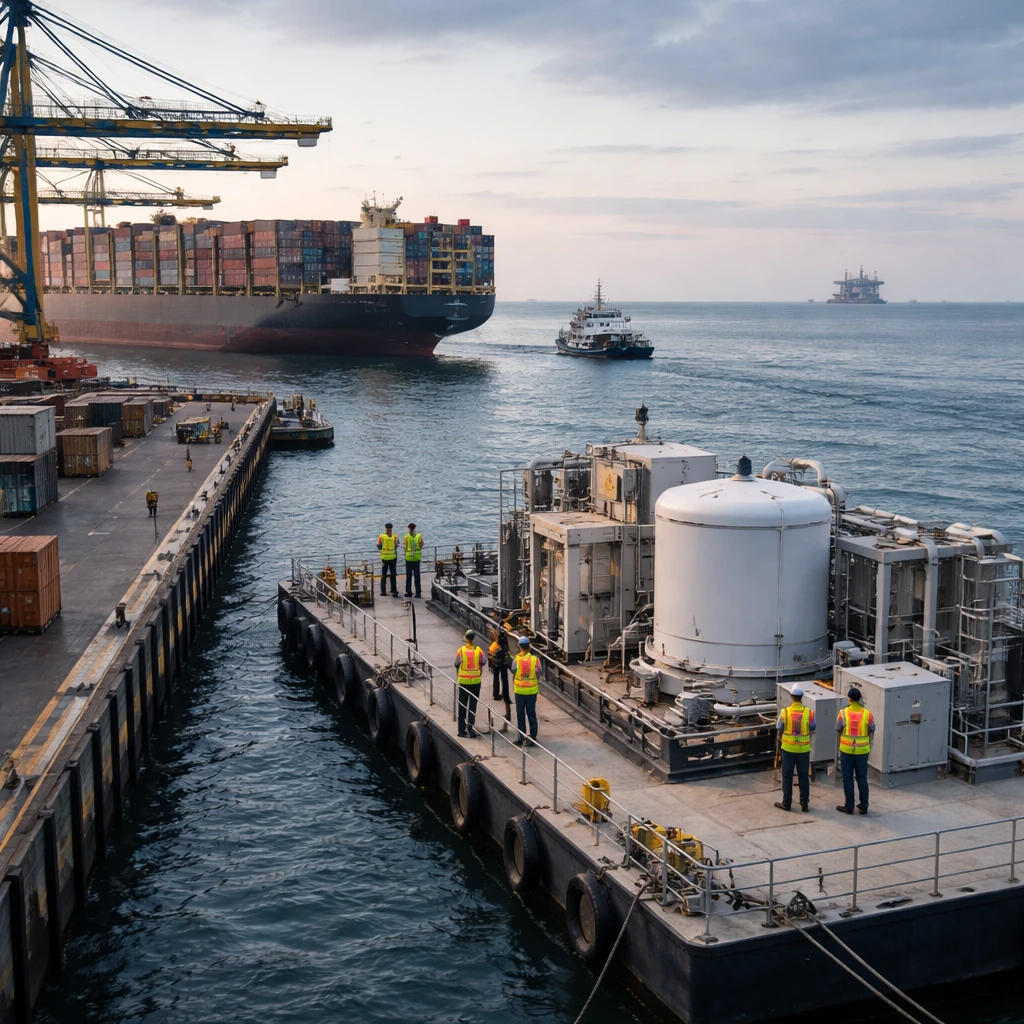
The federal government is taking initial steps to examine whether nuclear power can be deployed in areas of the ocean under U.S. jurisdiction. The Interior Department’s Marine Minerals Administration and the U.S. Nuclear Regulatory Commission announced on Wednesday an agreement to improve coordination as they evaluate the prospect of undersea nuclear power plants within the roughly 3.2 billion acres overseen by the federal government.
No commercial nuclear facilities are currently approved or planned in federal waters, according to the agencies. The Marine Minerals Administration said the purpose of the agreement is to study whether — and under what conditions — the technology could be introduced responsibly in the future.
Separately on Wednesday, officials from the Department of Transportation and the Port of Long Beach signed a memorandum of cooperation focused on testing small modular reactors for commercial vessels and other uses at the port. The agreement frames the port as a testing ground for maritime applications of compact nuclear units.
Port of Long Beach Chief Executive Officer Noel Hacegaba described the move as a response to shifts in the energy market. "Everything that’s going on in the energy market, the cost of fuel, and the uncertainty surrounding that is strengthening the case for energy diversification," he said after the signing at the Transportation Department’s Maritime Administration in Washington. "Now is the right time for us to explore nuclear energy."
Hacegaba also noted that Long Beach-based Bluecore Energy is collaborating with the port on research and development for maritime small modular reactors. The cooperation between the port and a private company is positioned as part of efforts to understand practical applications of the technology for ships and port operations.
The coordinated reviews by federal agencies and the port-level testing program represent exploratory steps rather than approvals or deployments. Officials have framed the initiatives as assessments to determine feasibility and responsible implementation, leaving open the outcome of whether commercial undersea plants or maritime reactors will move forward.
As the assessments proceed, agencies and stakeholders will be focused on the technical, regulatory, and operational implications for energy supply at sea and in port facilities. For now, the efforts are centered on studying the possibilities and establishing frameworks for further action if warranted.