
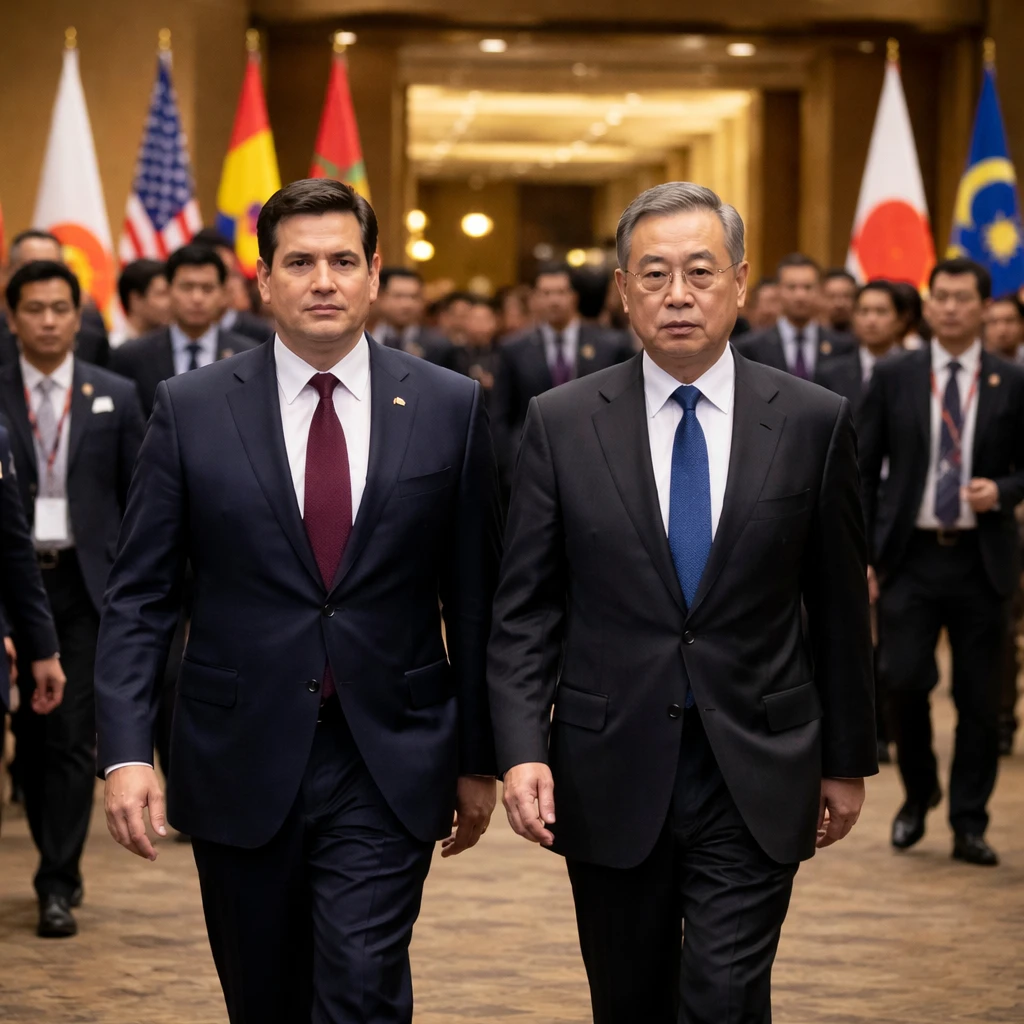
MANILA, July 22 - U.S. Secretary of State Marco Rubio is scheduled to hold talks with Chinese Foreign Minister Wang Yi on Wednesday during a regional meeting convened by the Association of Southeast Asian Nations in Manila, a State Department official confirmed.
The two senior diplomats are expected to discuss arrangements for a potential leaders' summit in September, a follow-up to a meeting between their presidents earlier this year. The meeting takes place amid a fragile truce between Washington and Beijing that has been strained by recent U.S. allegations of Chinese interference in U.S. elections, accusations that Chinese officials have denied.
The broader gathering in Manila is unfolding at a time of renewed hostilities in other regions and the prospect of a new front in tensions involving the United States and Iran. Diplomatic relations between Beijing and a close U.S. ally, the Philippines, have also frayed following an incident in the South China Sea that prompted both capitals to summon each other's ambassadors.
Rubio took part early on Wednesday in discussions with the foreign ministers of ASEAN. Officials say he is likely to emphasize Washington's commitment to defending maritime rights in the South China Sea and to upholding U.S. obligations to partners in the region.
On his arrival in Manila, Rubio published an opinion piece in Philippine media criticizing Beijing and warning of mounting pressures on Southeast Asian states. In that commentary he described the region as facing "new and coercive threats" and reiterated a U.S. promise to defend freedom of navigation.
"That freedom is by no means guaranteed. If those waters fall under the control of a power willing to use commerce as a geopolitical weapon, both the United States and the ASEAN states would face dire new threats to their sovereignty, security, and economic futures," Rubio wrote.
China asserts sovereignty over nearly the entire South China Sea with a maritime demarcation that extends into the exclusive economic zones of the Philippines, Malaysia, Vietnam, Brunei and Indonesia. These claims lie at the heart of longstanding disputes over islands and maritime features.
On the sidelines of the Manila meetings, Wang is also scheduled to meet Philippine Foreign Secretary Maria Theresa Lazaro, who is serving as chair of the ASEAN-led gathering.
Tensions between Beijing and Manila have risen in recent years as Philippine President Ferdinand Marcos has adopted a firmer position on South China Sea issues while deepening defense ties with the United States and broadening security cooperation with Australia and Japan.
In a meeting on Tuesday with ASEAN Secretary-General Kao Kim Hourn, Wang accused certain parts of the Philippines' security apparatus of deliberately provoking and creating maritime incidents, according to Beijing's readout of the discussion. Wang said those actions served the interests of "external forces," and urged that South China Sea disputes should not obstruct Beijing's relations with ASEAN. He added that China is prepared to work with the bloc to "eliminate interfering factors."
Delegations from Australia, Russia, Japan, Canada, South Korea, Britain, the European Union and India are also attending the Manila meetings, reflecting the wide international interest in the regional agenda.
Analysts have suggested that the Rubio-Wang exchange will likely center on logistical and substantive preparations for a second summit between U.S. President Donald Trump and Chinese President Xi Jinping after their meeting last May. President Trump has indicated that President Xi's visit to the United States is expected at the end of September, and Rubio has said the summit remains anticipated.
Note: This article presents statements and reported plans as provided by officials and official readouts. Where specific claims or characterizations are attributed to parties, they are reported as described in the meeting summaries and public commentary.