
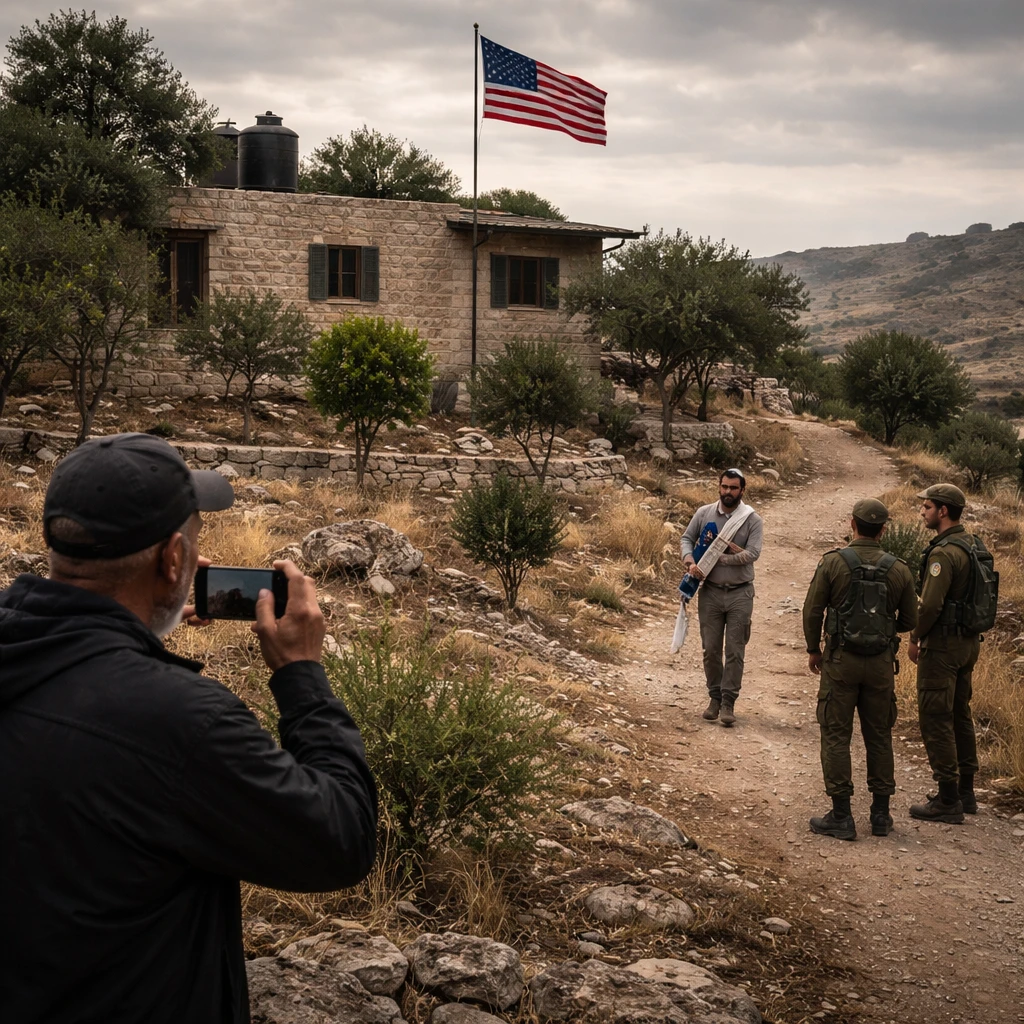
Palestinian American Loui Ridi returned from the United States to his native village in the Israeli-occupied West Bank and hoisted a large American flag over his property in Qusra, hoping the symbol would deter nearby militant settlers. Despite the display, one settler walked onto Ridi's land on Tuesday, sparking a tense face-to-face encounter that was filmed by Reuters, the only media outlet present.
Ridi, who grew up in the village, arrived late on Monday amid growing alarm that Jewish settlers encircling three Palestinian homes in Qusra might eventually seize the properties. The encirclement has lasted for more than a week and prompted condemnation from U.S. officials.
On Tuesday morning, while Ridi walked among his cherry and fig trees, a settler came down from a hill above the plot. The interaction was recorded on mobile phones. The settler, carrying what appeared to be a Torah and filming Ridi, approached and said in Hebrew, "You came to make a mess, ha?" Ridi, who was also filming, responded in kind, saying, "You are a terrorist settler, you know that?"
An Israeli military vehicle passed the scene multiple times before soldiers disembarked and spoke with the settler, telling him the area was a closed military zone. The settler told the soldiers, "I’ll leave if they leave. There are a lot of guys here. We’re all just guarding our territory. If they go inside the house, we’ll leave." He then retreated up the road and later rejoined two other settlers before walking up the hill and out of sight. When approached by Reuters, the settler did not answer questions about his purpose on the property.
Following the encounter, an Israeli soldier instructed Ridi to enter his home, saying, "Just be inside, they go and you’ll be inside. Don’t talk to each other, ok? I’ll solve this problem." Ridi told the soldiers that the settler’s presence was illegal and said the settler should be arrested. The soldier did not arrest the settler at the scene.
The confrontation underscored mounting tensions in Qusra, where settlers began surrounding the homes more than a week earlier. Rights groups say such actions are part of a broader effort by settlers to obtain additional land from Palestinians, further reducing contiguous territory Palestinians consider necessary for an eventual state.
The Israeli military has said it deployed forces to the area to restrain settlers and to preserve security for residents. Nevertheless, the families whose homes are being besieged say they are too afraid to leave. In response to the threat, Ridi raised the U.S. flag over his house shortly after arriving in the village.
Regarding his decision to display the American flag, Ridi said, "I decided I want to raise this flag. If, God forbid, I’m unable to protect this house and the settlers end up here, they’re going to raise (their) flag. But before they raise their flag, they have to move the American flag, and that’s the message."
Violence by Jewish settlers in the West Bank has increased in recent periods, and some settlers have been emboldened by the policies of the government led by Prime Minister Benjamin Netanyahu, who has overseen a significant expansion of settlements, according to observers cited in the account.
One of Ridi’s neighbors, Ibrahim Hassan, who does not hold U.S. citizenship, told Reuters he fled his home last month after settlers, accompanied by men in green military garb, smashed his windows, entered his house and beat him. At the time this account was filed, Israel’s military had not immediately responded to a request for comment.
U.S. officials estimate that tens of thousands of Americans live in the occupied West Bank, with many concentrated in a group of villages between Ramallah and Nablus where Qusra is located. Local officials in the nearby village of Turmus Ayya, about 7 km southwest of Qusra, say approximately 80% of that town’s population holds U.S. citizenship.
Yaser Alkam, 58, a spokesman for the Palestinian American community in Turmus Ayya, explained why American flags appear on many homes. "It’s a form of security, a form of protection. It provides deterrence not only to the settlers but also to the IDF," he said. He added that the flags convey a direct message to the Trump administration: "Here’s an American citizen being attacked in the West Bank by an American tax-funded army, American weapons used to attack Palestinian Americans in the West Bank."
The U.S. Ambassador to Israel, Mike Huckabee, described the settlers who have besieged Ridi’s home as "Israeli terrorists" and condemned their actions. A U.S. official and an Israeli official said on Friday that White House officials are urging Prime Minister Netanyahu to publicly denounce the settlers’ behavior. Netanyahu has not publicly commented on the siege in Qusra.
The standoff in Qusra highlights multiple pressures converging on a small cluster of homes: civilian fears about personal safety and property loss, visible armed civilian presence in proximity to private residences, and an ambiguous immediate enforcement response from military personnel who have at times advised residents to remain indoors. The presence of American citizens among the residents adds a diplomatic dimension that has prompted high-level engagement from U.S. envoys and White House officials.
For now, the families continue to live under the shadow of the encirclement, with the American flag flying above Ridi’s plot as both a personal statement and an attempt at deterrence.