
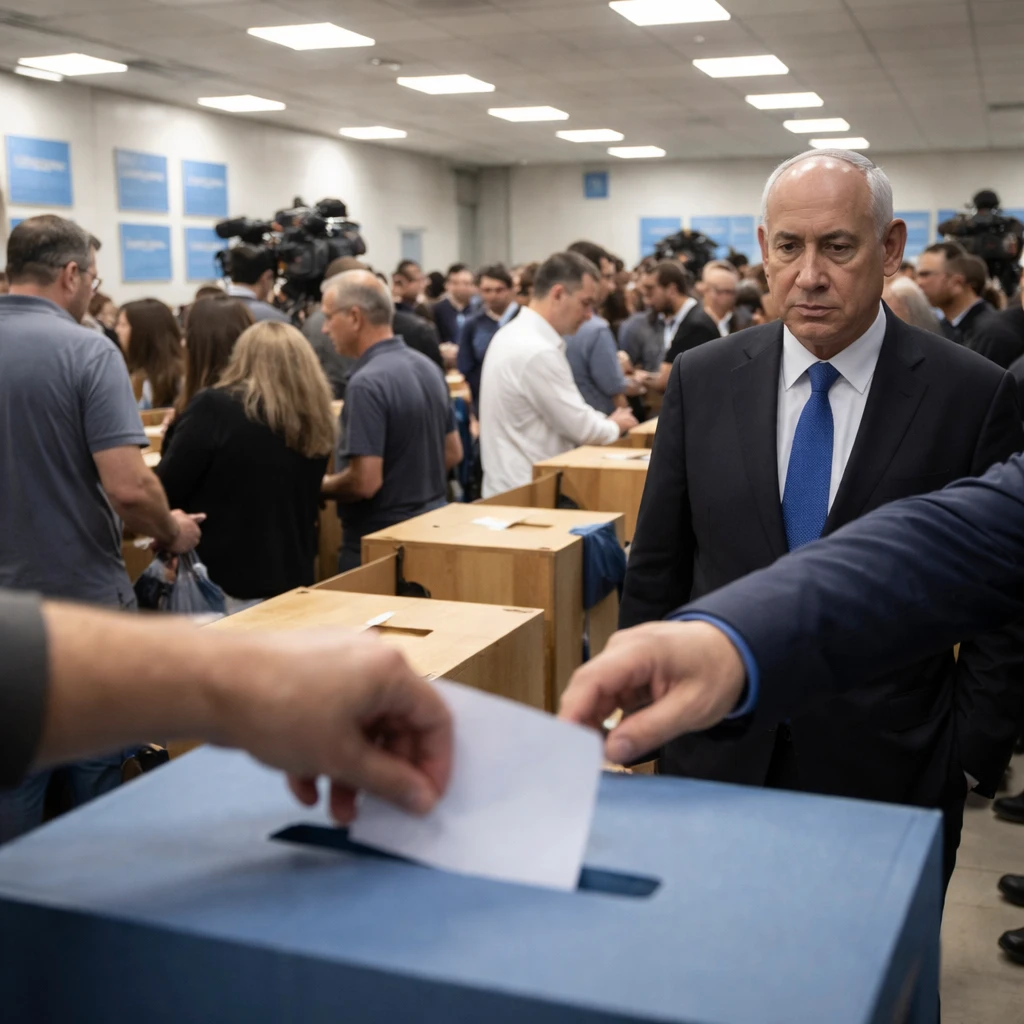
Likud will hold internal primaries on Monday to select its candidate slate for the national election in October, a contest that analysts say could undermine Prime Minister Benjamin Netanyahu’s re-election prospects if party members elevate populist, hard-right figures.
Polls indicate the party’s standing has weakened markedly since the October 7, 2023, Hamas attack on Israel, with forecasts suggesting Likud could lose up to a third of its Knesset seats. The primary outcome matters not only for the party’s parliamentary strength, but for Netanyahu’s longer-term ability to build a government that can attract centrist voters.
Division between members and voters
Researchers tracking the party’s internal dynamics say a sharp divergence has emerged between the roughly 140,000 registered Likud members who will decide the party list and the broader set of Likud voters.
"The gap between Likud party members and Likud voters and the general public has increased substantially, and this might have a dramatic effect on Netanyahu’s ability to win," said Nimrod Nir of the Hebrew University’s Agam Labs.
An Agam Labs poll published on August 11 found that 54.9% of Likud voters prefer a more centrist government than the incumbent coalition, which includes ultra-Orthodox and nationalist partners. By contrast, only about a third of the registered party members expressed a preference for a centre-right government, while two thirds favor a continuation of a coalition similar to the outgoing one formed after the 2022 election.
Netanyahu’s push for moderation
Facing these internal pressures, Netanyahu has been attempting to recruit more moderate candidates to offset momentum among populist hard-liners in the primaries.
In a video statement posted on July 22, Netanyahu said: "As Prime Minister of Israel, I intend to deepen the unity within us. Therefore I will work to establish a broad national government, a stable government that will ensure our security and future."
But at least one senior former Likud official with knowledge of party strategy said those efforts have not progressed as hoped. "If (Netanyahu) improves the list and brings better people then maybe he will succeed but he’s not going in the right direction," the former member said, declining to elaborate.
Four current and former senior Likud figures, speaking on condition of anonymity, described the party as scrambling to recover voters who have drifted away since the last election. A Likud party spokesperson did not reply to a request for comment.
Policy fractures and undecided voters
The Agam Labs survey, which polled roughly 1,000 party members and more than 1,000 voters, found deeper splits when respondents were asked about specific policy matters.
One significant fault line concerns military conscription for ultra-Orthodox Jews. The current coalition has granted concessions to ultra-Orthodox leaders seeking exemptions from mandatory service, a stance that has become especially contentious amid the Gaza war. Non-Orthodox Israeli Jews have questioned why they should shoulder a larger portion of the wartime burden.
According to Agam Labs, over 80% of Likud voters support increasing the number of ultra-Orthodox conscripts, while support among registered Likud members is lower, at 65%.
These and other divisive issues could prove decisive in a race where around one fifth of the electorate currently describe themselves as undecided. Pollsters and researchers say many of those undecided voters are disillusioned with Likud and are the very group the party is trying to reclaim.
"These are the people that are going to decide what’s going to happen with the election," said Gayil Talshir, a political scientist at the Hebrew University.
What to watch
- How the primary results reflect the balance between hard-right and centrist-leaning candidates within Likud.
- Whether Netanyahu’s efforts to recruit moderates can alter the list sufficiently to appeal to centrist Likud voters and undecided members of the electorate.
- The effect of divisive issues such as ultra-Orthodox conscription on voter preferences as the campaign progresses toward October.
As the party finalizes its candidate list, analysts say the internal choices made by Likud members will shape the prime minister’s immediate electoral challenge and influence which voters he can persuade before the national vote in October.