
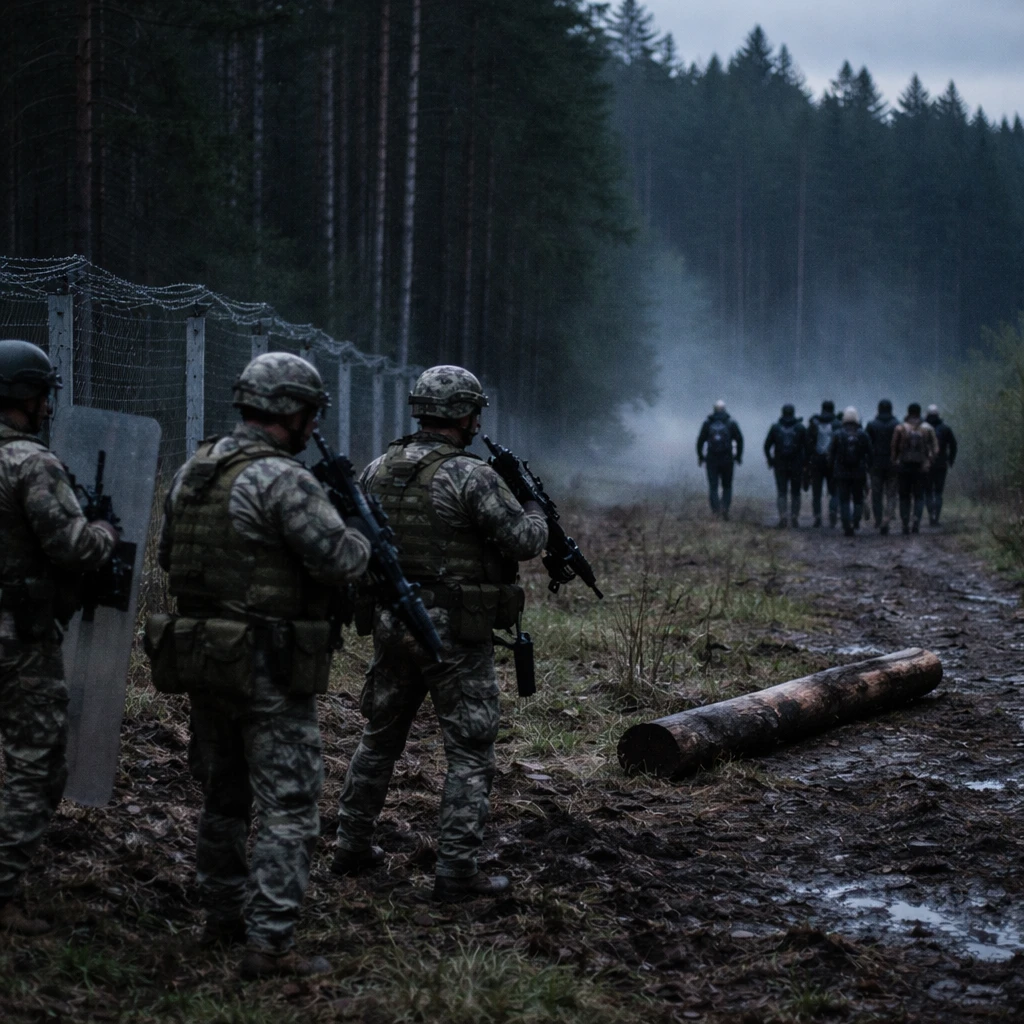
Latvian military personnel employed tear gas and fired a single warning shot to halt migrants attempting to enter Latvia from Belarus, the armed forces said in an official statement. The incident involved a group of at least five people who allegedly threw logs toward soldiers as they tried to cross the border, the army added.
The army said in a post on the social media platform X that the episode occurred within the past 24 hours. "To halt the unlawful actions and prevent further escalation of the situation, soldiers used tear gas", the statement said. As the group continued to disregard lawful orders and maintained aggressive behaviour, the army said that "one warning shot was fired into the air, after which the individuals retreated to Belarusian territory".
Latvian Prime Minister Andris Kulbergs told reporters last week that the number of migrants attempting to enter Latvia from Belarus has doubled recently, though he did not provide precise figures. Kulbergs described the situation as a "hybrid threat" and said the increase in attempted crossings has led Latvia to double the number of border guards deployed along the frontier.
"We have a serious situation... we have used way more resources than we were anticipating. But we are handling that very well", Kulbergs said. He added that Lithuanian and Estonian border guards, in addition to the Latvian army, are assisting at the border. He warned that the migration flows "is causing a concern for the society. It is disrupting people".
Latvia, alongside Poland and Lithuania, has publicly accused Belarus and Russia of coordinating flows of migrants from the Middle East and Africa to destabilise countries on NATO's eastern flank. Minsk and Moscow have repeatedly denied those allegations.
The incident at the Latvian border comes amid a regional pattern of confrontations linked to migration attempts. In December 2021, Polish security forces used water cannon against migrants who had been throwing rocks across the Belarusian border, where thousands gathered in chaotic attempts to reach the European Union. Separately, in December 2025, Poland reported that more than 180 migrants entered the country through a tunnel concealed in a forest on the Belarus border.
Latvia has been contending with a migrant situation on its Belarus frontier since 2021, accusing Minsk and Moscow of flying people from the Middle East and Africa to Belarus and attempting to push them across the frontier. Belarus and Russia have dismissed those accusations.
Additional geopolitical developments cited by regional authorities include Belarus allowing Russian armed forces to use its territory as a staging post to invade Ukraine in early 2022. More recently, in May of this year, Belarus announced that its armed forces had begun training exercises that involved Russian nuclear weapons.
The Latvian army's account stressed that the measures it took - tear gas and a warning shot - were aimed at preventing escalation and restoring control at the border. The government response has focused on increasing personnel and coordinating with neighbouring Baltic states to manage the heightened number of attempted crossings.
Key points
- Latvian soldiers used tear gas and fired a warning shot to stop a group of migrants who threw logs at troops attempting to enter from Belarus.
- Prime Minister Andris Kulbergs said attempted crossings from Belarus have doubled recently, prompting Latvia to double border guard deployments, with assistance from Lithuanian and Estonian border guards.
- Latvia, Poland and Lithuania accuse Belarus and Russia of orchestrating migrant flows; Minsk and Moscow deny the charges. Past regional incidents have included water cannon use in 2021 and an alleged tunnel crossing reported by Poland in 2025.
Risks and uncertainties
- Escalation risk at the border - confrontations between migrants and security forces could intensify, affecting security sector resources and operations.
- Regional political tensions - accusations between Baltic states and Belarus and Russia introduce uncertainty for diplomatic stability and defence planning.
- Resource strain - sustained increased border deployments may pressure public-sector budgets and logistics, with implications for defence and homeland security expenditures.