
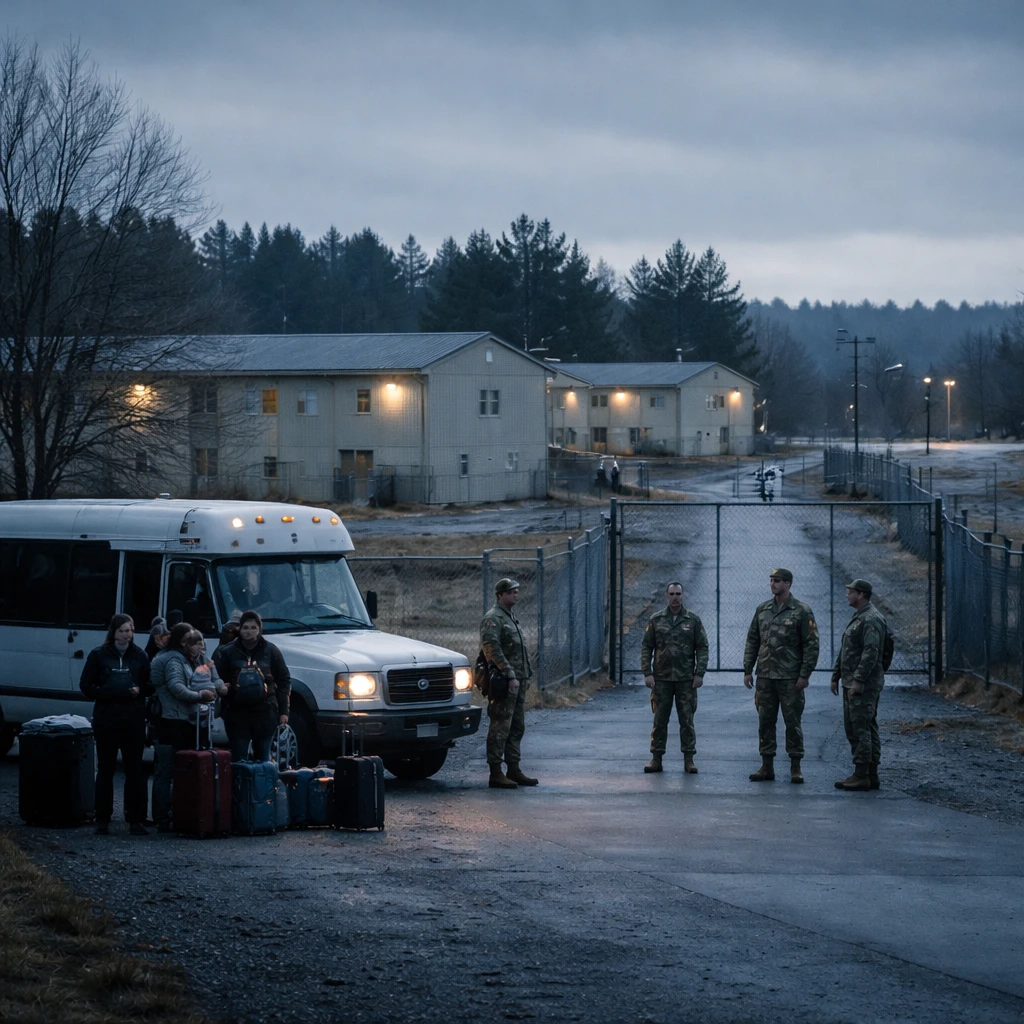
U.S. public health and defense authorities placed 14 American citizens under temporary quarantine at Fort Drum, a U.S. Army base in upstate New York, after the travelers attempted to reenter the United States following visits to the Democratic Republic of Congo, where an Ebola outbreak is underway. Records reviewed by news outlets and two people familiar with the matter indicate the group was held at the base for four days and was not symptomatic for Ebola, and officials determined they were not at risk of transmitting the disease.
According to the accounts, the travelers returned from Congo via Canada and were stopped when they tried to cross into the United States at land ports of entry in Vermont and New York. There is no standing U.S. order that bars citizens from returning by land. However, a "do-not-board" order issued earlier this month requires U.S. citizens who have been in Congo to quarantine for at least 21 days before boarding a commercial flight to the United States.
Two notifications from the Department of Defense stated that the travelers could not return directly to the U.S. from Congo as the Trump administration broadens measures it says are intended to keep out individuals it considers at risk of Ebola, according to a copy of one memo and one person who reviewed the other. The situation has highlighted a set of policies that officials describe as unprecedented and unevenly applied, raising concern among some public health and legal experts.
Experts cited in the reporting emphasized that U.S. citizens generally retain the legal right to reenter the country. They noted, however, that those who have been exposed to a highly infectious disease can be quarantined. That distinction has produced disagreements over how broadly authorities should apply restrictions to travelers who have been in Congo but who were not in known outbreak zones.
Government data made public on Wednesday showed nearly 2,500 confirmed cases of the Bundibugyo strain of Ebola in Congo, making this the third-largest Ebola outbreak on record. The federal response to the outbreak has included actions beyond screening and quarantine orders. The administration has constructed a new isolation facility in Kenya and recently quarantined seven American aid workers there. Separately, two Americans with Ebola were transferred to Germany for treatment on the grounds it was closer than the United States.
Sources described confusion within agencies as officials attempted to apply the new measures. At the Centers for Disease Control and Prevention, career employees are reportedly required to consult political leaders at the agency on a case-by-case basis to determine whether travelers arriving from Congo may be admitted to the United States. Sources characterized the broader response as causing chaos across government, a description attributable to those familiar with internal deliberations who were not authorized to speak publicly.
Legal and public health voices have questioned the legal basis for blanket restrictions. James Hodge, director of the Center for Public Health Law and Policy at Arizona State University, noted that the "do-not-board" order applies to anyone who has visited Congo, including areas outside the regions where the outbreak is concentrated. He asked, "The question would be, under what standard are you measuring whether you were exposed to Ebola? Just because you were in the Congo?" and added that such a standard would likely not stand up in many legal settings.
Emily Hilliard, a spokeswoman for the Department of Health and Human Services, provided a statement saying the agency's "do-not-board" order covers a 30-day period and is designed "with the intent to consistently re-evaluate the rapidly evolving outbreak situation on the ground." She declined further comment and referred additional questions to the Department of Homeland Security. Representatives at DHS declined to comment and redirected inquiries to the CDC. A larger health agency that manages external communications for the CDC did not respond to requests for comment on the matter.
The group of travelers included recently naturalized citizens who had been visiting family in Congo. In at least two family groups there were children - including two young teenagers - and a 70-year-old, according to people familiar with the episode. The families flew to Canada and then attempted to cross back into the U.S. at land ports of entry on a Thursday. They spent that night at the Vermont crossing and were transported the following day to Fort Drum, located roughly 30 miles from the Canadian border.
At Fort Drum the families were housed in apartment-style quarters and placed under observation by CDC officials. They were evaluated medically and released on the following Monday. Members of the group then continued to their intended destinations by bus and plane. A Pentagon official said Fort Drum accepted the families "to provide a temporary, isolated assessment facility and life support," and that CDC personnel conducted medical evaluations. The official added that the families were "relocated by HHS personnel" on Monday.
Defense Department officials informed lawmakers that Fort Drum offered housing facilities at the request of federal health agencies. Major General Scott M. Naumann, the installation commander at Fort Drum, wrote to Congress that the base provided a "temporary isolated quarantine facility" at the request of health officials, and that memos to lawmakers stated there was no danger to the public or base personnel. A request for comment to Major General Naumann was not answered.
In a related correspondence, U.S. Defense Secretary Pete Hegseth wrote to Senator Roger Wicker, chair of the Senate Armed Services Committee, asserting that the quarantine at Fort Drum "will not negatively affect military training, operations, readiness, or other military requirements, including National Guard and Reserve readiness." The department's notifications and letters to lawmakers underscore how health-driven requirements have involved military installations in roles that include temporary housing and isolation support.
Summary
A group of 14 American citizens who had recently been in the Democratic Republic of Congo were housed at Fort Drum for four days after attempting to reenter the United States via Canada. None displayed Ebola symptoms and they were medically evaluated by CDC staff before being released. The case spotlights an expanding array of federal restrictions and logistical steps intended to prevent Ebola from reaching U.S. soil amid a large outbreak in Congo.
Key points
- Fourteen Americans were quarantined at Fort Drum for four days after trying to reenter the U.S. from Canada; they were not symptomatic and were assessed by CDC officials - sectors affected include public health and transportation.
- A "do-not-board" order requires U.S. citizens in Congo to quarantine at least 21 days before traveling on commercial flights, but there is no blanket prohibition on returning by land - this affects travel, border operations, and logistics.
- Federal agencies and the Defense Department have been mobilized to provide temporary isolation facilities, reflecting operational impacts on military installations and interagency coordination.
Risks and uncertainties
- Legal challenges - Experts say broad restrictions on citizens who have been in Congo may face legal scrutiny, since Americans retain a right to reenter the country; this could affect policy implementation across government and the legal sector.
- Operational strain on agencies - The need for case-by-case clearance and use of military facilities for temporary isolation introduces strain and potential disruption to agency workflows and military resources, including readiness considerations for installations used as assessment sites.
- Public health uncertainty - While the group was asymptomatic and assessed as not at risk of transmission, the ongoing outbreak in Congo, with nearly 2,500 confirmed Bundibugyo cases reported, continues to drive policy changes and logistical responses that create uncertainty for travel and aid operations.