
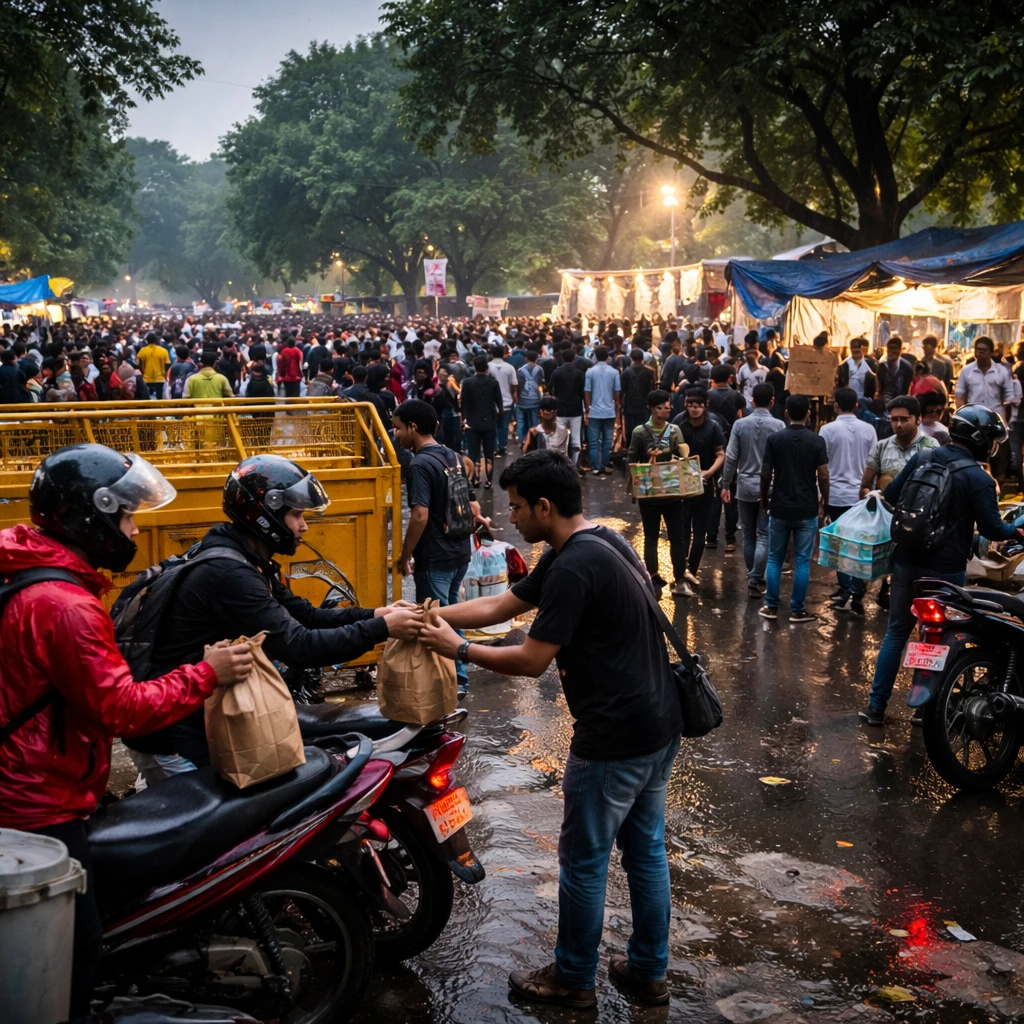
NEW DELHI, July 22 - A continuous procession of motorbike riders delivering food, bottled water and snacks has become a vital lifeline for a youth-driven protest that has taken root near the Jantar Mantar observatory in central Delhi. Riders weave through congested streets to reach clusters of volunteers, transferring packages that donors from across India and overseas send to back the rare public challenge to Prime Minister Narendra Modi's administration.
"From Kerala to the USA, orders are coming from everywhere," said rider Suraj Kumar, 25, perched on his motorcycle with a bag containing kachoris, a favoured deep-fried snack. Volunteers climbed over police barricades to receive the donations; a packet then moved hand-to-hand toward the heart of the encampment a few hundred metres away, where demonstrators had assembled around a raised platform.
The protest has been led by the Cockroach Janta Party (CJP), a group that started as online satire in May and has since demanded the resignation of Education Minister Dharmendra Pradhan in response to repeated test paper leaks. The encampment has been in place since last month, but activity intensified after a well-known activist began an indefinite hunger strike in solidarity with the movement.
How the protest continues
Participants and volunteers credit the steady inflow of donations and ad-hoc support systems for keeping the site active at all hours. The supplies include food, bottled water, fruit and biscuits, which are collected and distributed by volunteers who have remained on site for days.
"People are angry, especially after the police started beating innocent students. But not everyone can come here so they are sending food," said Raj Rathore, 25, a volunteer who has spent several days unloading deliveries and organising distribution. Students said volunteer-run networks and donations have enabled protesters to maintain a constant presence.
Students describe the camp as fuelled by what they call "people's kindness" and a sense of unity. "This protest is running purely because of people's kindness, and the fact that we are all united," said Rina Rawat, a 20-year-old student at Delhi University who has been directing crowds into orderly queues. Rawat added that she was struck on her left leg by police batons during the previous day's confrontation but returned the following day to continue organising.
Scale, composition and grievances
By late afternoon on Wednesday, organisers said the number of protesters at the site had swelled to around 5,000, despite intermittent monsoon rainfall. The crowd was dominated by Gen Z students carrying placards, playing patriotic Bollywood music, and chanting slogans alleging authoritarianism.
Many of those present emphasised anger at repeated exam paper leaks and at a perceived failure to generate sufficient employment despite years of economic growth. The article notes that Indians under 30 are estimated to constitute more than half of the country's 1.42 billion population, and some speakers linked that demographic reality to frustration over job opportunities.
"Modi, we won't tolerate your autocracy," shouted one demonstrator as the crowd cheered, a display that participants described as unusual under a leader who has held power since 2014. Some individuals at the site said they had previously supported the prime minister but were moved by what they described as police brutality during the attempted march on parliament.
Police response and official statements
The encampment persisted even after a major police crackdown earlier in the week, when tens of thousands of mostly young people tried to march on parliament and were met with force. Authorities undertook intensified measures on Monday in response to that attempt.
Prime Minister Modi has not made direct comments about the demonstrations, though a minister said after a meeting of the ruling coalition that the premier had told them the "strongest possible steps are being taken to protect the interest of the students". Education Minister Dharmendra Pradhan has pledged "answers, reforms and accountability" regarding the issues raised by protesters.
Support services inside the camp
Volunteers have taken responsibility for maintaining the physical environment and meeting basic needs at the site. People cleared puddles and gathered garbage, while others used handheld fans to provide relief from humidity. A medical stall staffed by volunteer doctors and medical students has been operating at the location for about a month, offering first aid and medicines for dizziness and nausea, and assisting those affected by stress linked to the paper leaks.
"We are providing first aid and medicines for dizziness and nausea," said Bhavna, 23, a volunteer medic who did not give her last name. "We too have suffered because of paper leaks, the anxiety that gives you is enormous." Organisers and participants also distributed roses, copies of the Constitution, and portraits of revolutionary Bhagat Singh as symbolic gestures; some protesters wore Spider-Man masks and described themselves ironically as "baddies."
Social composition and political tone
There were visible efforts by participants to keep the protest focused on its stated objectives rather than sectarian divides. Nineteen-year-old Arpita Verma said there had been too much Hindu-Muslim politics in the country and that those dynamics were being set aside at the site. "We have no space for that here - now we are united by a common cause, and we are not afraid at all," she said.
Organisers and volunteers described a grassroots campaign sustained by donations from a broad geographic spread of supporters and by the labour of young people present at the camp. That logistical backbone - food deliveries, volunteer medical care, waste management and crowd coordination - has been central to keeping the encampment operational amid weather interruptions and sustained police presence.
Closing observation
The protest around Jantar Mantar continues to rely on informal supply chains and volunteer networks to maintain momentum. Those on site say the movement’s endurance is a reflection of large-scale sympathy and material contributions from people who cannot be physically present but who are contributing through food, water and other essentials. The situation remains fluid as organisers press for accountability over the examination leaks and as authorities manage the security response.