
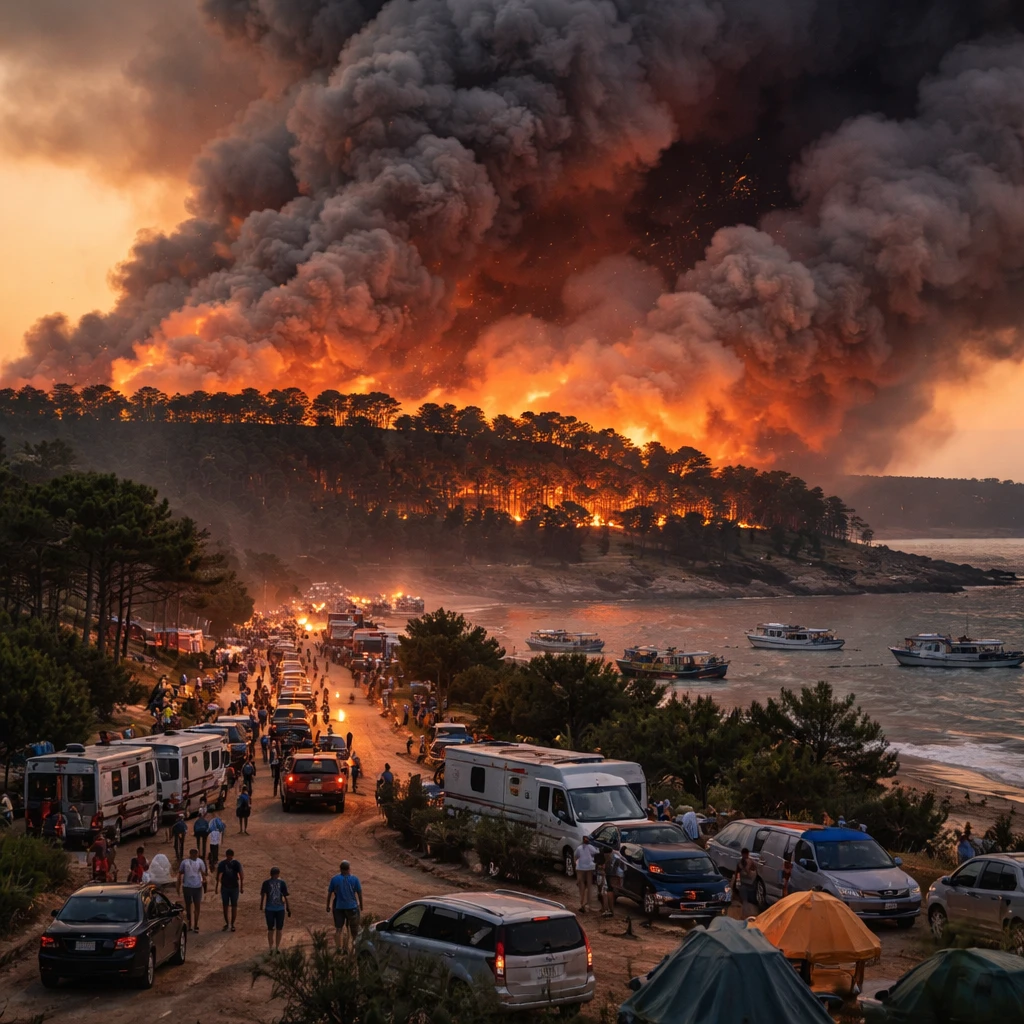
A fast-moving wildfire in southwestern France has driven over 10,000 people from homes and campsites as it raced through roughly 2,000 hectares of land west of Bordeaux, officials said. The blaze, which moved quickly overnight, forced large-scale evacuations on the Cap Ferret peninsula and brought into focus the broader stress on Europe from consecutive heatwaves and deepening drought.
Authorities in the area said about 500 firefighters were engaged in efforts to control the fire and that, at the time of reporting, no injuries had been recorded. The flames are located close to the Arcachon Bay tourist area, where many visitors stay in campgrounds that were among those evacuated.
Evacuations and local response
Lège-Cap Ferret's mayor, Philippe de Gonneville, said the fire spread overnight faster than expected. Lège is one of 11 villages on the Cap Ferret peninsula and the only one currently under direct threat from the blaze, officials said. Local authorities reported evacuating 5,200 people from the municipality overnight and indicated that access to parts of the peninsula was completely closed.
Officials have contingency plans to move the entire peninsula's population by road and by sea if the situation deteriorates. The flames are reported to have started near the town of Saumos, about 15 kilometres from Lège-Cap Ferret, and extended to the edge of Lège, prompting the evacuation of several campgrounds and neighbourhoods adjacent to the forest.
Regional fire activity and casualties
Wildfires remain a significant problem across other parts of southern Europe. In Spain, authorities continued to battle multiple long-running blazes under persistent high temperatures and difficult conditions. Central Spain saw firefighters, emergency services and military units deployed to monitor and suppress active fires in provinces including Guadalajara, Toledo, Ciudad Real and Albacete. Spanish officials reported that more than 100,000 hectares have burned nationwide so far this year.
In Italy, a 59-year-old firefighter died after falling ill while fighting a large wildfire near San Cataldo in Sicily, according to authorities. The fatality underscores the human toll that prolonged wildfire seasons can exact on emergency personnel.
Heatwaves, drought and wider impacts
Across Europe, three consecutive heatwaves this season have worsened drought conditions, strained water supplies and left vegetation extremely dry, creating conditions that facilitate the rapid spread of wildfires. Scientists and officials say this season's extreme heat has contributed to vegetation becoming tinder-dry and has helped wildfires burn more land this year than the typical annual average seen over the past two decades on a continent that is warming faster than the global mean.
Health impacts have been severe. Authorities recorded more than 10,000 excess deaths across Europe and Britain during two record-breaking heatwaves in May and late June, with scientists stating that heat was the only credible explanation for the unusually high death toll. Belgium reported that June 27, during its heatwave, was the country's second deadliest day of the 21st century, with 650 deaths.
Climate-tracking data show the degree of warming in real time. The monitoring tool referenced by authorities indicated that the average high across Western Europe was forecast at 26.5 degrees Celsius on the day referenced, roughly 2.9 degrees Celsius above the normal high for July 23 based on 1961-1990 climatology.
Water stress and agricultural concerns
Numerous European countries are experiencing drought this summer, with impacts on agriculture, water management and daily life. Officials in France warned that the country may face its smallest maize crop in 50 years. Romania implemented restrictions on farmers' access to water for irrigation, and the Netherlands declared a national water shortage. London introduced hosepipe bans, and seven Greek islands declared water emergencies to conserve supplies.
Scientists from the World Weather Attribution group released an analysis indicating that climate change is modifying how droughts form in Europe. Their report said that extreme heat is accelerating evaporative losses from soils, which in turn intensifies water shortages.
Local adaptation and land management experiments
Some communities are responding by experimenting with nature-based fire mitigation. In Spain's Galicia region, authorities and local groups have reintroduced native livestock to help rebalance ecosystems and reduce the build-up of flammable undergrowth. One breed, the Cachena cattle - locally nicknamed a 'goat-cow' - has been deployed to graze and reduce the fuel load in areas that were at the centre of Spain's worst year for fires in 2025.
These grazing efforts aim to remove the dry undergrowth that acts as a powder keg for fires, a practice being tried in zones where traditional land use and depopulation have changed landscape management and increased vulnerability to wildfires.
Outlook and implications
The immediate priority for emergency services in southwestern France is containing the blaze, protecting lives and property, and preventing further spread into populated areas of the Cap Ferret peninsula. The wider pattern across Europe of repeated heatwaves and drought continues to elevate wildfire risk, strain emergency services and create cascading impacts on agriculture, water supplies and vulnerable populations.
Authorities in the affected regions remain on alert and have mobilised resources to fight fires and carry out evacuations where required. Contingency plans for broader evacuations and protective measures underline the precarious conditions facing communities in the path of large wildfires this season.