
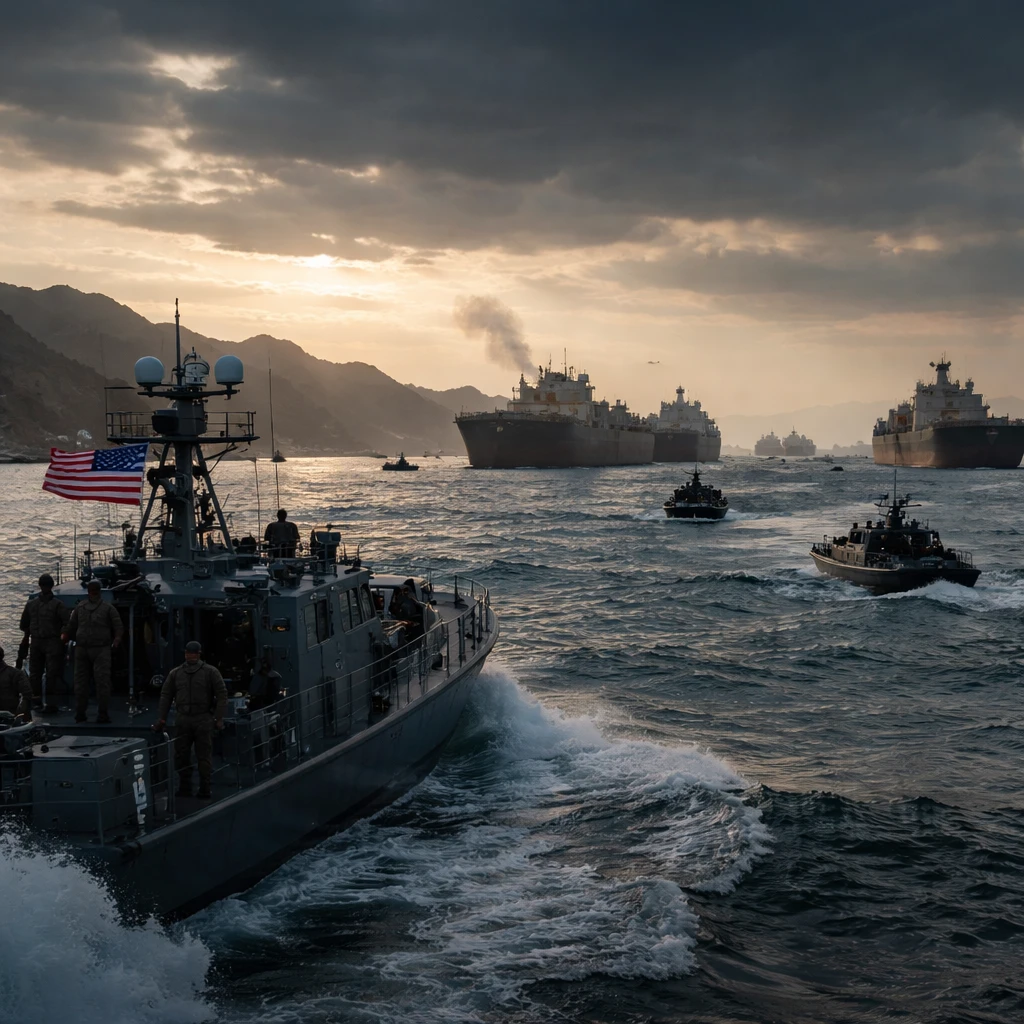
As the campaign against Iran reaches its sixth month, the White House is grappling with an increasingly constrained set of strategies to bring the conflict to a close. What began as a conflict the president said would be resolved in a matter of weeks now presents him with choices that trade immediate political gains for longer-term strategic costs.
At the center of the dilemma is an emerging interim understanding being negotiated between Iran and Oman over transit through the Strait of Hormuz. According to senior regional officials and a senior Iranian source, the terms under discussion would grant Tehran some degree of control over ships entering the Gulf through the strait - a significant shift from the status quo prior to the start of the conflict. Analysts describe that potential outcome as Tehran's most substantial concession since the U.S. and Israel struck Iran on February 28.
The White House faces three broad pathways, each with its own set of political and operational risks. One option is to accept the Iran-Oman arrangement, reopening the strait and enabling a possible resumption of negotiations focused on Iran's nuclear program - the stated central objective of the U.S. military campaign. A second option would be to carry out a sharp escalation of military force, likely including a fresh wave of airstrikes, to try to reverse Iranian advances. A third option is to maintain the current uneasy equilibrium - enforcing a blockade of Iranian ports and responding periodically to attacks on shipping.
Each path carries downsides. Analysts say acceding to an Iran-Oman deal could effectively formalize a new Iranian supervisory role over a vital oil-shipping corridor, contradicting earlier vows from U.S. officials to prevent Tehran from asserting control. Pursuing large-scale strikes, meanwhile, would expose the administration to heightened political risk ahead of November midterm elections and offers no clear assurance of achieving decisive results, given that prior bombing failed to collapse Iran's capabilities. Maintaining the status quo presents no face-saving exit for a president who had predicted the conflict would be over by mid-April.
"It’s a menu of bad options but Trump may have come to the realization that he can’t let this war go on endlessly," said Aaron David Miller, a former Middle East negotiator for both Democratic and Republican administrations. "Something has to give, and that may be recognition of a new Iranian reality in the strait."
A U.S. official, speaking on condition of anonymity, said any "temporary" shipping routes would be "without any impediments," with no party overseeing transit. That statement reflects a U.S. preference for keeping maritime channels free of tolls or fees, even as regional interlocutors pursue arrangements that would give Iran a role in managing traffic through the chokepoint.
U.S. Secretary of State Marco Rubio has repeatedly emphasized that the strait - through which, since the start of the conflict, Iran has exerted near-control over about a fifth of global oil and liquefied natural gas shipments - must remain an open international waterway unfettered by Iranian tolls or oversight. Yet the president has in the past contradicted aspects of some officials' public statements on the war, and analysts say such contradictions could occur again as political and economic pressures mount.
Those pressures are numerous. U.S. gasoline prices have risen, approval ratings for the president are weak, and the conflict itself is broadly unpopular among the American public. Together, these factors shrink the administration's political room to maneuver, observers say. The president's rhetorical brinkmanship has so far failed to force Tehran to yield, making it increasingly plausible that Washington will need to accept compromises to achieve any near-term de-escalation.
Reopening the strait is widely seen by officials as a prerequisite for renewed U.S.-Iran talks. White House officials want any resumed diplomacy to concentrate on Iran's nuclear activities, which have been represented as the principal target of the U.S. military campaign. Whether the administration would accept the precise terms of an Iran-Oman accord remains unclear; Iranian officials say details are still being resolved, while the president has asserted that an agreement reopening the waterway is imminent.
Even if the Iran-Oman memorandum is finalized and leads to U.S.-Iran discussions, experts express skepticism about the prospects for converting a preliminary accord into a lasting peace. A prior memorandum of understanding signed in June between the United States and Iran unraveled quickly after its announcement; that earlier agreement had included some initial sanctions relief for Iran, a move that drew public criticism from figures within the president's own party.
White House officials have increasingly come to accept that the conflict will likely endure in some form through the midterm elections, a White House official said on condition of anonymity. With early voting in some states beginning as soon as September, the continued conflict could complicate electoral dynamics for the president, who campaigned on avoiding foreign interventions and on shifting focus to domestic economic priorities, even as his party works to retain control of Congress.
A U.S. official told reporters that the president’s decisions on Iran are not guided by "fluid opinion polls." But the political calculus remains central: pursuing a wider military campaign risks alienating voters and allies, while conceding to terms that give Iran a new supervisory role in the strait risks political blowback from critics who view such an outcome as a concession that undermines U.S. objectives.
On the military front, the president has claimed to have degraded Iran's leadership and military capabilities, asserting that many of Iran's leaders have been killed and that the country's forces have been weakened. Yet analysts and officials largely agree that central goals of the campaign remain unmet. The administration said it canceled plans for new large-scale attacks after Middle Eastern partners urged another round of diplomacy, while simultaneously warning of forceful action if diplomacy failed.
Some analysts who influenced public commentary suggested that concerns over the depletion of U.S. missile stockpiles may have played a role in the decision to hold back on further major strikes, although the president has denied claims that U.S. munitions are running low. Even so, the president's public statements have been mixed: at a rally he said, "I’d rather make a deal because I don’t want to kill people," adding, "But at some point we’re gonna."
Iran has warned Washington’s Gulf partners that further U.S. strikes would trigger retaliation against their energy infrastructure, according to five sources familiar with the discussions. That threat elevates the potential regional consequences of any renewed U.S. military action, particularly given the interconnectedness of energy markets and the strategic vulnerability of infrastructure in Gulf states.
Observers also note that other major powers are closely watching U.S. choices in the region. "They are learning what U.S. limitations are going to be for years to come," said Jonathan Panikoff, former deputy U.S. intelligence officer for the Middle East. That dynamic, analysts warn, could have implications for global strategic calculations beyond the immediate crisis.
Even some commentators who have broadly supported a hardline approach to Iran are urging caution. Behnam Ben Taleblu of the Foundation for the Defense of Democracies characterized the Islamic Republic's strategy as an effort to place the president in a lose-lose position before November, urging the administration not to rush into actions and to be candid about where U.S. leverage is and is not effective.
For the White House, the decision is effectively one of political and strategic trade-offs: accept a negotiated maritime arrangement that cedes Tehran a role it previously did not hold, press forward with escalatory strikes that could prolong the conflict and risk domestic political fallout, or continue a grinding interdiction strategy that leaves the president without a clear path to a decisive or publicly palatable victory. Whichever route is chosen, officials and analysts acknowledge that the available options are constrained and fraught.
Summary
The U.S. campaign against Iran has reached its sixth month and the administration faces three difficult choices: accept an interim Iran-Oman arrangement that would give Tehran oversight in the Strait of Hormuz, escalate militarily with uncertain prospects and political costs, or sustain a blockade and limited retaliation that prolongs the conflict. Domestic political pressures, high gasoline prices and doubts about the sustainability of further strikes limit the president’s options ahead of the midterm elections.
Key Points
- Possible Iran-Oman terms would grant Tehran some control over transit through the Strait of Hormuz, a critical route for global oil and LNG shipments.
- Escalation via fresh airstrikes carries political risk for the administration and does not guarantee a decisive military outcome.
- The protracted conflict is affecting energy markets and domestic political dynamics, constraining the administration’s strategic choices.
Risks and Uncertainties
- Escalatory military action could provoke retaliation against Gulf energy infrastructure, disrupting energy markets and shipping.
- An Iran-Oman accord that cedes oversight to Tehran could formalize a new regional status quo, complicating U.S. leverage in negotiations.
- Concerns about U.S. missile stockpiles and munitions availability create uncertainty around the feasibility of sustained large-scale strikes.