
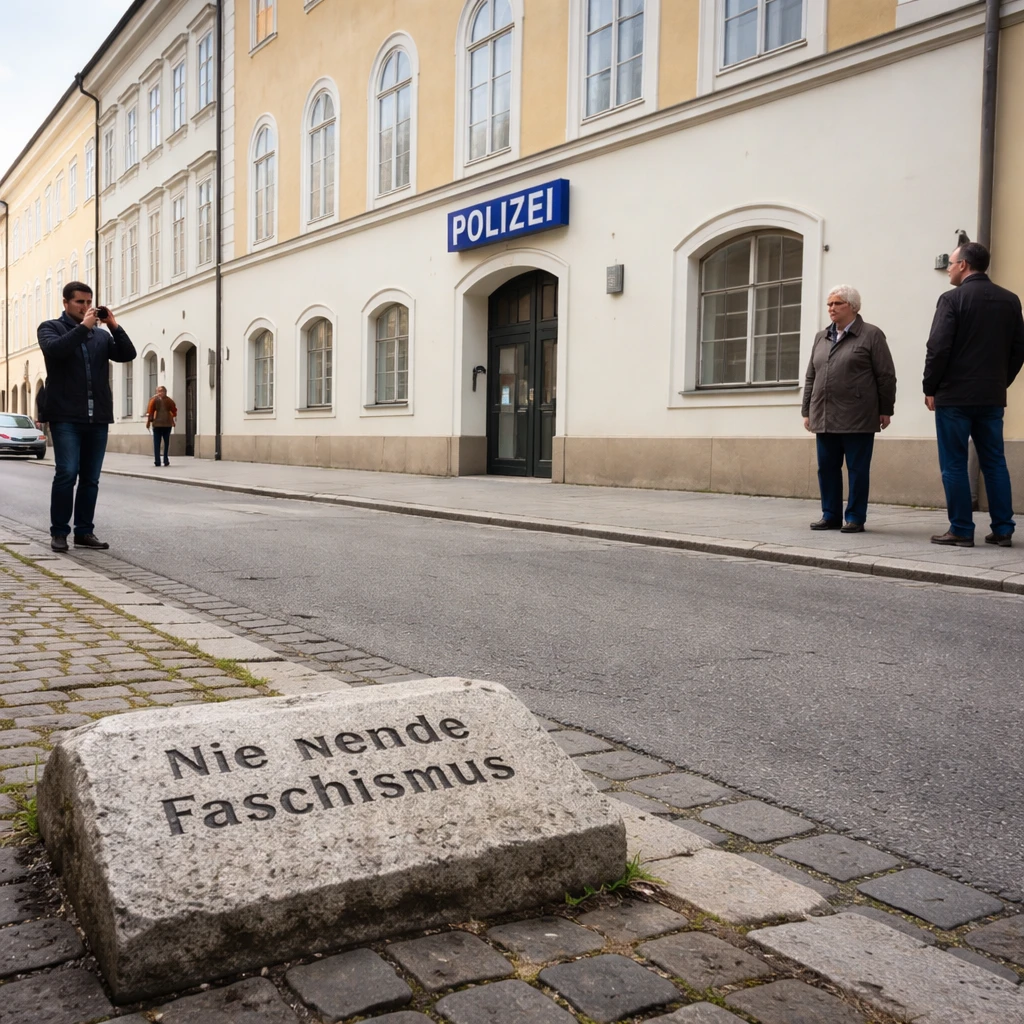
The house in Braunau am Inn where Adolf Hitler was born has been repurposed as a police station, marking the official start of a new chapter for a building long at the centre of national debate. Austrian authorities completed the conversion with the stated aim of preventing the property from functioning as a destination for neo-Nazi pilgrimage.
The three-storey terraced house, located near Austria's border with Germany, was in private hands for some time and had been used by a charity serving handicapped people before the state intervened. Austria made a compulsory purchase of the building in 2017 and in 2019 announced plans to remodel it and convert it into a facility for law enforcement.
Even prior to the renovation, visible reminders of the building's contested history were limited. A rock placed on the pavement that came from the Mauthausen concentration camp carries the inscription "Never again fascism" but makes no explicit reference to Hitler. That memorial stone remains where it was laid. The only new sign affixed to the building's white facade reads "Police".
Stephan Mlczoch, head of the Austrian interior ministry's history department, said on a guided visit to the property that the conversion's "aim was to prevent any association with Adolf Hitler, so as to strip it of that mystique." The intention is to remove the aura that has drawn attention to the site over many years.
The building briefly served as an art museum under Nazi rule, reflecting a period when a cult of personality intensified the site's symbolic value. Mlczoch noted that Hitler only lived in the house for a few weeks in 1889 before his family moved away. Despite that short stay, passers-by frequently stop to take photographs, though their motivations are not known.
Local officials said incidents involving visitors are now "isolated incidents" and occur less often than in the past. Austria bans the Hitler salute and other Nazi symbols, and such displays are prohibited in public.
Johannes Waidbacher, the town's mayor, described the wider public reaction to the conversion as broadly accepting. He said: "I think on the whole the people of Braunau have accepted it and can live with it." Waidbacher served on a commission that examined possible future uses for the house and recommended either a charitable or an official administrative purpose. He explained the rationale for the final decision by saying a charity would have left the site too accessible to the public.
Asked whether the plan would succeed in its goals, Waidbacher cautioned: "I think it isn’t a bad approach but whether it works as we all hope and expect, we’ll have to wait and see."
The conversion has not proceeded without criticism. The Mauthausen Committee, which represents Holocaust survivors in Austria, has expressed opposition. Robert Eiter of the committee and the Network Against Racism and Right-Wing Extremism argued that a police station is not an appropriate use and said authorities should do more to highlight Hitler's crimes.
Eiter contrasted a regular commemorative ceremony at the Mauthausen concentration camp memorial, where participants declare "never again," with what he described as a tendency in Braunau to "let's forget as soon as possible." He added: "The world won’t forget where the worst mass murderer in history was born. Wikipedia won’t change its entries," and warned there would be no reduction in the number of neo-Nazis making "the pilgrimage to Braunau."
Views among residents vary. Some expressed reservations about the choice to repurpose the building. One local, Irene, 74, said she would have preferred the charity to remain and that she "would have preferred if they had done something else but it is what it is."
Others welcomed the change. Thomas Spreitz, an estate agent, described the decision as "great and a good idea," saying: "Every now and then there are (neo-Nazi) groups there, and now that’s history."
The site’s transformation into a police facility closes a contentious chapter in local planning and national discussion over how to handle a building tied to a painful past. Whether the new function will fully eliminate the location’s symbolic pull remains to be seen, according to both local officials and critics.