
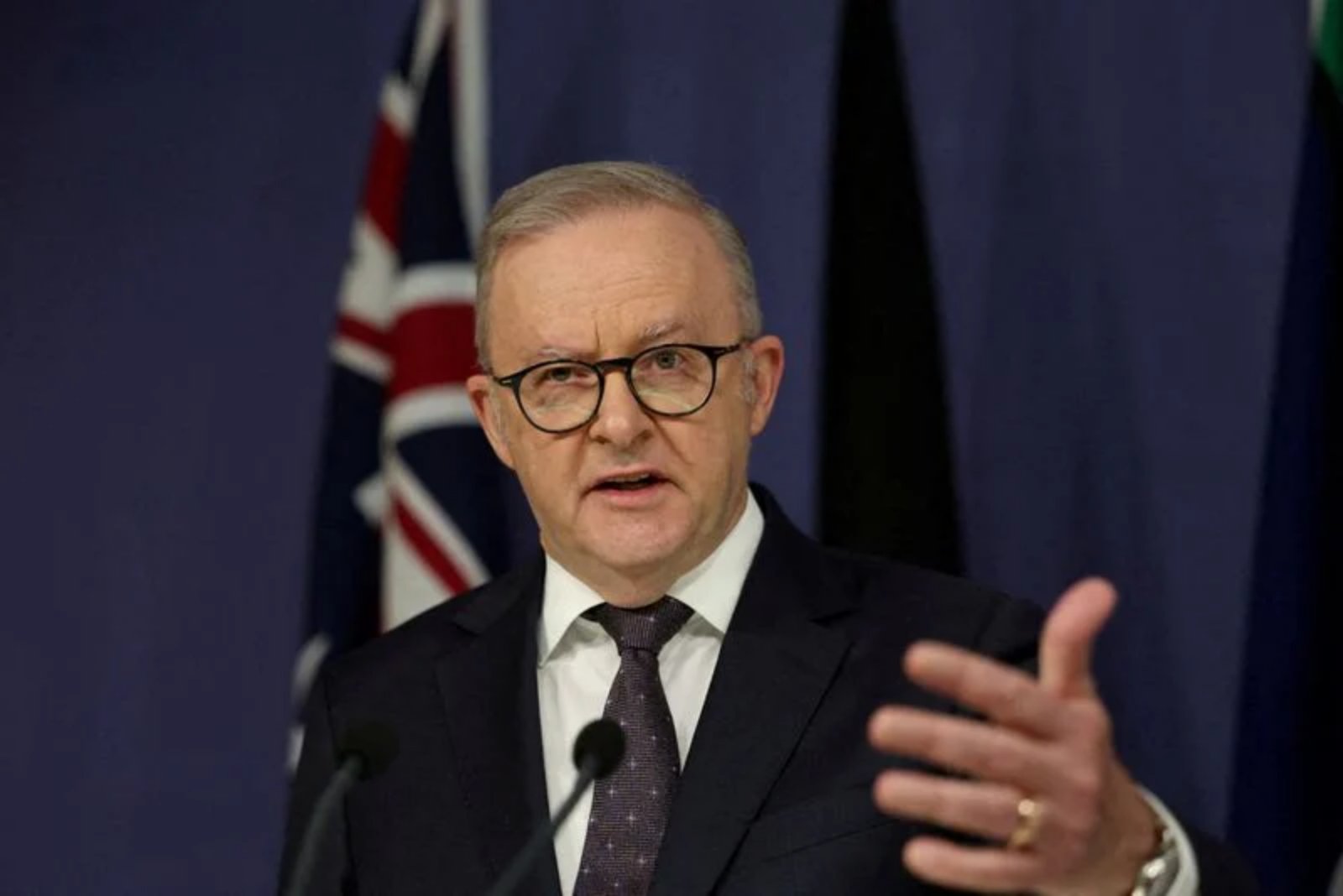
Australian Prime Minister Anthony Albanese arrived in Honiara on Tuesday and was met by Solomon Islands Prime Minister Matthew Wale as both governments announced plans to boost their bilateral relationship and pursue further talks on a comprehensive treaty.
Albanese, on a Pacific tour, posted on X from Honiara that "Australia and Solomon Islands are stepping up our partnership." He added that "because Australia’s security starts in the Pacific, and we’ll always show up for our neighbours." The leaders agreed to press ahead with negotiations on a new comprehensive treaty during their meeting.
The announcement came a day after China test-fired an intercontinental ballistic missile from a nuclear-powered submarine into the Pacific - the country’s first such test since 2024 - an act that drew expressions of concern from the United States, Australia, Japan, New Zealand and Taiwan.
Joseph Wu, secretary-general of Taiwan’s National Security Council, shared an image on social media purportedly showing the missile traveling over the Philippines before landing between Tonga and Nauru, roughly 1,000 km (620 miles) from the Solomon Islands. In his post he said: "China just proved itself again to be a bully on the block."
China’s Foreign Ministry spokesperson Mao Ning urged restraint in a briefing on Monday, saying Beijing hoped countries "will not over-interpret the matter."
Within Australia, concerns about Beijing’s expanding military reach were reflected in comments by Defence Minister Richard Marles. Speaking to the Australian Broadcasting Corp., Marles described the development as "China demonstrating a much greater range in terms of being able to deploy a nuclear weapon and ultimately what that is, is deeply destabilising."
The Solomon Islands have been seen by analysts as the Pacific nation with the closest ties to Beijing since signing a security pact with China in 2022. That pact prompted concern in Washington and intensified Australian diplomatic engagement across the region.
Matthew Wale, who took office in May as the Solomon Islands’ prime minister, stated during an official visit to Australia last month that he intended to pursue a comprehensive treaty with Canberra while reviewing the existing security agreement with China. During Tuesday’s meeting in Honiara he said: "We have much to transact, so we look forward to great conversations going forward."
Australia’s current diplomatic push coincides with a flurry of recent strategic agreements in the Pacific. Canberra signed pacts with Fiji on Monday and with Vanuatu last month as part of a broader effort to shore up relationships with island states.
Despite these security-focused moves, China remains Australia’s largest trading partner. Canberra’s approach balances this economic reality with concerns about Beijing’s growing influence in the Pacific and a desire to prevent any permanent Chinese military presence in the South Pacific.
For Australia and the United States, the South Pacific has long been treated as a strategic sphere of interest, and recent events have reinforced Canberra’s determination to deepen security ties with regional partners while continuing diplomatic engagement with states that maintain links to Beijing.
Context and implications
The meetings in Honiara underscore a splintered regional landscape where security concerns and economic ties overlap. Canberra’s commitment to pursue a comprehensive treaty with the Solomon Islands signals an intensified diplomatic effort to reassure Pacific partners and limit the prospect of a permanent foreign military foothold in the region.
At the same time, Beijing’s missile test has added urgency to debates among regional capitals about military capabilities and strategic reach. Commentators within Australia have characterized the test as raising the potential for a broader and more destabilising dynamic across the Pacific.
How the Solomon Islands will balance its relationships with China and Australia remains an open question, acknowledged by Honiara’s expressed intention to review the 2022 security arrangement while negotiating with Canberra.