
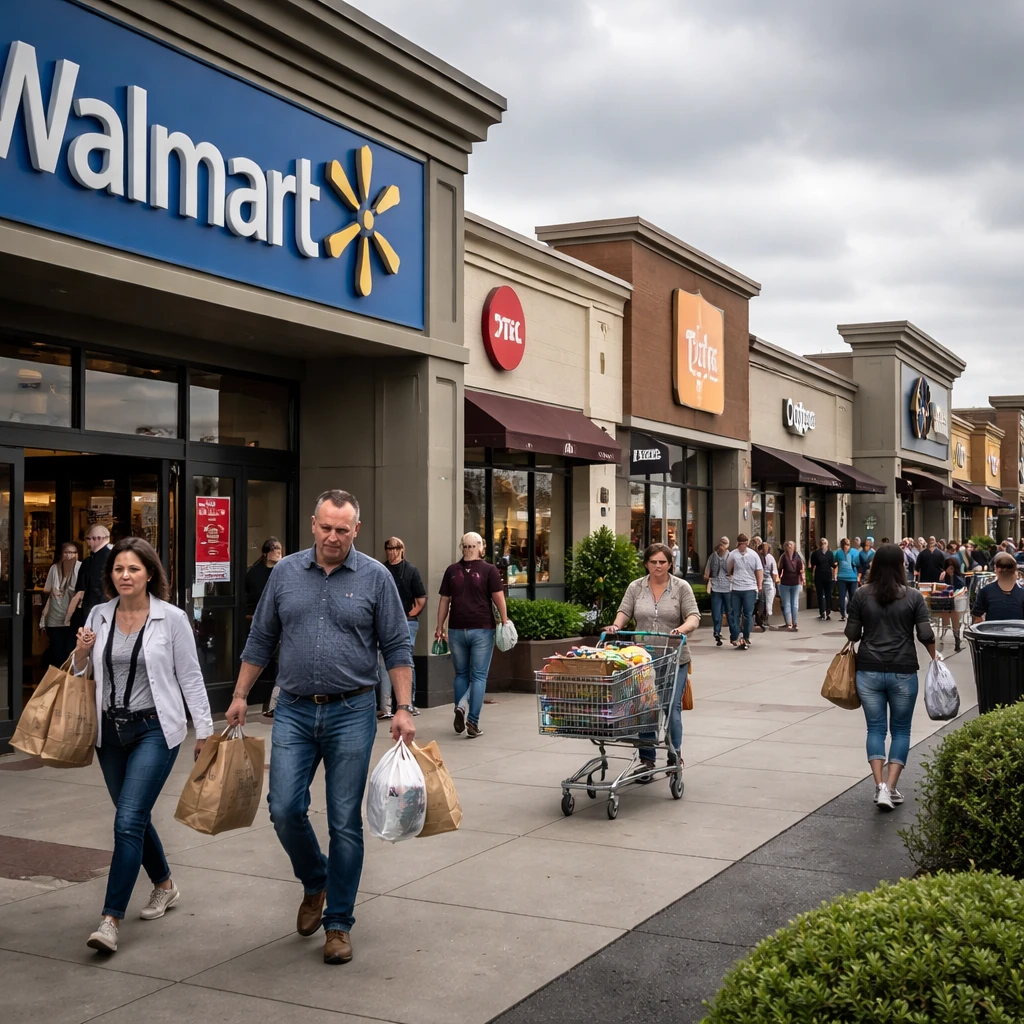
Walmart’s stock fell 9% after the company disclosed its slowest U.S. comparable sales growth in six years, a result market participants interpreted as a clear indication that U.S. consumers are cutting back. The report has prompted investors to reassess exposure across retail and consumer-facing equities, separating firms likely to suffer from pullbacks in optional spending from those insulated by essential goods, recurring revenue, or strong pricing power.
Where the pressure lands - discretionary names
Companies that depend on purchases consumers can defer are the most vulnerable. The article lays out a concise risk matrix for several household names, showing valuation, revenue momentum, leverage and year-to-date performance:
- Target (TGT): 16.4x P/E, 2.0% revenue growth, 104.7% debt-to-equity, +61.6% YTD - categorized as high risk.
- Dollar General (DG): 17.0x P/E, 4.7% revenue growth, 178.6% debt-to-equity, -9.2% YTD - categorized as high risk.
- Home Depot (HD): 23.7x P/E, 2.2% revenue growth, 459.4% debt-to-equity, - categorized as moderate risk.
- Tesla (TSLA): 317.8x P/E, 17.8% revenue growth, 11.8% debt-to-equity, 18.4% YTD - noted for extreme valuation.
- Starbucks (SBUX): 59.4x P/E, 4.5% revenue growth, net cash, - categorized as moderate risk.
Target is singled out because revenue growth has slowed to 2.0% while the stock has climbed 61.6% year-to-date, a divergence that suggests market optimism may be exposed if consumer spending eases. Dollar General’s relatively modest valuation masks substantial leverage at 178.6% debt-to-equity and a customer base sensitive to inflation, which together increase vulnerability. Home Depot’s exposure is tied to home-related spending that consumers often reduce first; its 459.4% debt-to-equity ratio amplifies that risk. Tesla’s valuation is described as extreme, making it sensitive to any deterioration in demand despite robust revenue growth.
Where resilience shows up - staples, subscriptions and pricing power
Firms selling necessities or those with recurring revenue streams exhibit greater insulation when consumers retrench. The piece highlights several consumer staples and related businesses with their valuation, revenue growth, dividend yield and the defensive qualities attributed to each:
- Coca-Cola (KO): 27.4x P/E, 6.5% revenue growth, 2.3% dividend yield - described as having a global brand and inelastic demand.
- PepsiCo (PEP): 18.7x P/E, 5.6% revenue growth, 4.2% dividend yield - benefits from snacks and beverage diversification.
- Procter & Gamble (PG): 21.6x P/E, 3.3% revenue growth, 3.0% dividend yield - framed as a household essentials leader.
- Altria (MO): 14.1x P/E, 0.9% revenue growth, 6.3% dividend yield - noted for an addictive product and a deep moat.
- Monster Beverage (MNST): 44.2x P/E, 20.4% revenue growth, 0% dividend yield - characterized as a growth outlier with low debt.
PepsiCo stands out in the staples cohort for its 4.2% dividend yield and lower P/E relative to Coca-Cola, with snack sales via Frito-Lay acting as a buffer that pure beverage companies may lack. Monster Beverage is highlighted for its combination of double-digit revenue growth and virtually no leverage, marking it as more recession-resistant among consumer-branded beverage players.
The middle ground - hybrid businesses
Amazon represents a mixed case. The company reported 15.8% revenue growth and trades at about a 21x P/E. While Amazon’s retail operations could face the same headwinds as traditional merchants, its AWS cloud segment provides a counterbalance because enterprise cloud spending typically holds up better when consumer demand softens. Similarly, Costco’s 9.2% revenue growth and membership model create recurring revenue that helps protect against declines in average basket sizes; however, its 46.8x P/E is comparatively high.
Key takeaway
Walmart’s underwhelming U.S. comp sales have acted as a signal for broader discretionary weakness. Companies focused on necessities or those with subscription-style economics (for example, Coca-Cola, PepsiCo, Procter & Gamble, Costco membership, Amazon Prime/AWS) are depicted as having structural protection. Retailers and consumer firms dependent on optional purchases, especially those carrying high leverage (Target, Dollar General, Home Depot), are portrayed as facing a tougher outlook if households continue to cut back.