
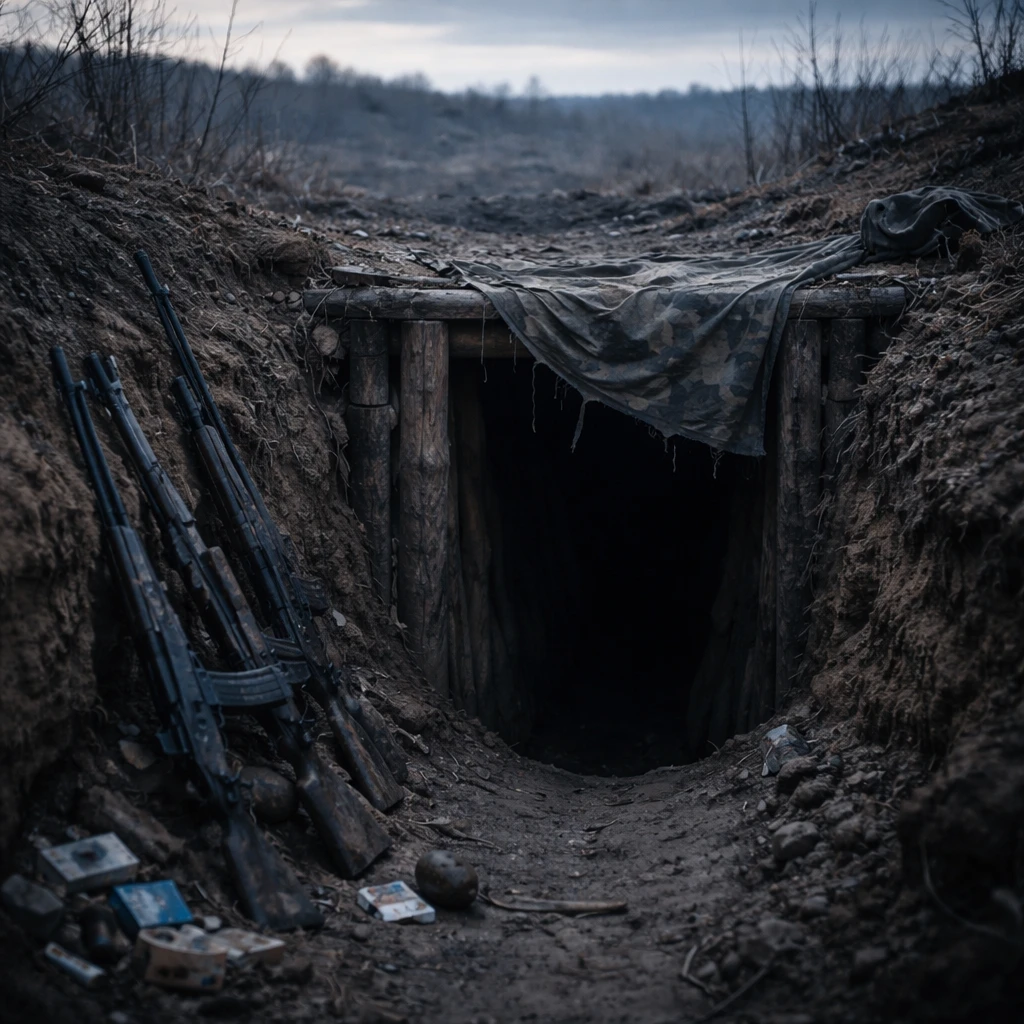
Serhii Krynitskyi emerged from months underground with images that he recorded to make sense of what he had survived. The footage, taken on a cellphone and at times powered by batteries salvaged from disabled drones, captured the last moments of the only man who had shared his living space for nearly a year in a foxhole - a cramped redoubt he and two other privates had hollowed beneath the front lines near Chasiv Yar.
In one harrowing clip Krynitskyi trains the camera on his companion's body, wedged in the dugout, a blood-stained leg exposed. A shrapnel wound from a bomb released by a drone had severed an artery. "In the morning, you're joking together," the 42-year-old says to the lens, his face marked by grime and fatigue, "And by the evening, it's the gates of heaven calling." The video corresponds to roughly day 326 of his deployment, according to the timestamps attached to the files.
The soldier's recordings, 22 of which were provided to this reporter by his unit, form a continuous chronicle of a 346-day tour spent almost entirely beneath the earth. They document not only combat and loss but the improvised routines and adaptations required to endure a war where cheap unmanned aerial vehicles have altered the battlefield.
Drone proliferation and the shift in tactics
Krynitskyi's account illustrates a tactical shift driven by the ubiquity of drones. Both armies have flooded the skies with small unmanned aircraft that make concentrations of men, heavy weapons and armoured vehicles dangerously exposed. As a result, the traditional practice of massing forces along narrow stretches of a long front has been largely abandoned in favor of dispersed, small teams occupying shallow dugouts across a wide area - a 30 km wide swath described by combatants as the "kill zone."
Within this environment platoons and brigades increasingly rely on tiny detachments - sometimes only two or three soldiers - spread out to probe for weaknesses and to try to infiltrate defended positions. These teams operate with high risk for small territorial gains. Rotation is difficult because moving personnel to and from the front invites detection and attack, leaving many soldiers stuck in place for prolonged periods.
Living in a foxhole
Deployed with the 24th Mechanised Brigade between April 20, 2025 and March 31, 2026, Krynitskyi and his comrades dug a roughly 3 by 4 metre cavity where they lived, slept and fought. The deeper the hole, they reasoned, the greater the chance of surviving drone strikes and artillery. When their shelter was struck they had to excavate again. Drafted from civilian life late in 2024, Krynitskyi had previously worked in farming, construction and as a rabbit breeder after recovering from a serious injury and a month-long coma.
Conditions inside the dugout were severe. The men capped lookout shifts at two hours because anything longer was unbearable. They battled the cold and plugged openings to block frigid drafts. Resupply was erratic; sometimes three or four days could pass before a drone sent to deliver food or ammunition could get through under enemy fire. That scarcity pushed them to scavenge from fallen adversaries - not only food but sundries and batteries to keep devices charged.
In video diaries recorded from August 2025 onward, Krynitskyi catalogued personal finds with a mixture of dark humour and attachment. He showcased packets of cigarettes salvaged from dead Russian soldiers - Camels, Winstons, Chesterfields among them - describing his obsession with them "like some nerd collects stamps." In another clip he proudly displayed 13 rifles, lined up mud-caked, calling them his "small arsenal."
Close-quarters combat and casualties
The small teams faced frequent close-range engagements. Krynitskyi said Russian soldiers sometimes advanced on foot in groups of two or three, at times approaching within approximately 20 metres before being engaged. Across his deployment he reported killing 23 enemy combatants at close range; that number was confirmed by his unit, the 24th Mechanised Brigade. Reuters could not independently verify all aspects of the infantryman's account.
He recounted one early encounter with particular clarity: a Russian soldier wounded by a grenade feigned surrender, then raised a rifle to fire. "Well, I reacted," Krynitskyi said simply. "He stopped aiming at me." In another clip filmed on November 24, more than 200 days into his tour, he filmed two enemy bodies lying where they had fallen after an assault, dismissing the dead as "Fools" who "crawled up where they don't belong."
Death of a comrade and extraction
The most devastating episode occurred on March 11. Krynitskyi heard an explosion outside the dugout and rushed out into the cool spring air to find his comrade struck in the leg by a drone attack. He dragged the wounded man back into the foxhole, tore through thick trousers to find the wound and applied a tourniquet. Command ordered the position abandoned as Russian forces closed in. Despite attempts to save him, the wounded soldier succumbed as blood loss proved fatal.
Krynitskyi crawled out of the dugout that night for the last time and joined several other infantrymen holed up nearby. He spent nearly three more weeks there before making a hazardous march approximately 25 km to safety. His weakened physical state, after months spent mostly underground, made the movement more arduous. He left behind the body of the man he had come to know in countless conversations between assaults. At the request of his brigade, the names of the two deceased soldiers were withheld.
Recognition and aftermath
In May, President Volodymyr Zelenskiy awarded Krynitskyi the Hero of Ukraine medal for personal bravery. Returning to Kramatorsk, the city where he resettled after the front, he described the psychological toll of long deployments under constant threat: "Many guys have gone out of their mind," he said, describing the lingering effects of the marathon stints at the front. Nearly two months after leaving the line, the scars remained visible - his hands trembled and he fought to hold back tears when discussing what he had seen and done.
As he began speaking at schools in his home region, Krynitskyi found some solace in the sense that his sacrifices had meaning. He told pupils he realised that defending the land had not been in vain because it helped ensure that children could learn and "see the clear sky."
Context on casualties and scale
The invasion, which began in 2022, has produced extremely heavy losses on both sides. Estimates cited by Krynitskyi's unit reference a major research group's assessment that Russian battlefield casualties - including the killed, wounded and missing - may be as high as 1.4 million, and that Ukrainian forces have suffered between 525,000 and 625,000 casualties. These figures were included in the material provided with the soldier's recordings.
Krynitskyi's foxhole sat on one of the deadliest stretches within the described kill zone. The position's isolation, the prevalence of drone assault, and the difficulty of rotating troops all combined to create an experience of sustained danger, limited resources and repeated close-range fighting.
Documentation and verification
The 22 video files were reviewed and their metadata used to verify dates. The 24th Mechanised Brigade confirmed the count of 23 enemy combatants reported killed by Krynitskyi. The Russian defence ministry did not provide comment in response to requests about the changing nature of the battlefield and how it affects soldiers on both sides.
Krynitskyi's recordings, raw and often laced with expletives, provide a direct window into the daily realities inside a narrow underground shelter: regular close combat, reliance on scavenged supplies, interrupted resupply, makeshift medical responses and the emotional strain of watching friends die in confined quarters. They also reflect the improvisation soldiers adopt when conventional logistics become unreliable - from using batteries pillaged from downed drones to power phones to cataloguing weapons taken from the dead.
Concluding observations
His story is one of survival under conditions reshaped by modern, low-cost unmanned technology. It shows how battlefield tactics have adapted in response to that technology - dispersal of forces into small teams, a premium on concealment and an increased difficulty in rotating personnel - with profound consequences for the soldiers who must hold the line. Krynitskyi's testimony, the videos he recorded and the medal he received together trace a single soldier's journey through an extended, subterranean fight on a brutal front.