
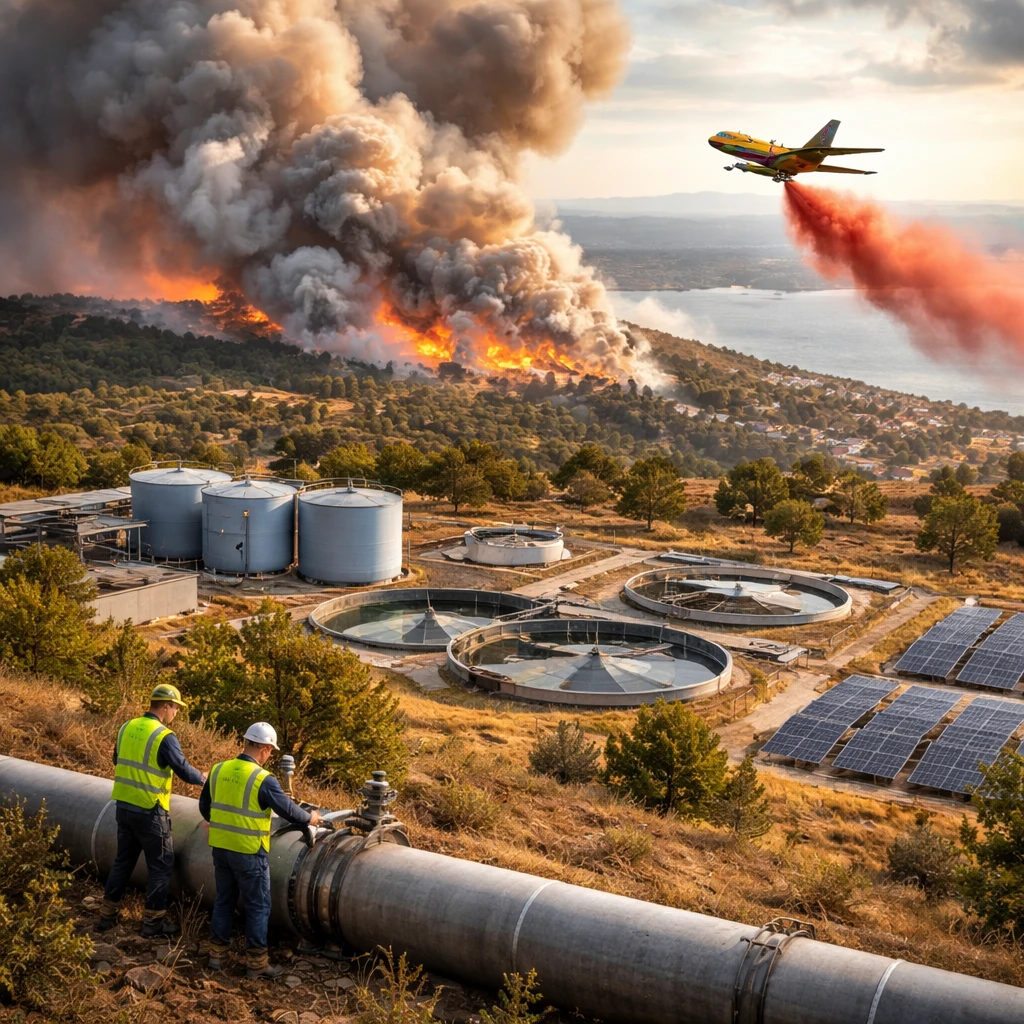
Europe’s wildfire emergency has moved from episodic to structural, and financial markets are beginning to reflect that shift. A major fire near Bordeaux on Jul 22, 2026 prompted evacuations of more than 10,000 people and burned roughly 2,000 hectares. The 2026 season has now already surpassed the annual average of the past 20 years, according to the figures cited.
Beyond France, Spain has reported more than 100,000 hectares scorched so far in 2026, Italy suffered the loss of a firefighter in Sicily, and heat-related mortality across Europe has exceeded 10,000 excess deaths this season. Three consecutive heatwaves and prolonged drought have combined to increase demand for goods and services tied to wildfire suppression, water recycling and drought resilience.
The pure-play chemical defender
Perimeter Solutions (PRM) stands out as the listed company most narrowly focused on wildfire suppression. The company makes the red retardant that aerial tankers spray on flames and perimeters. Quoted figures show PRM trading at $33.30 with a market capitalization of $5.5 billion. Over the last 12 months the stock has returned +97.7%, with year-to-date performance of +20.9% and a 52-week trading range from $15.43 to $38.17.
Supporters point to forecasts for net income growth this year, analyst projections of higher sales and a balance sheet where liquid assets cover short-term obligations. Those factors form the bull case for PRM as governments expand aerial firefighting contracts across Europe and other affected regions.
On the other hand, risks remain explicit. The company is not yet profitable on a trailing-12-month basis, the stock trades at a high price-to-book multiple and its shares have been volatile. The note that PRM has already risen +24.7% over the past six months underscores that entry timing matters for investors.
Water scarcity and the drought double
Drought has pushed water management and technology providers into the spotlight. Veolia (VIE) is highlighted as Europe’s largest water, waste and energy services group, a profile that matches the needs of drought-affected countries cited in the reporting such as Romania, the Netherlands, Greece and France. Veolia is quoted at €36.35 and carrying a market capitalization of €26.6 billion, with year-to-date performance of +22.0% and one-year performance of +18.4%.
Veolia has a long record of dividend payments, with 26 consecutive years of payouts and six straight dividend increases noted in the figures. That income history is presented as a signal of operational stability, although the stock is trading near its 52-week high of €37.66 and so investors are urged to exercise discipline when selecting entry points.
Xylem (XYL) provides the counterpoint. Quoted at $121.05 with a market cap of $28.7 billion, the water-technology specialist is down about -11.5% year-to-date and -9.0% over 12 months. The article frames Xylem as a potential contrarian pick for municipalities investing in drought resilience, reinforced by a record of 15 consecutive dividend increases that could offer some downside cushion after the recent sell-off.
Aerial firefighting and aircraft makers
Aircraft manufacturers that supply helicopters used in civil protection missions also feature as beneficiaries. Leonardo SpA (LDOF) is quoted at €52.92 with a market capitalization of €30.6 billion, showing a one-month change of +14.5% and a 12-month rise of +11.4% in the figures provided. Airbus Group (AIR) is shown at €208.80 with a market cap of €164.6 billion, up +8.8% over one month and +15.9% in the past year.
Both firms supply rotorcraft such as the AW139 and H225 that are deployed against wildfires. The coverage describes these companies as secondary wildfire beneficiaries: their core defense and aerospace businesses remain the primary revenue drivers, while wildfire-related contracts add incremental upside. Leonardo is noted as benefiting from a surge in European defense spending, while Airbus gains diversification through its commercial aviation exposure.
Thematic snapshot and cross-sector pressures
A compact thematic table in the reporting classifies the risk profile for each name: PRM is labeled high risk and already re-rated; Veolia sits at medium risk and is near highs; Xylem is described as lower risk and beaten-down value; Leonardo holds medium risk with defense momentum; and Airbus is shown as lower risk and a large-cap diversifier.
The drought is also compressing hydropower output, which the article notes can amplify both water and energy scarcity. Companies operating at the intersection of water and energy, such as Veolia with its energy-from-waste capabilities, could therefore face a compounded structural tailwind. The piece also records that the Marex CEO warned about potential underpricing of these risks on Jul 16.
The market reaction so far has been uneven: one pure-play supplier of fire retardant has nearly doubled over 12 months while others in water technology and aerospace show mixed moves. Investors and policymakers will likely watch contract awards for aerial firefighting, municipal investment in drought resilience and continued wildfire intensity as signals for where capital may flow next.